


Frank Keller was clearing snow from his wife’s side of the porch when a hoarse cry rose from the creek below. He stopped with the shovel raised. Ruth had been dead nineteen years, and he still cleared both sides, including the three feet in front of a door he never used. Below the house, where the logging road dipped toward a culvert, the snow lay smooth except for a shallow depression beside the willows.
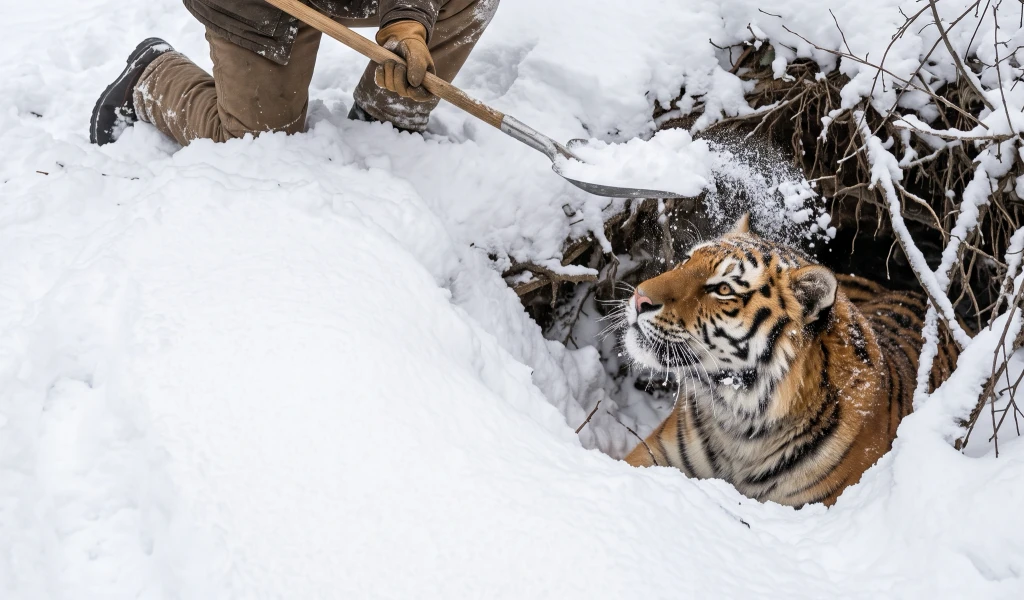
The cry came again, then stopped abruptly. In the silence, Frank heard only the wind lifting loose snow from the roof.
Frank leaned the shovel against the railing and went inside for his rifle. The radio on the kitchen counter crackled as he reached for it.
“You up there, Keller?”
Earl Dwyer had been calling since seven. Frank had ignored the first two attempts, expecting another report on the weather or another invitation to eat something he hadn’t opened with a can opener.
“I’m up.”
“County’s asking everybody north of the junction to stay inside. One of Henson’s cats is loose.”
Frank looked toward the window. Beyond the cleared porch, the woods were blue with shade.
“What kind of cat?”
“Tiger. Female. Got out Monday. He finally told somebody last night.”
It was Thursday. Frank set the rifle on the table instead of putting it over his shoulder, then picked it up again.
“Frank?”
“There’s something down by my culvert.”
“Don’t go look.”
Frank pulled on his gloves. At seventy-one, he had trouble with the last two fingers of his left hand, especially in January. He had to push them into place with his right thumb.
“Call the sheriff. Tell them where.”
“You stay in that house until—”
He clipped the radio to his coat and stepped outside.
The culvert was less than two hundred yards downhill, though the snow made it a longer walk. He followed his own snowshoe tracks from the day before. At the edge of the willows, he stopped. A heavy animal had gone through the brush, breaking twigs at knee height. Something red showed beneath a crust of ice.
Frank knew tracks. He had hunted these woods since he was twelve, before the mills closed, before the road acquired a locked gate, before people started calling his house a cabin because it was inconvenient to reach. These prints belonged to nothing that should have been here.
He kept the rifle pointed down and walked along the bank.
At first he saw only a curve of orange under the snow. Then the curve moved. A slow contraction traveled through it, and the rough breath came from a hollow between the animal’s shoulder and the frozen roots.
She had tried to pull herself beneath the bank. Snow had drifted over her back, leaving her face pressed into a pocket of air. One eye opened when his snowshoes creaked.
Frank stopped so abruptly that his bad knee buckled. The rifle came up before he had decided to raise it.
For nineteen years he had avoided photographs of tigers. He turned off wildlife programs, crossed to the other side of a store when a child’s sweatshirt had a striped cat on it, refused to drive past the abandoned animal park outside town. Yet he recognized the small movement of the ears. He remembered the way a tiger gathered itself before standing.
Ruth had been on the other side of a gate that winter. He had been carrying a toolbox across the service yard. There had been one shout, and he had dropped everything.
His finger rested alongside the trigger. The animal beneath the bank blinked, slowly, and the snow on her whiskers trembled.
He could shoot from where he stood. Nobody would ask a seventy-one-year-old man why he had been afraid of a loose tiger.
Then she tried to lift her head. Her right foreleg tightened against something concealed by the drift, and a short, strained sound escaped her. Frank saw a cable running from the leg into the willows. The snow around it had been churned and frozen, churned and frozen again.
He lowered the rifle.
“Earl.”
The radio hissed against his collar. He took it in his hand and tried again.
“I’m here,” Earl answered. “Deputy’s coming to the gate. They’ve got a vet on the way.”
“She’s caught in wire.”
“How close are you?”
Frank looked at the tiger. She had closed her eye.
“Close enough.”
“Then back up. Right now.”
He did. He retreated to a spruce twenty feet away, where he could see her without standing over her face. He stayed there while Earl relayed questions from the deputy. Was she upright? No. Could she move freely? No. Was anyone else in the area? Just him.
The deputy told him to keep his distance. Frank agreed, although he had already begun counting the things in his workshop: a low utility sled, an old moving blanket, bolt cutters left from the fencing job at Earl’s place.
Snow slid from a branch and fell across the tiger’s nose. She didn’t lift it this time.
Frank planted his rifle upright against the spruce and returned to the porch for the shovel. When Earl demanded to know what he was doing, he answered without stopping.
“Giving her air.”
He worked from the bank above her, reaching with the shovel to remove snow from the opening without touching the animal. He widened it slowly. Once, a whisker caught on the blade and he drew back, startled by the nearness of her mouth.
Below the drift, the tiger watched him. He could hear each breath now. The cable had cut through the fur above her paw, and the exposed skin was swollen. Her body occupied most of the hollow. He couldn’t tell how much of her was hidden or how long she had been there.
“That’s all I’m doing,” he told the radio.
Earl didn’t answer for a moment.
“I’m bringing the deputy in. You hear engines, you don’t come meet us. Stay where she can see you.”
Frank slid the shovel back onto the bank. He watched the tiger’s eye until it closed, then watched her ribs. When his legs began to shake, he sat on a fallen tree with the rifle across his lap.
He had once spent an entire afternoon sitting beside a deer he’d wounded, unable to get a clear second shot without driving it deeper into a swamp. Ruth had said nothing when he came home late. She had made him take off his wet socks and eat. Afterward, she’d sat at the table cleaning mud from the knife he couldn’t bring himself to touch.
He had forgotten that part for years. He remembered it now, and resented the animal for making him.
The engines reached him a little before noon. Earl came first, his patched orange coat stretched tight over his belly. Deputy Jo Bennett followed on a second snowmobile, with a woman behind her and a utility sled trailing through the powder.
The woman got off carefully, carrying two hard cases. She wore insulated bib overalls under a dark coat. A strip of silver tape secured one boot where the sole had begun to separate.
“Dr. Tessa Vaughn,” she said. “You’re Mr. Keller?”
“Frank.”
She looked past him toward the bank. Then she looked at the rifle across his knees.
“Would you put that back at the house? Deputy Bennett will stay here.”
He held it a little tighter. The vet waited, giving him room to answer, and he realized she was watching his face rather than the gun.
“I didn’t shoot her.”
“I can see that. I need one person watching the animal and one person managing everything else. More guns won’t help me do my part.”
Frank stood. Earl took the rifle without making a joke, which was how Frank knew his friend was worried.
Tessa crouched well clear of the tiger. She asked Frank what he had seen, then repeated the important details to someone on her phone. The signal held on the upper bank. She had worked with big cats before, she told the deputy, but she wanted the sanctuary veterinarian involved before they moved this one.
Frank listened to her describe the breathing, the leg, the time spent in the snow. She spoke plainly. She didn’t promise anything.
While Tessa prepared her equipment, Earl touched Frank’s sleeve.
“Come up and get warm for a minute.”
“I’m warm.”
Earl glanced at the ice forming in Frank’s beard and chose not to argue. He left for the house instead, returning with a thermos and the quilt Frank kept folded on the spare bed.
Tessa waited until she was satisfied that the tiger was deeply sedated before approaching. Frank watched from behind the deputy. Without the snow, the animal seemed larger and more ordinary at the same time: a body that needed warmth, a foot that had been ruined by a piece of wire, a tongue too dry against the edge of her mouth.
“Juniper,” Tessa said quietly.
“You know her?”
“I’ve seen her records. She’s one of the animals we were trying to find a placement for.”
She examined the leg, then looked along the cable to where it had been fastened among the roots. Her expression changed. She asked the deputy to photograph it before anyone cut it away.
Frank took the cutters from the sled. Tessa held out a hand to stop him while she checked the tiger once more.
Up on the bank, the deputy’s radio sounded. She listened, asked a question, and walked down to them.
“Henson says he put out capture lines. Says we aren’t to remove this one. He wants to retrieve her himself.”
Tessa stared at the swelling above the paw. “He’s the one who set it?” The deputy nodded. Frank tightened his hand around the cutters. Juniper’s breath stirred a few grains of snow beside her nose. “And he wants her back,” Tessa said…
To read the rest of the story – CLICK the NEXT button 👇👇👇