


In more than thirty years at the outpost, Walter Daniels had never seen Old Hump twenty paces from his porch. He fired into the air. The bear didn’t run. He raised his heavy head, looked toward the cabin, and slowly settled into the snow, as though being near a man felt safer than returning to wherever he had come from.
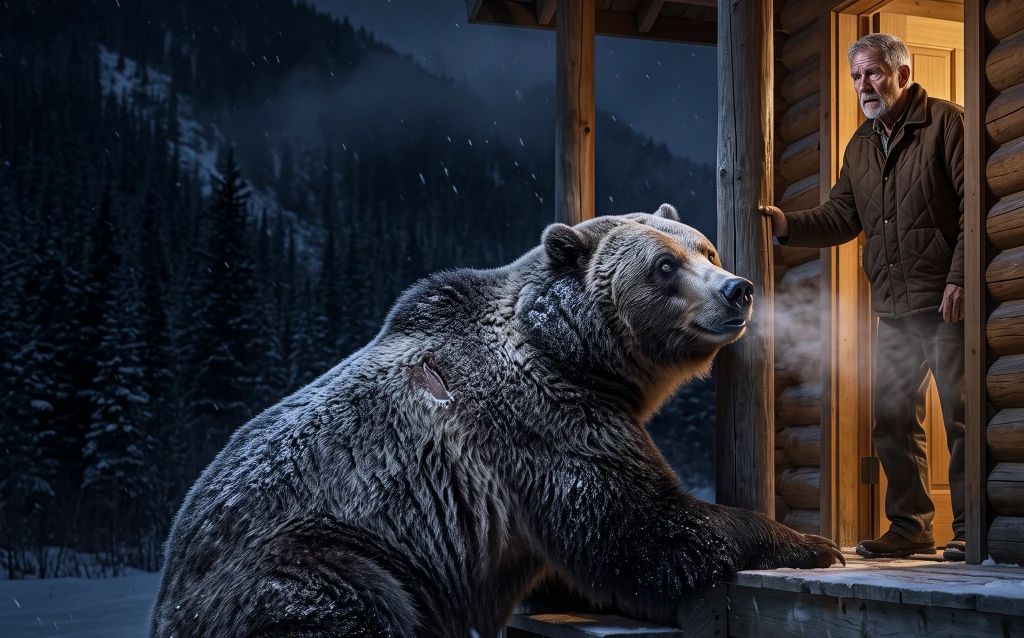
A few seconds later, a muffled boom came from the upper hollow. It wasn’t a gunshot or a tree cracking. It sounded as though someone deep underground had struck an enormous iron door. Old Hump sprang up and backed toward the house.
Walter didn’t know that, a few days later, he would remember that night and understand. The bear’s strange behavior hadn’t caused the trouble. It had been the first sign of something the people hadn’t noticed yet.
Earlier that night, silence had woken him.
Two dogs lived outside the cabin: Red and Catfish. His nephew, Eli, had named Catfish about ten years earlier, when the dog was a puppy with an absurdly long body who was forever sticking his nose into the fish bucket. The name stuck, even after he grew into a huge black dog.
At night, the dogs usually kept busy. They barked back at the woods, rattled their chains, growled at a fox, or shuffled around their kennels. Tonight, there was nothing.
Walter opened his eyes and stared at the ceiling for a few seconds. The woodstove crackled. An old quilted work jacket hung on a nail beside the door, and the wall clock showed 2:45 a.m.
Outside, a chain gave a faint clink. Just once. Then silence again.
Walter sat up. “Red.”
The dog didn’t answer. That was bad.
He pulled on his insulated boots, shrugged into the jacket, and picked up the shotgun.
His thumb automatically traced the crack in his shotgun’s wooden stock. He always did that when something bothered him. The crack had appeared fifteen years earlier, after the gun fell off a sled. He had been meaning to replace the stock ever since.
He eased the door open. The cold caught his face immediately. A low, starless sky hung over the clearing, and the snow outside the cabin looked gray.
The light from the doorway fell across a kennel. Beside it, Red lay with his belly pressed against the crusted snow. Catfish had wedged himself beneath the lean-to. Both dogs were looking to the right.
Walter looked that way, too. At first, he saw a dark patch beside the larch. Then it moved: an immense back, round ears, a heavy head. A bear.
Walter couldn’t make sense of what he was seeing. Fear came later.
He had known this animal for years, though not the way a person knew a pet. They never approached each other, and Walter didn’t imagine that the bear thought like a man. But in the small world surrounding an isolated outpost in the mountains of northwestern Montana, you learned to recognize your neighbors.
One moose grew a crooked antler. A dark-tailed fox followed the old clearing every fall. In the upper hollow lived an enormous old grizzly with a particularly pronounced hump between his shoulders. Old Hump.
Walter had seen him in spring and summer, and several times in the fall. Once, they had met almost nose to nose beside the creek. The bear stood up, tested the air, and left first.
After that, Walter stayed out of the upper hollow unless he had a reason. Why bother a place where you had no business? The bear seemed to observe the same arrangement. In all those years, he had never come near the cabin.
Until tonight. Walter raised the shotgun and fired upward. The report rolled between the slopes. Red flinched, and snow dropped from a branch.
The bear turned his head. Walter felt a flash of irritation.
“Well? Get out of here.”
Old Hump stood a little longer, shifted his heavy front paws, then lay down in the snow. Walter slowly lowered the gun. That was when he began to feel uneasy.
A hungry bear that hadn’t denned would be looking for food. A sick animal might behave strangely. An angry one would show it.
This bear was doing none of those things. He simply wouldn’t leave. Walter stayed up until dawn, sitting by the window, feeding the stove one log at a time, and checking the yard. Around four, Old Hump disappeared.
A deep hollow marked where he had lain. His tracks led down from the upper ravine, then away from the cabin.
In the morning, Walter studied them carefully. There was no mistaking those broad paw prints. He crouched and rubbed his thumb along the crack in the stock again.
For no obvious reason, he remembered his mother. He had been about eight when she sent him out one winter day to fetch wood from the shed. He found unfamiliar tracks beside the woodpile and came back empty-handed.
She hadn’t even scolded him. She looked out the window and said, “If you don’t understand what you’re looking at, don’t rush back for a closer look.”
Walter probably hadn’t thought about that in twenty years.
By noon, the old Forest Service radio was working. The signal kept breaking up, but Eli heard the important part.
“There was a bear beside the house last night.”
Static rustled through the speaker. Eli’s voice vanished briefly, then returned.
“Fresh tracks?”
Walter looked at the dark prints outside the window.
“From last night.”
Eli paused. “Maybe he never denned?”
Walter looked outside again.
“A bear wandering around in winter would stay clear of me. This one came right up.”
“Uncle Walt, a bear doesn’t care which way it goes.”
“If he didn’t care, he’d have left after the shot.”
Another pause. More static.
“I’m coming up.”
“No need.”
“You called me. Now you’re telling me not to come?”
Walter had only meant to report what he’d seen. He started to say he hadn’t called for help, then thought better of it.
“You won’t make it before dark.”
“I’ll be there in the morning.”
The connection broke. Walter kept the microphone in his hand for another minute.
He didn’t like having people around the outpost in winter, even Eli. In summer and fall, he could put up with it. Winter was when everything followed his order.
The firewood was stacked just so. The kerosene belonged in its place. The dogs ate at a certain time, and the shovel always stood to the right of the door.
A man didn’t necessarily spend years alone because he hated people. Sometimes he simply discovered that, without them, things stopped moving around. Still, when Walter put down the microphone, he felt relieved.
Old Hump returned the next night. This time, Walter was waiting. The dogs warned him beforehand with low, short growls rather than barking.
The bear emerged from the darkness in almost the same place, but came closer to the porch light. Walter caught sight of his flank and went still. A fresh scrape ran back from the shoulder through his fur. It looked shallow, but Walter could see it even from a distance, as though a rock or sharp branch had caught him.
Old Hump stood there, turned his muzzle toward the upper slope, and listened. Walter listened, too. He heard nothing.
The bear shifted his paws beside the larch. A few minutes later, he left, following the creek downhill. He didn’t return the way he had come. Walter liked that even less.
Eli arrived the following afternoon. They heard the snowmobile well before it appeared between the trees. Eli Mason was more than thirty years younger than his uncle, broad-shouldered and always in a hurry, winter or summer. Even when he sat down, he looked ready to get up and go somewhere.
He took off a mitten, rubbed his palms, then adjusted his left sleeve for no reason. He always tugged at that sleeve when he was nervous, as though the cuff had grown too short.
“Well, show me your buddy.”
Walter looked at him. “What buddy?”
“Old Hump.”
“You can call him that when he’s standing beside you.”
Eli grinned, then went over to the tracks. His grin faded. The prints beside the larch were well preserved. He followed them for about a hundred and sixty feet.
“He’s big.”
“I know.”
“Where was the wound?”
Walter pointed to his own shoulder. Eli crouched beside a paw print. “Maybe he got into it with another bear.”
“In winter?”
“What about winter? Bears don’t check calendars.”
Walter grunted.
Eli had been that way since childhood. Whenever he found a gap, he plugged it with the first explanation that came to mind. A noise meant a tree. A track meant an animal. A broken branch meant wind.
He preferred a simple answer. Walter had liked simple answers once. They grew less useful when a second odd thing appeared.
They already had three. The bear had approached a man, ignored a gunshot, and turned up wounded.
“Want to take a look up there?” Eli asked.
“No.”
Eli looked surprised. “Why?”
“Because.”
“Hard to argue with that.”
Walter looked toward the upper woods. “We’ve got no reason to go.”
Eli opened his mouth, then let it go.
Two hours later, they were splitting wood beside the shed. Red abandoned a half-eaten fish and turned toward the slope. Catfish got up after him.
Walter straightened. Eli was lifting the ax for another swing.
“Hold it.”
The ax stopped. For ten seconds, nothing happened. Then the ground gave a barely perceptible shudder. It wasn’t enough to knock dishes off a shelf, just a faint jolt passing beneath their boots.
Almost at the same moment, a boom came from above. Eli slowly lowered the ax. “What was that?”
Walter didn’t answer. High in the hollow, snow fell from the branches. Birds lifted together from woods that had seemed empty a moment earlier.
“A rock came down,” Eli suggested.
Walter kept looking uphill.
“Maybe.”
“Maybe?”
“I’m not up there. How would I know?”
Eli gave a surprised laugh. He wasn’t accustomed to hearing his uncle admit he didn’t know.
“Well, now I really want to find out.”
“I don’t.”
That evening, Walter spread an old map beneath the lamp and studied it. Eli said nothing, though he glanced over several times. The upper hollow was almost blank on the map. A creek, two old clearings, an elevation mark, and a thin pencil line.
Walter couldn’t remember drawing that line. Probably sometime in the nineties. It led toward the north slope and stopped.
“What’s there?” Eli asked.
Walter ran a fingernail along the pencil mark. “An old trail.”
“To where?”
Walter folded the map in half. “Nowhere anymore.”
He took it off the table. “We’ll check the road tomorrow. If it’s clear, you can head down.”
Eli stayed where he was.
“What about you?”
“I’m staying.”
His nephew looked at the dark window. “After the bear’s been here twice?”
“He hasn’t eaten me yet.”
Eli snorted. “That’s a great safety standard.”
Walter smiled. “Live as long as I have, and you can pick your own.”
That night, they both woke up. Catfish was whining. Eli sat up on the bunk. “Again?”
Walter was already putting on his boots. Old Hump stood beside the shed, closer than ever. He wasn’t looking at the house. He was looking uphill.
Walter stepped onto the porch. Eli stayed in the doorway with a flashlight.
“Uncle Walt—”
“Quiet.”
The bear lifted his head. The boom came again, much louder this time. Something cracked high on the slope.
Old Hump flinched with his whole body and turned. Eli instinctively stepped inside, certain the bear was about to charge. But the animal didn’t come at them. He took two steps backward, then another, retreating without looking away from the dark hollow until he stood almost beside the porch.
Eli stopped breathing.
“Uncle Walt.”
Walter didn’t answer.
“He’s scared of us, right?”
Walter watched the flattened ears and the way the bear kept drawing in air from the upper slope. “No.” “What do you mean, no?” Walter slowly raised his eyes toward the hollow beyond the black spruces. “It’s not us he’s scared of…”
To read the rest of the story – CLICK the NEXT button 👇👇👇