


The locksmith’s cardboard sleeve was still on the hall table when I carried my bag downstairs. Two new keys lay beside it, bright enough to catch the light from the kitchen. Dad had died that afternoon. Before nine o’clock, Vivian had arranged for my old front-door key to become useless. She stood between the staircase and the coat closet, wearing the black blouse I’d seen when I came in. My laptop was tucked under one arm. The bag knocked against my knee.
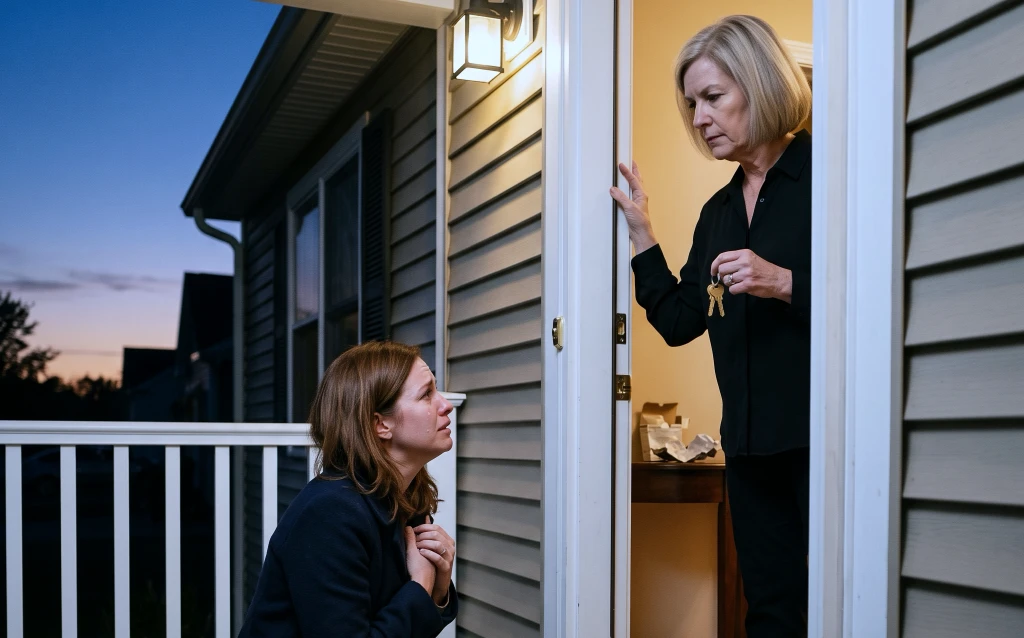
“You’ll need somewhere else tonight, Elise. This place belongs to me.”
I checked that I had my car keys. In the same pocket was another set, heavier and older, for a downtown entrance she’d never walked through.
“All right,” I said.
She stepped aside. I went out through the door I’d spent most of my life using, and she stayed in the hall, certain she had settled everything.
A week earlier, I’d made the forty-minute drive from my apartment to Dad’s house in the northern suburbs of Dayton. Wednesday dinner had been a standing arrangement for years. Nobody needed to remind Vivian I was coming.
There were three forks on the table.
I hung my coat on the pantry hook, took a plate from the cupboard, and found the spare silverware. At the table’s narrow end, I moved a folded stack of napkins far enough to make room. Six years had passed since I’d last pointed out the missing place setting.
Vivian lifted the lid from a pot of chicken and dumplings. Steam dampened the underside of the kitchen cabinets, and she wiped it away before she served anyone.
Dad watched me sit down. His cuffs had slipped over his wrists, and he had to steady his spoon against the bowl before lifting it. The previous winter, he’d filled that chair differently.
“He hasn’t wanted much lunch lately,” Vivian had told me on the phone.
Dad had given me access to his hospital portal. I’d read what the cardiologist actually wrote.
Across from him, Natalie tilted her phone beneath the table and scrolled with one thumb. She was twenty-four and still lived there. Vivian said staying home showed good judgment; I’d never offered an opinion.
Dad waited until Vivian went back to the stove.
“That paperwork for the property,” he said. “Did the last page get straightened out?”
“Thomas, we’re eating.” Vivian returned with the pot. “I was telling you about the contractor.”
He glanced toward me. I gave him a small nod, enough to answer the question she hadn’t allowed me to answer aloud. He resumed eating.
Afterward, I stood at the sink while the others moved into the living room. A drumstick bone had caught in the drain basket, and I worked it loose with the handle of a spoon. Vivian came back for her tea as I rinsed the last bowl.
A few envelopes had been left beside the kettle. I recognized a utility bill and an insurance notice. Under them was a thick cream envelope addressed to Thomas Mercer, with an attorney’s name printed in the corner.
Vivian gathered the stack before I could read it.
“Nothing that needs attention,” she said, putting it in a drawer.
I dried my hands, said good night to Dad, and drove home with the smell of cooked celery caught in my sleeves. At the first long red light, I opened the window. Cold October air made my eyes water.
That was my last dinner with him.
My mother, Ruth, died when I was ten. When I try to picture her, I usually get the laundry room: a basket balanced on her hip, a sock tucked between two fingers, her laugh when she found one of Dad’s receipts in the lint trap.
The funeral comes back in pieces. Her ordinary afternoons are clearer.
Dad could evaluate a property without getting out of his truck, but he didn’t know how to talk to a child who waited until the bathwater was running to cry. He would knock, ask whether I needed a clean towel, and remain outside the door until I answered.
On Saturdays, he began taking me with him. We drove through neighborhoods where the factories had closed and neighborhoods where a fresh sidewalk meant somebody expected the factories’ managers to move in. His truck heater took several miles to warm up. I kept my mittens on until he handed me a property sheet to read.
“Give me a number,” he’d say.
I’d study the house from the passenger seat. Sometimes I based my answer on the porch. Sometimes on whether the yard had a swing.
He’d let me finish, then point out the roofline, the lot, the distance to the school. We’d compare the asking price with sales he’d written on the back of an envelope. A pretty kitchen didn’t cancel a bad foundation; a poor photograph didn’t necessarily mean a poor house.
At first I understood very little. I liked having something he wanted to hear me say.
By twelve, I could find the principal balance on a mortgage statement. Dad would cover the payment amount with his thumb and ask me to work it out. He taught me to check tax records and calculate what a loan would cost after the first year.
Once, we stopped outside a house with a sunroom the owners had added without insulating it. I thought it was beautiful. Dad tapped the heating estimate.
“You can’t pay your way out of every trouble,” he said. “But it helps to know what the trouble will cost before somebody hands you the bill.”
He remarried that year.
Vivian brought Natalie, who was two, along with flowered boxes of kitchen things and a habit of thanking people before they had agreed to help. New curtains went up. The pantry shelves were relabeled. On Sundays, an apple cake cooled beside the stove.
I wanted those things to mean we were becoming a family. I offered to entertain Natalie while Vivian unpacked. I learned which bowl she preferred for cereal.
Six months later, Vivian told me the little room beside the garage would give me more privacy. My former bedroom had already been painted lavender. Natalie’s toys were lined up beneath the window, and the dresser I’d used since kindergarten held dolls instead of my clothes. In my new room, cold came through the floor, and I could smell the garage whenever Dad opened its inside door.
He found me carrying a box down the hall. “She’s trying to get settled,” he said. “Things were rough for her before us. Give her a little time.”
I waited for him to take the box or tell me to bring it back. He didn’t.
Vivian rarely needed an argument. She completed a change and presented it as something we’d agreed on. Over the next two years, Natalie’s things spread from room to room while mine became easier to put away.
The photographs changed, too. Mom’s picture moved from the mantel to a hall shelf, then upstairs. Eventually, I found it in the attic with several empty frames. Downstairs, there was a studio portrait of Vivian, Dad, and Natalie, all wearing burgundy sweaters. I’d been home the afternoon they had it taken.
On the family computer, Vivian kept a household spreadsheet. She saved grocery receipts in a tin, entered gasoline purchases, and checked the dates on automatic payments. On the first evening of each month, she and Dad sat together to review it.
I was useful enough to wash up afterward, but I wasn’t asked to join them.
Dad said her first husband had left her with debts. Keeping track helped her feel safe, so I tried to remember that when she questioned every grocery charge.
At fourteen, I stood beside the kitchen counter while Mr. Keene from next door admired our Christmas card. There were three people in the photograph, with the Mercer name printed underneath.
“Where’s Elise?” he asked.
Vivian touched the corner of the card.
“Try getting a teenager to sit still. School keeps her running.”
I had spent that entire Saturday in my room. Dad was close enough to hear. His cup paused on its way to his mouth, and he looked across the counter at me.
For a second, I thought he’d correct her.
He set the cup down, picked up his work gloves, and went into the garage. Mr. Keene changed the subject. I stayed where I was until Vivian asked me to put the cake plates away.
Two summers later, Dad took me to his office instead of driving our usual route. He cleared a space across from him, moved a box of invoices off the spare chair, and shut the door. My name was written on a file tab.
“This has been going for a couple of years,” he said.
The first statement showed five thousand dollars invested when I was fourteen. On the newest one, the balance was a little over sixty-two hundred. He explained the custodial account and showed me my name on the ownership records. I kept looking at it.
He spent the morning showing me the quarterly statements. I checked the return against the benchmark while a radio on his filing cabinet gave market updates through a loose speaker.
Before we left, he slid an old pocket calculator across the desk. One corner of its case had split, and the plastic over the display was scratched.
“Don’t take an answer just because it’s mine,” he said. “Check it.”
My first calculation didn’t agree with the balance. Dad waited while I compared the entries and found the dividend payment I’d left out. When I tried again, he nodded and put the statement in my folder.
“Does Vivian know?” He rubbed a small mark on his desk with his thumb. “Don’t bring this up at home,” he said. “She’ll want it in the household budget. It stays here, in your name…”
To read the rest of the story – CLICK the NEXT button 👇👇👇