


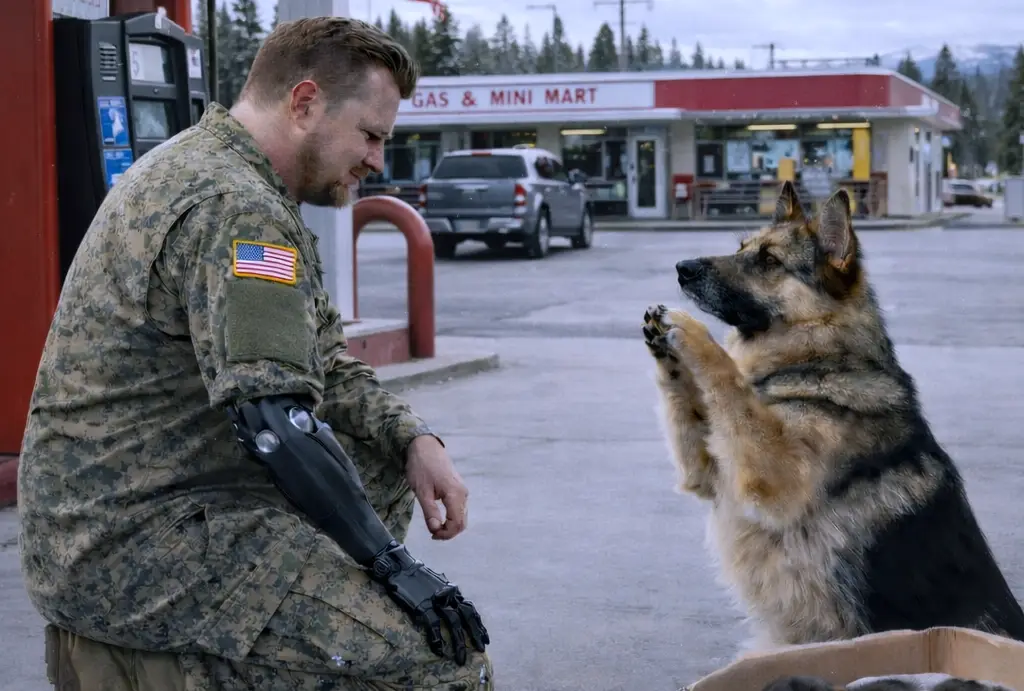
The dawn broke over the northern highway like a bruised knuckle—cold, hard, and unforgiving. It was the kind of freeze that didn’t just sit on the skin but tried to burrow right through to the bone. On either side of the asphalt, endless ranks of pine trees stood like a silent, disciplined army, their dark green needles stark against the pale, washout sky.
Traffic was heavy, a sluggish river of steel and exhaust bottlenecked by roadwork miles up ahead. Orange cones and blinking arrows pulsed in the gray light, while construction workers in high-visibility jackets stood as still as sentinels, breath pluming in the frigid air. It was a limbo zone, a place where time seemed to stretch thin, where drivers stared blankly through windshields, their minds a thousand miles away from the reality of the road.
Cade Rourke drove with both hands at ten and two, his posture upright, lacking the casual slump of the other commuters. At forty years old, he occupied space with a heavy, deliberate gravity. He stood just over six feet, broad through the chest and shoulders—not with the vanity muscles of a gym rat, but with the dense, functional strength of a man who had spent decades keeping himself alive when the odds said he shouldn’t be.
His face was a map of American masculinity, carved from granite: a sharp, uncompromising jawline, high cheekbones, and a clean shave that offered no place for shadows to hide. His dark brown hair was sheared into a high-and-tight undercut, a remnant of a life he had supposedly left behind. Even out here, amidst civilians, he remained disciplined.
His blue-gray eyes scanned the horizon with a practiced detachment. To a casual observer, he looked calm. To anyone who had ever carried a rifle for a living, he looked contained—like a coiled spring waiting for a trigger that might never be pulled.
He was dressed in his standard uniform for solo travel: a long-sleeved camouflage combat shirt and matching trousers. The fabric was faded from use but spotless, tailored to move with him, never against him. A black tactical belt hugged his waist, equipped with a utility pouch and a holster that seemed designed for tools rather than weaponry, though the distinction was often academic in his hands.
Tan military boots rested heavy on the pedals. On his left wrist, a chunky tactical watch with a matte black face caught a glint of the winter sun as he adjusted the wheel. This wasn’t a costume or a fashion statement. It was armor. It was habit.
Cade was heading toward a pinprick on the map called Briar Hollow. He had chosen the town for its obscurity, a place where nothing ever happened, or so he hoped. He told himself he was starting over, turning a new page. But deep down, he knew that “starting over” was just a bedtime story adults told themselves to make the wreckage of the past easier to look at.
He had walked away from the Navy SEALs six months ago. Officially, he was retired. Unofficially, he was adrift. The war hadn’t followed him home with loud bangs and flashbacks; it had come quietly. It lived in the way he automatically scanned every room he entered, in the way silence felt heavy rather than peaceful, and in the way his body hummed with a readiness that was no longer required.
He wasn’t thinking about any of that when he saw her.
The dog was standing near the concrete median, just past the rumble strip where the road flared out for the construction zone. Cars were thundering past, a chaotic stream of noise and wind, but the dog didn’t flinch. She didn’t bark, and she didn’t run. She was a German Shepherd, full-grown, her coat a mix of black and tan that was thick, matted with mud, and dulled by the harsh winter elements.
She sat on her haunches, her spine rigid, her head held high. Her front paws were pressed together, pads touching, in a gesture that looked disturbingly like prayer. It wasn’t a circus trick. It was the desperate posture of a creature running on empty, her muscles trembling with the sheer physical effort of staying upright.
Beside her, wedged halfway against the jersey barrier, sat a white Styrofoam cooler, stained gray with road grime. Inside, barely visible from the height of the truck, three tiny shapes were curled into a furry knot. Puppies. They couldn’t have been more than a few weeks old, their small ribcages fluttering with shallow, rapid breaths.
Cade lifted his boot off the accelerator. He told himself it was just because the traffic was bunching up. He told himself that stopping on an icy highway was a tactical error, a good way to get rear-ended.
His instincts, honed by years of threat assessment, processed the scene in a nanosecond. No owner. No leash. No collar visible from this distance. A dangerous construction zone.
Keep driving, a voice in his head whispered. It’s not your problem.
The dog didn’t look at the other cars. She locked eyes with him. Her gaze was a warm, burning amber-brown, steady and unnervingly calm. There was no panic in those eyes, no frantic begging. It was the look of a soldier who had expended every round of ammunition, used every option, and was now standing guard over the only thing that mattered. Cade had seen that thousand-yard stare on the faces of men who knew the end was coming.
He drove past her.
The truck rolled forward another thirty yards. Then, Cade’s chest tightened, a sharp, physical pang that had nothing to do with his heart health. His jaw clenched until his teeth ached.
He flicked his eyes to the rearview mirror. The Shepherd hadn’t moved an inch. She was still sitting there, squared up to the road, her eyes fixed on the empty space where his truck had just been.
“Dammit,” Cade cursed softly, the word barely a breath.
He yanked the wheel to the right, pulling onto the shoulder. He killed the engine and sat there for a heartbeat, listening to the truck settle—the ticking of cooling metal, the hiss of tires on wet asphalt. This was how it always started. One small deviation from the plan. One split-second choice.
He opened the door and stepped out.
The cold hit him like a physical blow. Cade ignored it, closing the distance to the dog with long, deliberate strides. He kept his posture relaxed, his hands open and visible. The German Shepherd tracked him, her head swiveling, but she didn’t bare her teeth. She didn’t growl.
Up close, the reality of her condition was brutal. He could see the ribs sawing against her skin beneath the heavy coat, the way her legs shook with exhaustion. A faint, hairless groove circled her neck—the scar of a rope or collar that had been too tight for too long.
“You did this on purpose, didn’t you?” Cade murmured. It wasn’t an accusation; it was a statement of fact.
He crouched beside the styrofoam box and peeled back the lid. The puppies were impossibly small, their eyes barely slits, their fur soft and patchy. They let out weak, high-pitched whimpers at the sudden rush of cold air, instinctively pressing closer together to conserve heat.
Without a second thought, Cade shrugged out of his heavy camo jacket. He wrapped the fabric around the box, tucking the ends in tight to trap the warmth. He lifted the bundle carefully.
The moment he took the weight, the mother dog stood up. She moved with a fluid grace that belied her starvation, stepping back to give him room to work.
When Cade turned and headed back toward the truck, she followed him. No hesitation. She hopped into the back seat and sat down, posture perfect, as if she had rehearsed this extraction a dozen times. Cade paused with his hand on the door, struck by the absolute certainty of her actions. It wasn’t hope. It was expectation.