


Owen Tasker had the rear door of his truck open before he remembered there was nothing to load but forty pounds of ice melt. He had said it under his breath, too: Load up. Ten months after Juno died, the words still came out on their own, as if she might round the bumper at a trot with her ears pinned back and her nose already in the cab.
He was lifting the first bag when somebody across the feed store lot shouted, “Grab him!”
A puppy was coming down the row of parked cars at a dead run. He was rust-colored, with a white blaze down his face and feet he hadn’t grown into, maybe four months old. Fifty feet behind him a man held up a red harness with nothing in it.
Owen set the bag on the tailgate and did what he’d done on a hundred loose-dog calls. He didn’t chase. He dropped to one knee, turned his shoulder to the pup, and made himself the least interesting thing in the lot. The puppy swung wide around him without a glance, ears up, eyes fixed on something at the end of the row.
Owen followed at a walk. At the end of the row, a white van with PINE HOLLOW ANIMAL RESCUE stenciled on the side had its sliding door open. A canopy snapped over a folding table of brochures, and crates were stacked two high inside the van. The puppy went straight to the bottom crate, shoved his face against the bars, and went still.
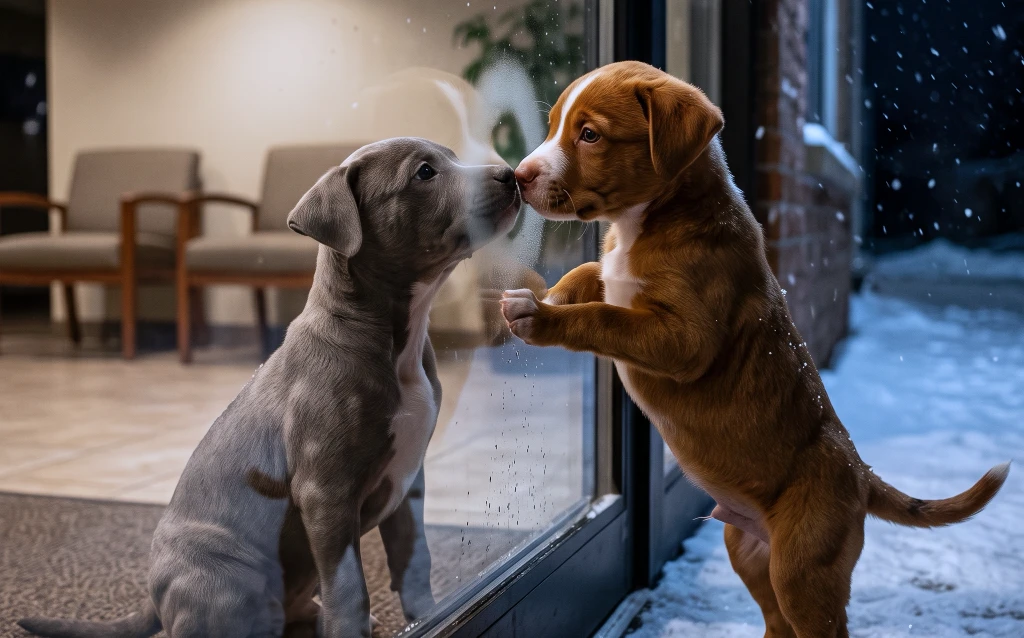
The pup inside was smaller and gray, with darker ears and one hind leg wrapped from hip to paw in a blue splint. She pushed her nose through the bars to meet his and kept it there.
Owen walked over slowly and hooked two fingers under the runaway’s collar. The pup didn’t fight him. He didn’t seem to notice there was a hand on him at all.
“Thank you. Oh, Lord, thank you.” A gray-haired woman in a canvas barn coat came around the van with a clipboard pressed to her chest. She was breathing hard. Owen knew her the way he knew most people in the county, by sight and by the calls he’d taken near their property. Lo Whitcomb ran the rescue out on Burnt Creek Road, three miles south of his place.
The family came next: a father still holding the empty harness, a boy of about seven, and a girl of eleven or twelve clutching a bag of treats. The father looked embarrassed. “I had him buckled. I swear I did.”
“He’s backed out of better harnesses than that,” Lo said. “That’s on me. I should have told you.”
The girl crouched beside the van. She took a jerky stick from the bag and held it low, the way someone had obviously taught her. “Tug,” she said. “Hey, Tug. Come here, buddy.”
The puppy turned his head and accepted the jerky politely. He didn’t eat it. He carried it the two steps back to the crate, set it on the floor of the van in front of the bars, and lay down with his chin across it like a man guarding a wallet.
Lo unlatched the crate. The gray pup leaned forward on her front legs, the splint sliding behind her, and took the jerky out from under her brother’s chin. He watched her chew it. Only when it was gone did he lift his head and look at the girl again, as if he were ready to hear whatever she had to say.
Nobody said anything for a moment. The canopy cracked in the wind.
“We came for him,” the father said at last, more to Lo than to anyone else. “We talked about it for a month. We’ve got the yard and the time, and the kids are old enough. But we can’t do a second one. Not with the—” He gestured at the splint and stopped there.
“I know,” Lo said.
“He’s not going to be happy at our place, is he?”
Lo didn’t answer, which Owen thought was a kindness. The girl stood and put the treat bag on the brochure table. Her brother asked if they could still get a hot dog inside, and the father said yes in the voice of a man grateful to be asked something easy. Owen watched them cross the lot, the empty harness swinging from the father’s hand.
“I’ll take that back,” Lo said, nodding at Owen’s grip on the collar. She snapped a slip lead over the pup’s head and let him stay where he was. “You’re Juno’s guy.”
Owen had expected it, and he still had to look away, at the stacked crates. “I was.”
“She did the reading program at the library with my grandson. He read her a book about a tractor, and she lay there the whole time like it was the best thing she’d ever heard.” Lo looked down at the puppies. “I was sorry to hear.”
“Thanks.” He nodded at the splint, because that was easier. “What happened to her?”
Lo told him while she checked the latches on the other crates. The two had been found the third week of October in a plastic storage tote at a pullout on Rimrock Road, south of town. It had been nineteen degrees that night. The tote’s lid had cracked along one side, and the broken edge had sliced the gray pup’s right hind leg above the hock. Sam Okafor had stitched the tendons back together at the clinic, but the repair hadn’t held. A second surgery was set for the eighteenth.
“I listed them as a pair for six weeks,” Lo said. “Nothing. People love him and get scared of her bills. Or they want her and can’t see themselves with a hundred-pound shepherd-something by spring. So last week I split them up.” She set her palm flat on top of the crate. “Today was the first nibble.”
“Names?”
“Tug and Wren. A volunteer’s kids named them. Tug because you can’t walk him anywhere he doesn’t want to go.”
Lo lifted Wren out and set her on the van floor by the door so she could see the lot. The puppy hitched herself to the edge on her front legs, the splinted leg trailing, then slid down onto the asphalt and settled against Owen’s boot. Within a minute her eyes had closed. Her bad foot lay across his laces, curled under at the toes, and he could see the raw pink patch on the top of it where it had been dragged.
He didn’t move his foot. He told himself it was because he didn’t want to wake her.
Tug coughed.
It was a deep, honking sound, as if he had swallowed a goose. Lo stopped with her hand on a crate door. Tug shook his head, coughed twice more, and pressed his nose back toward his sister.
“No,” Lo said quietly. “Oh, no, no.”
“Kennel cough?”
“The Hendersons’ boarding barn had a run of it last week. One of my volunteers walks dogs out there on Sundays.” She was already on her phone, thumbing through contacts. “If he’s got it, Sam won’t touch Wren. Not with anesthesia, not with that leg. And they’ve been nose to nose all day.”
Owen listened to her make three calls. One foster had a houseful of her own dogs. One was out of state until January. One didn’t pick up. Lo lowered the phone and looked at the van, then at the puppy coughing against the crate, and then at Owen’s truck with the rear door still open and nothing in it but a bag of ice melt.
“You don’t have a dog at home,” she said.
“No.”
“Then you’re the only person in this parking lot I can ask.”
Tug coughed again. In the crate, Wren pushed her nose to the bars toward the sound, and Lo held out the end of the slip lead.
To read the rest of the story – CLICK the NEXT button 👇👇👇