


The sound came through the window screen a little after one in the morning. It was a thin note that cracked at the top, and Josie Tuttle was on her feet before she had decided to be. She knew that note. For eleven years it had come from under the kitchen table whenever Moose thought somebody was being stingy with a pork chop. For one night in April it had come through her bedroom wall while she lay facing the plaster and told herself he was only dreaming.
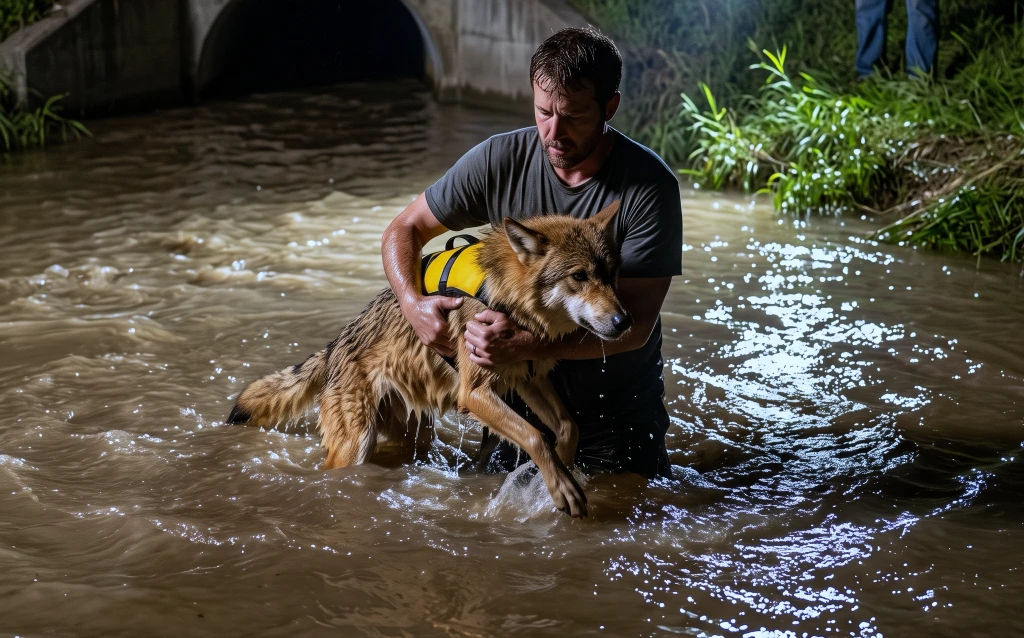
Moose had been gone eight weeks, and Josie was thirteen, which her mother said was old enough to stay alone overnight and not old enough to go outside after dark. Tonight there was nobody in the house but her. Her mother was working the overnight console at the county 911 center in Swan Quarter, and her father was half a mile down the farm road at Royce Gaskins’s storage barn, feeding diesel to the trash pump that had kept the floor dry since Monday.
She took the big flashlight from the drawer by the stove. On the hook beside the back door hung the things nobody had found the heart to move: Moose’s brown leather leash, its handle gone dark and soft where he had gnawed it as a puppy, and the yellow float vest he used to wear in the jon boat, the one that made him look like a school crossing guard. Her hand closed on the leash. She didn’t stop to ask herself why.
Three days of storm had crossed Hyde County and gone out to sea around supper, but the land hadn’t caught up. Water lay silver between the rows of Royce’s knee-high corn. The north ditch ran behind the rented house and under the farm road through a concrete culvert, and tonight it was moving fast enough to talk.
The flashlight found the culvert first, then the thing pinned against it.
An animal had fetched up against the headwall where the ditch narrowed into the pipe. The current had it by the hindquarters and was trying to feed it into the dark. The only thing holding it back was its own chin, hooked over the lip of the pipe. Every few seconds the chin slipped and the nose went under, and then the animal heaved and got the chin back and blew water out in a spray that caught the light.
A dog, she thought. Somebody’s hound crossed with something leggy. People dumped them on the farm roads out here when they couldn’t feed them anymore.
“Hey,” she said. “Hey, hey. I see you.”
Its ears flattened. It didn’t look at her. Everything it had was going into the next breath.
She climbed out onto the headwall. The concrete was two feet wide and slick with a skin of silt the storm had left behind. Below her, the water hit the mouth of the pipe and went in with a hollow sucking noise she felt through her knees. The week they moved in, her father had walked her out here and told her about culverts, how the pull at the mouth was always worse than it looked. She lay flat on her stomach anyway and reached down.
Her fingertips found wet fur under the jaw. She pushed up. The head was heavier than she expected, and hot, and at her touch the animal jerked and its teeth snapped shut an inch from her wrist. She held on. It didn’t try again. It just breathed, a ragged hauling breath, with its chin resting in her palm.
She couldn’t stay like this. Her shoulder was already trembling, and every surge dragged the body a little farther into the pipe.
The vest.
She counted to three, let go, and ran. It was forty yards to the back door and forty back, the beam jerking across puddles. When she got there the nose was under and the chin had slid off the lip. She threw herself flat, got one hand beneath the jaw, and with the other worked the float vest down between the animal’s throat and the concrete until its head rode on the foam like a pillow.
Then the leash. She threaded the snap through the vest’s grab handle, ran the leather around a rusted rebar loop sticking out of the headwall, and tied it the way her father tied down tarps, two turns and two half hitches, pulled tight with her teeth. The leather bit into her palms. The vest held, and the muzzle stayed above the water. For the first time since she’d come out, the animal breathed without choking.
“Okay,” she whispered. “Okay. Hush now. Hush.”
She called her father. It rang out to his recorded voice, unhurried, like a man with nowhere to be. She called again. The pump at the storage barn was the size of a riding mower, and his phone would be lying on the dash of his truck, where it always was when he worked. Where it had been that night in April.
She called her mother and got a recording there too. Dispatchers kept their phones in a locker. Josie knew that. She had known it in April.
Her mother had taped a list inside the cabinet door after they moved in, and Josie read it every time she reached for a glass: Dana work, Wade cell, Poison Control, Dr. Hatch, Royce. Royce Gaskins picked up on the second ring, his voice thick with sleep.
“It’s Josie. I’m at the north culvert. There’s a dog caught, and I can’t get my dad.”
“You stay out of that water. I’m coming.”
He was there in under six minutes, his farm truck bouncing down the road and a handheld spotlight already lit and swinging out the window. Royce was seventy-one and moved as if his left hip were something he’d borrowed and would have to give back. He didn’t try to get down to her. He unclipped the radio from his shirt pocket.
“Wade. North culvert, behind your house. Your girl’s out on the headwall. Come now.”
The radio hissed. Then her father’s voice, flattened by distance and the engine behind it: “Coming.”
Royce lowered himself to one knee on the shoulder of the road with a sound through his teeth and got a fist into the back of her waistband. “You’re not going anywhere I’m not,” he said. “What’ve you got?”
“Somebody’s dog.”
He put the spotlight on it and said nothing.
Her father’s pickup came fast and stopped crooked. Wade Tuttle climbed out with ear protectors still around his neck, saw her on the concrete, and for one second didn’t move at all. Then he was moving. He took the coil of rope from Royce’s truck bed, tied one end around his own waist and the other to the trailer hitch, and slid down the bank on the upstream side, where the water was slower. It came to his ribs.
“Wade, that thing’ll take a hand off you,” Royce said.
“Then keep the light on its head.”
He worked his forearm under the animal’s chest and lifted, and Josie felt the weight come off the vest. The animal thrashed once, weakly, and quit. Her father murmured something to it that she couldn’t make out, low and even, the voice he used on stuck bolts and scared kids.
“Back leg’s hung,” he said. “Something’s got it. Hold on.” He went down along the body with his free hand, under the water, feeling. His face changed. “There’s a chain.”
Royce swung the beam down. Where the hindquarters vanished into the brown water, a length of chain broke the surface and ran taut toward the bank, toward a stake the flood had half pulled out of the mud. Josie didn’t need anyone to tell her what was on the other end. Something had torn into Cole Gaskins’s duck pen Thursday night, and on Friday she’d seen the traps stacked in the back of Royce’s truck, wired together and smelling of whatever he put on them.
Royce held the light there for a long moment. Then he walked it slowly up the animal’s body, over the wet shoulder to the neck, where the vest had pushed the fur aside. Something showed there that wasn’t fur: a thick band, and a small square box about the size of a deck of cards.
“Lord,” Royce said quietly. “That’s a radio collar.”
“Whose?” Josie asked.
“Government’s.” He already had his phone out and was thumbing through it with one stiff finger. “That’s no dog, honey. That’s one of the red wolves.”
She looked at it. The long legs. The big ears laid flat. The cinnamon wash along the muzzle that she’d taken for mud.
When someone answered, Royce gave his name and his road like a man who had done it before. “I’ve got one of your females in a foothold trap at my north culvert,” he said. “Alive. My hired man’s holding her head up. Yes, ma’am.” He listened. Then he spoke very clearly. “It’s my trap. I set that line Friday, and I didn’t get back out to check it. That’s on me.”
Josie turned to her father.
He stood in the water to his chest with both arms under the wolf, and the spotlight lay full on his right hand where it rested against the animal’s shoulder. On the back of it, in marker gone gray from three days of work and rain, were the letters she had watched him write on Monday morning at the kitchen counter, between OIL and SANDBAGS: N DITCH TRAPS.
He saw her looking. Slowly, he slid that hand down under the water…
To read the rest of the story – CLICK the NEXT button 👇👇👇