


I left the ribbon loose so Lauren could open my gift without a struggle. Four months of knitting had left my fingers stiff enough that I had to warm them under the tap before I could button my blouse. The blanket was ready. Its hidden pocket held everything Walter had asked me to give his grandson. Lauren had been very clear about what belonged in her nursery.
I stood at my bedroom mirror, working the last covered button through its hole. The new blouse was pale green, a color my husband used to like on me. For a moment I turned toward his side of the room, ready to ask whether it looked all right. His reading glasses were still in the dish on the dresser, beside a receipt he had meant to check.
Walter had been gone seven months.
I could move his clothes out of the closet, or sort the papers he had left behind, but I still made those small, foolish turns toward him. We had been married forty-three years. My body expected another person in the room.
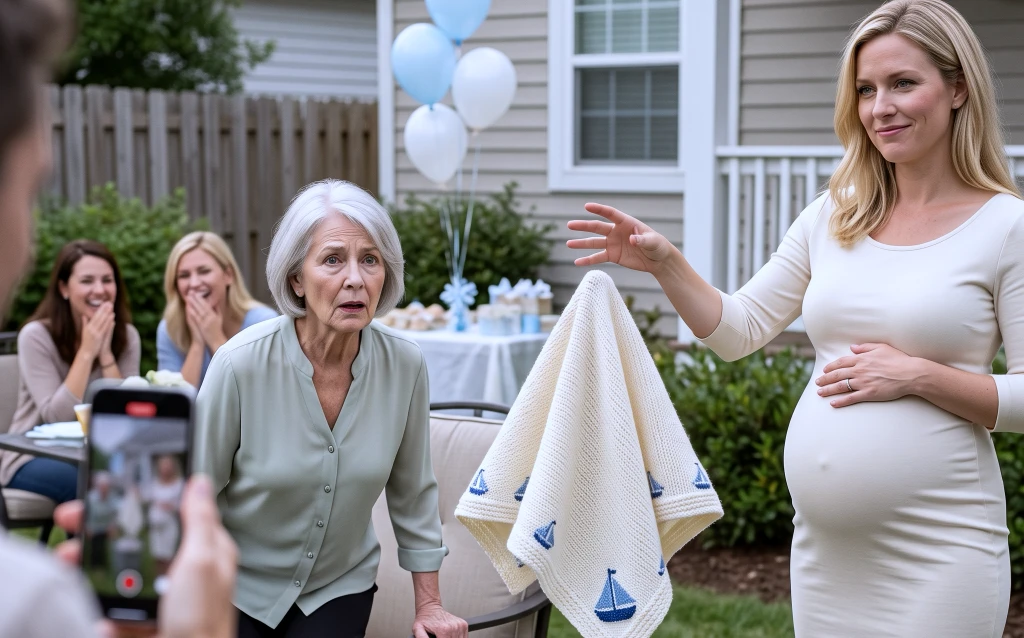
On the bed lay a plain white box containing an ivory blanket with little blue sailboats along its border. I had knitted W.W. into one corner, small enough that a person would have to look closely. Walter would have approved of that. He never liked his name on anything larger than a fishing license.
He drove the same pickup until the driver’s seat had to be repaired twice. His gray jacket had shiny places at the elbows, and he always said it had another season in it. I would catch him studying a restaurant bill, then find out he had paid for somebody else’s meal. He could be particular about a dollar without being unwilling to give one away.
Our son, Nathan, had inherited his patience and almost none of his stubbornness. At thirty-two, he still took an extra second before answering an impatient person. As a boy, he would give up a toy rather than let another child go home crying. Walter admired his kindness and worried about what other people might ask of it.
After his father died, Nathan called me late at night. Sometimes he had a question about a tool or an old photograph; sometimes we talked until there was nothing left to say. Walter’s fishing cap hung on a hook by Nathan’s back door. He had taken it home after the funeral and never moved it.
Lauren’s calls came at more convenient hours and usually concerned arrangements. She was good at arrangements. Their wedding had gone off without a crooked place card, and photographs of their home showed rooms where even a book looked as though somebody had approved its position. When she announced the pregnancy, she already had a folder of ideas for the nursery.
I was sixty-eight and had run an alterations and fabric shop on Maple Street in Hastings for forty years. Brides came in with photographs and impossible deadlines; men arrived carrying suit pants over one arm, hoping I could find an inch the manufacturer had hidden. I understood wanting things to look right. I also knew what happened when a person cared more about the photograph than the body inside the clothes.
At first, I thought Lauren simply hadn’t spent much time around older women who worked with their hands. I offered to alter a dress for her once. She thanked me and said she preferred to have it done through the store. Another time I brought homemade rolls to dinner and discovered that the meal had been planned around a particular caterer. Nathan ate two of my rolls while we put them away.
Her mother, Joyce, used to inspect any gift before she praised it. She would turn a vase over for the mark on the bottom or ask which shop had wrapped a scarf. When I brought something from my kitchen, she smiled and said, “How very resourceful.”
Lauren had grown up hearing that tone. I suspected that being thought ordinary frightened her more than she would have admitted. Yet when she talked about the baby, her hand settled over her stomach without any concern for who was watching. I wanted to believe there would be room for both the woman she was and the mother she was becoming.
Walter hadn’t lived to meet that mother. In February, when the hospital had become our whole address, he asked me to bring down the cigar box from the top shelf of our closet. I expected old photographs or the loose change he used to empty from his pockets. He told me to sit before I opened it.
Inside were savings bonds, neatly grouped by date, along with records of the later bonds he had bought electronically. An envelope lay across the top. In his careful, square handwriting, he had written: For our first grandchild.
“Walter,” I said, “what have you been doing?”
“Making sure I had something to give.”
He had started when Nathan was two. A little from one paycheck, a little from the next, extra whenever he could manage it. He had kept at it for almost thirty years, through roof repairs and lean stretches, without taking any of it back.
I turned a page and found my full name, Evelyn Whitcomb, beside his. He had arranged the holdings so I could carry out what he wanted if he wasn’t there. He thought they were worth a little under fifty thousand dollars by then, though he insisted I have the figures checked. Even sick, he didn’t like guessing about money.
“You could have told me,” I said.
“You’d have wanted to put some of it toward the furnace.”
“We did need a furnace.”
“And we got one.”
His smile tired him. I set the papers aside and helped him drink from the plastic cup on his bedside table. He waited until I had adjusted the blanket over his knees before he asked the next thing.
“Would you make the baby something, Evie?”
“Of course.”
“A blanket. Put this inside it somehow. You’re the one who knows how.”
I told him Nathan ought to know about the savings. Walter shook his head against the pillow. He wanted them to open something their grandmother had made, something they could hold, before anyone began adding up the money.
“Let her find the rest, Evie.”
Over the next two evenings, he dictated a letter to our unborn grandchild. I wrote while he rested between sentences, then read each passage back. He corrected a word here and there and made me keep a joke I thought was unnecessary. The envelope was to remain sealed until the child’s eighteenth birthday.
He also dictated a shorter message for the family, to be read when the gift was opened. I kept that one separate. Walter had strong opinions about making a young person listen to a grandfather’s speech eighteen years too early.
“They should at least have a chance to get to know me,” he said.
I laughed because he wanted me to. Later, I went into the bathroom down the hall and held a folded paper towel against my mouth until I could come back without upsetting him. He was watching the door when I returned. I sat beside him and let him keep my hand.
In March, I bought the wool. I chose ivory because I didn’t yet know the baby’s name, and blue because Walter had always looked happiest near the water. The sailboats were simple enough to repeat and small enough to suit a newborn. I worked at the kitchen table with his empty chair across from me.
Arthritis had been troubling my hands for five years. By spring, some evenings allowed only two rows before I had to stop. I kept a bowl of warm water near the sink and a pencil in the pattern book to mark where I left off. When a stitch went wrong, I backed up and repaired it. I had spent too many years correcting other people’s hems to send my grandson a careless piece of work.
The blanket took four months.
Along the lower edge, I made a broad muslin pocket behind the knitted border, spreading the papers in thin bundles so they didn’t form one heavy lump. The sealed letter went beside them. I closed the seam with small stitches that could be removed without cutting the wool.
I practiced finding the opening with my fingers. At the shower, once Lauren had admired the blanket, I would show her where to look. Walter’s shorter message would follow. I could almost hear him objecting to my fussing, then asking whether I had checked it once more.
By June, it was finished. For two months it lay in a clean drawer, wrapped in tissue, while Nathan reported doctor’s appointments and Lauren sent photographs of the nursery. They had chosen the name Benjamin because she liked the way it looked in a monogram. I said it was a lovely name, and it was. I tried saying it aloud when I was alone.
The shower was held in September at Joyce’s house. Flowers stood in the entryway, and a cluster of balloons curved around Benjamin’s name behind the gift table. Someone had arranged sandwiches so small that I wondered what they had done with the rest of the bread. I carried my box through the front room carefully, keeping it level against my hip.
Lauren kissed the air beside my cheek and thanked me for coming. Her dress lay smoothly over her stomach, and she had one hand on her back as she moved between guests. Nathan took my coat, gave me a proper hug, and asked whether the drive had been all right. I wanted to tell him how much he looked like his father when he worried about me, but he was already being called over to help with a stroller.
I put my gift near the end of the table and found a seat along the edge of the room. There was good light there, and I could see the door. Years of fittings had taught me to leave a person room to turn without bumping into somebody else’s knees.
Marjorie arrived carrying a bag of baby socks and complaining about the parking. Walter’s younger sister was sixty-five and had never learned to enter a room quietly. She kissed my cheek, lowered herself into the chair beside mine, and looked at the gift table.
“That’s it?” she asked.
I nodded. She knew about the savings and Walter’s letters. He had told her what he was planning while he could still enjoy the look on somebody’s face.
Across the room, Lauren’s friend Tessa was testing the angle of her phone. Joyce moved a flower arrangement out of its way. When Tessa asked Lauren to turn slightly, Lauren did, smiling before the phone was raised.
“Are you going to tell her before she opens it?” Marjorie asked.
“I’ll show her the pocket when she has the blanket.”
“Evelyn, you could save yourself some explaining.”
“He wanted her to find it that way.”
Marjorie touched my wrist and left the matter there. I checked the white ribbon from where I sat; the bow was loose, just as I had intended. At the window, Nathan finished adjusting the stroller and accepted a drink from somebody passing a tray. Tessa raised her phone. “All right, everyone. Lauren’s going to open the gifts…”
To read the rest of the story – CLICK the NEXT button 👇👇👇