


The first time Boone went completely still at the kennel door, Mara Ellison was holding the form that could authorize his death. Across the cinder-block wall, a cheetah cub cried. It was not the sound Mara expected from an animal built to outrun almost anything alive. The cub made one thin, rusty chirp, like a hinge moving in an empty house. Boone’s front paws dropped from the steel gate. His mouth closed. For the first time since animal control had forced him through Red Mesa’s intake corridor eleven days earlier, the charcoal-colored dog held still while a person stood outside his kennel.
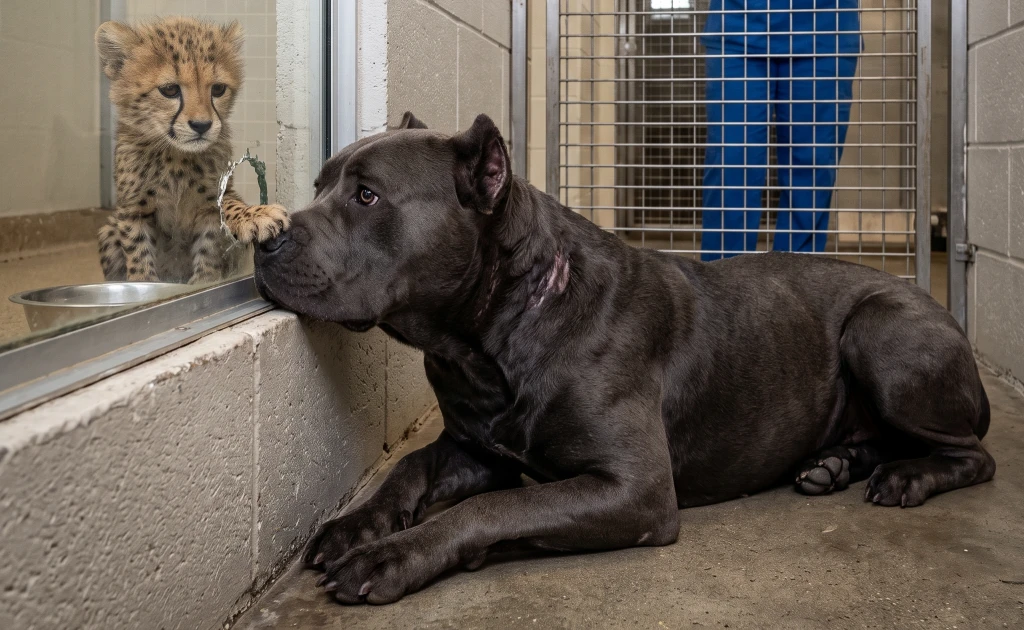
Mara kept her pen above the signature line.
The form did not order euthanasia. It scheduled Boone for Friday’s behavioral disposition review, where a veterinarian, a behavior consultant, and two senior staff members would decide whether he could be handled safely enough for treatment or placement. At Red Mesa Animal Care Center, however, a red folder rarely traveled backward. The county shelter was full, winter heating bills had arrived early, and Boone had come with six months of complaints about a dog hurling himself at the fence behind a rental house.
There was no verified bite in the file. There was a blurred photograph of a delivery driver on the hood of his van, an animal-control note that said attempted attack, and a red groove around Boone’s neck where someone had left a chain too tight for too long. His ownership hold had cleared on the ninth day. During capture, he had fought the catch pole until his gums bled; in the kennel, he had charged every hand that reached toward the latch.
Olivia Chen, the youngest of Mara’s lead kennel technicians and the one least impressed by a dramatic intake report, had watched him from the side instead of standing squarely in front of him.
“He turns his head before he comes forward,” she’d said. “He keeps asking us to back off.”
“And if somebody misses the ask?”
Olivia had looked at the red card Mara was fastening to the gate. DO NOT APPROACH, it said in black marker. “Then we shouldn’t send somebody in who misses it.”
Mara had left the card where it was. Red Mesa held a county contract, a domestic-animal license, and a small wildlife stabilization unit under a separate set of permits. All three depended on employees going home with the same number of fingers they had brought to work. Compassion did not mend tendons or defend a liability claim.
Five years earlier, during a canine-distemper outbreak, Mara had signed nineteen euthanasia authorizations in one night. She could still remember the markers squeaking across kennel cards as staff drew a black diagonal line through each animal’s name. By morning, protesters were at the gate calling her a butcher, though none of them had seen the dogs seizing under blankets or heard the county tell her there would be no money for an off-site quarantine.
Since then she made hard decisions early, before she knew each animal well enough to hesitate. She checked latches twice, counted syringes, and did not sit on kennel floors.
The cub cried again.
Boone turned his head toward the wall. A square utility chase ran between domestic isolation and the wildlife nursery, carrying pipes but no shared air. Sound found its way through every seam in the old building. Boone lowered himself with care, chest first, until his scarred shoulder rested against the block.
Then he exhaled. Not a whine or a growl. A low, breathy huff that Mara felt more than heard.
On the other side of the wall, the crying stopped.
Dr. Lena Reyes appeared in the wildlife doorway with her scrub cap pushed back and a streak of formula on one sleeve. “Did he just do that?”
“Dogs breathe, Lena. Even difficult ones.”
“Come look.”
Mara slid the disposition form under Boone’s folder and followed her through the two-door entry. She changed gloves, stepped through the disinfectant mat, and waited while Lena secured the inner door behind them. The wildlife nursery had its own equipment, drain, gowns, and air handler. Tonight it also had a federal custody notice taped beside a stainless-steel recovery pen, a plastic transport crate secured open inside it, and two portable heaters Daniel Mercer had borrowed from the county road department.
Inside the open crate, the cub crouched beneath a towel tent. She was ten weeks old, all legs and amber eyes, with black tear marks running down a face too small for them. Her paperwork called her C-17. Olivia had called her Piper after the first anxious chirp, and the name had stuck in conversation even though no one had written it on an official line.
Federal wildlife officers had removed Piper from an illegal exotic-animal operation west of Bellwether that morning. Her mother had died before the seizure team reached the property. The seizure report said officers found Piper wedged beneath the dead female’s foreleg and calling when they lifted her away. The cub was captive-born and had spent her first ten weeks in human confinement without the skills or legal clearance for release; her unreliable pedigree also excluded her from a managed breeding plan. Prairie Sky Conservation Center had agreed to provide permanent professional care. An ice closure over the pass had delayed its transport van until morning, leaving Red Mesa as the only authorized secure stop within driving distance.
One night only, the custody officer had emphasized. No shared air or objects, no physical exposure, minimal handling, transfer at first light.
Piper had refused formula at the seizure site, in the state veterinarian’s truck, and for six hours at Red Mesa. Lena had ruled out an immediate obstruction or injury, treated the dehydration she could safely treat, and dimmed the room. Nothing had persuaded the cub to take more than a taste.
Now Piper was no longer wedged against the back of the crate. She had crept toward the wall and pressed one spotted flank against the plastic. When Boone shifted in the next room, his nails made a soft scrape on concrete. Piper’s ears tilted toward the sound.
Lena placed the shallow dish near the front of the crate and withdrew her hand. “No reaching,” she murmured. “Let’s see what she chooses.”
For several seconds the cub stayed still. Boone gave another low huff through the block. Piper stretched her neck, sniffed the edge of the dish, and began to lap.
Lena kept her face neutral and counted Piper’s swallows under her breath. After half a minute, the cub backed beneath the towel again. She had taken only a little, but it was the first food she had kept down since the seizure.
“Well,” Mara said. Her voice came out rougher than she intended.
“It may be the lower sound. It may be another animal nearby. It may be coincidence.” Lena picked up the clipboard without taking her eyes from the crate. “We don’t know yet.”
“But you’re writing it down.”
“I’m writing down that she ate after he settled by the wall. I’m not writing a fairy tale.”
From domestic isolation came the faint jingle of Boone’s collar tag. Piper’s tail, which had been wrapped tightly around her hind legs, loosened by an inch.
Mara returned to the corridor. Boone had not moved. Up close, the red groove around his neck showed through the short hair like a second collar. His eyes followed Mara, but he did not rise when she crouched several feet from the gate.
She had not meant to crouch. The position put her knees below his shoulders and left the keys at her belt within reach if he broke through. Every habit she had built since the outbreak told her to stand, finish the form, and let Friday’s review protect the rest of the shelter from one more impossible animal.
Boone looked away first. His breath traveled into the wall.
Piper answered with a quieter chirp.
Mara lowered herself onto the overturned feed bucket outside the kennel. She stayed beyond the floor’s yellow safety line and kept her hands in her lap. Boone watched the utility wall, not her. The two animals could not see or touch each other, yet the pressure seemed to leave the room in small increments: first from his jaw, then from the line of his back, then from the cub’s calls until the only sound was the old hot-water pipe ticking behind the concrete.
Lena came out twenty minutes later carrying the empty dish. Not clean, but empty enough.
“Her temperature is normal, hydration is improving, and she’s alert,” she said. “The pass reopened an hour ago. Prairie Sky’s team will be here at six.”
Mara looked through the wired-glass window at Piper beneath her towel, then at Boone lying with his scarred neck against the wall. On the desk behind her, the corner of his red folder showed beneath the unsigned form.
Lena followed her gaze. “She’s stable enough to travel. What do you want me to tell them…”
To read the rest of the story – CLICK the NEXT button 👇👇👇