


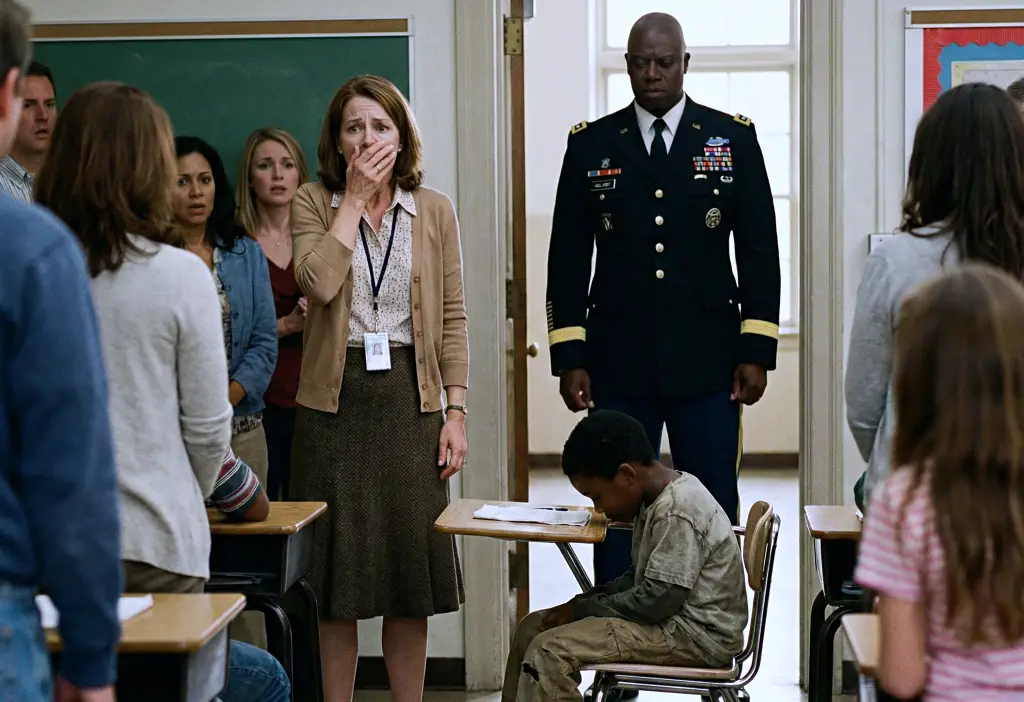
“A black boy from a rental apartment claiming his daddy is a four-star general? That is the most ridiculous lie I have heard in twenty-three years of teaching.”
Mrs. Patricia Whitmore didn’t whisper it. She announced it.
Her voice sliced through the stale air of the fourth-grade classroom at Jefferson Elementary like a serrated knife. She stood over Lucas Hughes’s desk, her shadow stretching long across his worn sneakers.
Then, she snatched Lucas’s carefully written assignment off the wood-grain laminate.
The sound of tearing paper echoed off the chalkboard.
Riiip.
She tore it in half. Then she put the pieces together and tore them again.
Riiip.
The confetti-sized pieces drifted down like snow, landing on Lucas’s shoes.
“You don’t get to make up fairy tales about being special, Lucas,” she said, her voice dropping to a chilly, patronizing register.
“Generals live in big houses. Their children go to private schools. They drive expensive cars.”
She leaned in closer. Her perfume was cloying and sweet, masking the venom underneath. “They certainly don’t show up looking like… well, like you.”
Ten-year-old Lucas stood frozen. His hands trembled at his sides. Every pair of eyes in the room was fixed on him—some in pity, some in morbid curiosity.
Mrs. Whitmore crumpled the remaining shreds in her fist and dropped them into the trash can with a decisive thud.
“Pathetic.”
To understand how a teacher could destroy a child for being black and telling the truth, you have to rewind the clock.
Two hours earlier, Lucas Hughes had woken up to the sound of his father’s voice booming from downstairs.
“Breakfast in five, soldier!”
The Hughes family lived in a modest, three-bedroom apartment in Arlington, Virginia. It was close enough to Fort Myer that, if you propped the windows open on a breezy morning, you could hear the faint, melancholic notes of the morning bugle.
The apartment was clean, but the furniture told the story of a family on the move. The edges were worn down, and the fabric was softened by years of use.
The walls were adorned with family photos, but nothing that screamed “military family.”
There were no uniforms on display. No medals gleaming in shadow boxes. No folded flags or commemorative plaques.
It was strict security protocol. General Vincent Hughes did not advertise his work to the neighbors.
In the kitchen, Lucas found his dad sitting at the small dinette table. He was dressed in worn jeans and a gray Georgetown sweatshirt.
To anyone passing by on the street, he looked like a regular father. Maybe a high school teacher, or perhaps an office worker taking a day off.
His mother, Dr. Angela Hughes, was already up. She poured coffee into a travel mug while wearing her blue surgical scrubs. She had an early surgery scheduled at Walter Reed National Military Medical Center.
On the refrigerator, held up by a magnet, was a child’s crayon drawing. It showed a stick figure in a green uniform with four exaggerated stars on each shoulder.
Next to it, a calendar hung with today’s date circled in thick red marker: Parent Career Day, Friday.
Lucas couldn’t stop smiling as he slid into his chair. He had been waiting for this day for weeks.
“Dad, can I tell them about the time you met the President?” Lucas asked, grabbing a spoon.
General Hughes glanced at his wife. Angela gave him a specific look—the one that said their son deserved better than a life of shadows and secrets.
“Lucas, remember what we talked about?” Vincent’s voice was gentle but carried the natural weight of command. “Some things stay private for security. We have to be careful.”
“But everyone else gets to brag about their parents,” Lucas said, his smile faltering.
“I know, son.” Vincent reached across the table. “Our family is different. We keep a low profile. You understand?”
Lucas nodded, staring at his cereal bowl. He didn’t really understand, not fully. Why did other kids get to be loud and proud while he had to stay quiet?
Angela squeezed her husband’s hand across the table. “He deserves to be proud of you, Vincent.”
“I know,” the general sighed, looking at his son with soft eyes. “Just keep it simple tomorrow, okay? You don’t need to prove anything to anyone.”
Lucas finished his cereal and headed upstairs to get ready for school. He didn’t know that in less than twelve hours, “simple” would become impossible.
Jefferson Elementary sat in the heart of Arlington, a melting pot of the D.C. metro area. The school served everyone.
There were military families transferring in and out like tides. There were diplomat kids whose parents worked at the embassies on Massachusetts Avenue. There were immigrant families chasing the American dream, and working-class children whose parents cleaned the very buildings where national policy was made.
It was supposed to be a place where every child mattered equally.
But Mrs. Patricia Whitmore had taught there for twenty-three years. And in those twenty-three years, she had developed a very clear, rigid sense of who was telling the truth and who was “exaggerating.”
Her classroom walls were a shrine to her own localized patriotism. A large American flag hung by the whiteboard. Framed photos showed her shaking hands with local city council members alongside certificates of teaching excellence.
She wore a flag pin on her lapel every single day. She had never served in the military, never lived overseas, never worked a day outside of her comfortable suburban bubble.
But she thought she knew what generals’ families looked like. And Lucas Hughes did not fit the picture.
During morning announcements, Principal Hayes’s voice crackled through the intercom system.
“Good morning, Jefferson Elementary. A reminder that Parent Career Day is today. We are honored to have some very special guests joining us. Please make them feel welcome.”
In Mrs. Whitmore’s classroom, the energy shifted immediately.
Tyler Bennett, a white kid whose father lobbied on Capitol Hill, shot his hand into the air. “Mrs. Whitmore, my dad is meeting with three senators this week about the infrastructure bill!”
“How impressive, Tyler.” Her face lit up, wreathed in a genuine smile. “Public service is so important to our democracy.”
Sophia Wilson, a Latina girl whose mother cleaned the Capitol building, raised her hand next. “My mom works there too. She cleans the offices after everyone leaves.”
“That’s nice, Sophia,” Mrs. Whitmore said.
Her smile didn’t quite reach her eyes this time. It was the smile one gives to a distant relative at a funeral. “Now, let’s open our textbooks to page forty-two.”
Lucas watched the exchange silently. He had seen this pattern before.
Some kids got praised; others got dismissed. It usually depended on what their parents did, what kind of car they pulled up in, and how much money they seemed to have.
At ten o’clock, Mrs. Whitmore handed out the assignment.
“Class, I want you to write three paragraphs about your parents’ careers,” she instructed, walking the aisles. “What do they do? Why does it matter? How does it help our community? Due before our guests arrive. Best handwriting, please.”
Students bent over their papers immediately. Lucas pulled out his pencil, took a deep breath, and began writing in careful block letters.
My dad is a four-star general in the United States Army. He has served our country for 32 years in places like Iraq, Afghanistan, and Korea. He helps make important decisions to keep America safe.
There are only about 40 four-star generals in the whole military. My dad worked his way up from second lieutenant. He says leadership means serving others, not yourself.
My dad has been deployed six times. Sometimes I don’t see him for months. But he does it because he loves our country. That’s what makes his job matter.
Deshaun Williams, Lucas’s best friend, leaned over the aisle. “Yo, is your dad really a general?” he whispered.
Lucas nodded, keeping his voice low. “Yeah. He just doesn’t talk about it much.”
“That’s so cool. My dad just fixes cars at the garage.”
“My dad says every job matters,” Lucas whispered back, repeating the lesson he’d heard a thousand times at the dinner table. “Your dad keeps people safe on the roads. That’s important too.”
Deshaun grinned, seemingly satisfied.
Suddenly, a shadow fell across Lucas’s paper. Mrs. Whitmore appeared beside his desk. She leaned down, the scent of her hairspray overpowering, and read over his shoulder.
Her lips pressed into a thin, white line.
Lucas felt his stomach drop. Something in her expression told him she didn’t believe a single word on the page.
But she said nothing—not yet. She just walked back to her desk, opened her planner, and made a sharp note.
As the morning wore on, Lucas’s phone buzzed in his backpack. The school allowed students to carry emergency contact devices, and his was an older smartphone his parents used to reach him.
During the bathroom break, he checked it. A text from his mother popped up.
Dad’s flight landed early. He’s at the airfield now. He’ll make career day after all. Keep it a surprise.
Lucas’s heart soared. His dad had been in Korea for three weeks for strategic planning meetings—stuff Lucas wasn’t allowed to know the details of.
But he was coming home early. He would be at Career Day. Lucas wanted to shout it from the rooftop.
Instead, he slipped the phone back into his bag and returned to class, a secret smile playing on his lips.
He didn’t notice Mrs. Whitmore watching him from her desk. He didn’t see the skeptical, almost predatory look in her eyes.
She had already made up her mind about Lucas Hughes. That boy was a liar. And tomorrow—no, today—in front of everyone, she was going to teach him a lesson about honesty.
The next morning arrived with an unusual, frantic energy at Jefferson Elementary. The air in Room 204 practically vibrated with anticipation.
Parents began filing into Mrs. Whitmore’s classroom at eight-thirty sharp. It was a diverse parade of professions.
A lawyer in a sharp, tailored navy suit checked his watch. An architect carried a long tube of blueprints tucked under her arm. A software developer in a hoodie looked around nervously. A chef in pristine kitchen whites smelled faintly of vanilla and flour. A nurse, eyes rimmed with fatigue, still wore her scrubs from the night shift.
Mrs. Whitmore greeted each one, her enthusiasm calibrated like a thermometer.
To the lawyer, she offered a firm, two-handed handshake and a bright, blinding smile. The chef received a polite, curt nod. For the nurse, she offered a quick, “Thank you for your service,” before immediately turning her back to arrange the folding chairs in a semi-circle.
Lucas sat at his desk, his leg bouncing nervously. He checked his phone under the desk every thirty seconds. His dad had texted at six that morning.
Customs cleared. Changing into uniform at the base. See you at school by ten. Proud of you, son.
Two more hours. Lucas just had to survive two more hours of Mrs. Whitmore’s glare.
“Class!” Mrs. Whitmore clapped her hands, the sharp sound cutting through the chatter. “Before our guests present, let’s share the paragraphs you wrote. I want our visitors to hear how thoughtfully you described their work.”
One by one, students stood and read.
Tyler Bennett stood up first, chest puffed out. He talked about his father’s lobbying firm, dropping phrases like “legislative impact” and “infrastructure bills” that he clearly had memorized over breakfast. Mrs. Whitmore beamed, nodding along as if he were reciting Shakespeare.
Sophia Wilson went next. She spoke softly about her mother’s cleaning work at the Capitol, describing how her mom took pride in making the marble floors shine so the lawmakers could work in a beautiful place.
Mrs. Whitmore offered a tight, plastic smile and moved the agenda along before Sophia had even fully sat down.
“Lucas Hughes,” Mrs. Whitmore said, her tone flattening. “You’re next.”