


The transport crate had been open for six minutes before the lion moved. Russell stood behind the protected-contact gate with his hand resting on the release cable. He’d brought enough rescued cats into Painted Mesa Wildlife Sanctuary to expect a rush, a warning growl, a swipe at the unfamiliar doorway. This one studied the strip of daylight beneath the crate door, then came out one foot at a time.
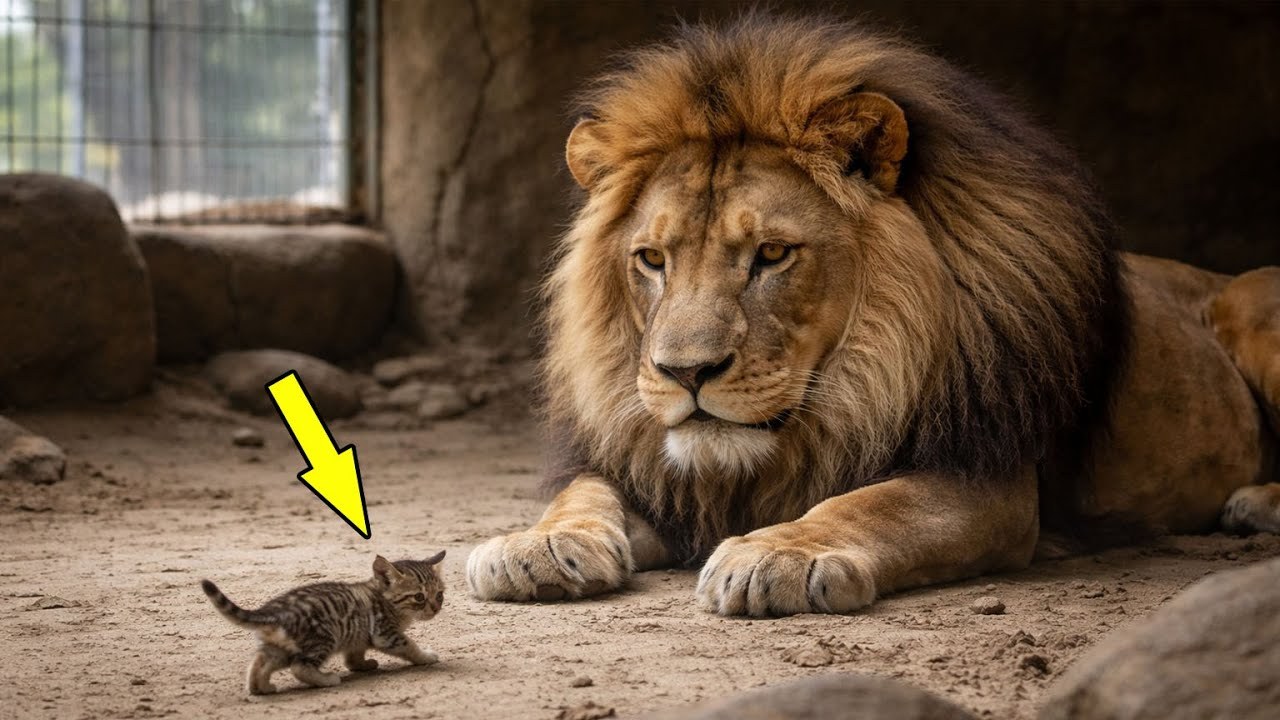
His mane was dusty and uneven. Beneath it, his shoulders had the substance of a powerful animal, though poor feeding had left hollows where muscle should have been. He stopped on the packed earth without looking toward the people waiting for him.
“Solomon,” Russell called, testing the name they’d chosen before the transport arrived. “You’ve got room here.”
The lion lowered his head and walked away.
He had come from an unlawful collection outside Moab, Utah, where cages stood close enough for animals to smell one another but offered none of the company they needed. His food had depended on what the owner could acquire cheaply. His confinement had lasted long enough that nobody could give the sanctuary a reliable account of his earlier life.
At Painted Mesa, outside Grants, New Mexico, he would have veterinary care, regular meals, shelter, and a broad enclosure cut into the sandstone country of Cibola County. On paper, his circumstances had changed completely.
Dr. Owen Mercer watched him through the observation glass that first morning. The behaviorist kept his notebook closed for several minutes.
“What worries you?” Russell asked.
Mercer nodded toward the lion. “Listen.”
Beyond the building, another big cat called from its habitat. Solomon stood motionless. He made no answering sound, no uneasy grunt, no complaint about the crate or the unfamiliar ground.
“Some animals arrive ready to fight everything,” Mercer said. “Others stop reaching for anything at all.”
They gave him quiet days. Then they offered careful enrichment, familiar voices, different feeding arrangements. Nobody crowded him. Nobody demanded a response.
By the end of that first autumn, the keepers had learned his habits. He ate what they provided and drank from the low basin. Now and then he walked the fence, though without much apparent interest in what lay beyond it. Mostly he returned to a flat sandstone shelf beneath an overhang in Habitat Seven.
The rock shaded him in the afternoon and kept the worst wind off his back. Its rough edge became as familiar to Russell as the arrangement of Solomon’s paws beneath his chest.
A bobcat might cry nearby. A cougar might spit at a keeper carrying a rake. Solomon’s ears scarcely moved.
Russell still spoke to him during rounds.
“Breakfast is on the other side today.”
Or, “You could at least tell me what you think of the weather.”
There was never an answer.
Two years passed. Staff changes, equipment replacements, and new arrivals altered the sanctuary around him. Solomon remained under his shelf, silent through them all.
Mercer’s reports became cautious. There was no evidence that the lion’s voice was physically impaired. His withdrawal appeared to run much deeper than a problem with his throat, and progress, if it came, might be very slow.
Eventually even the hopeful conversations stopped. The keepers continued caring for him with the same attention, but they no longer looked toward Habitat Seven every time a lion called.
Then, on a bitter morning in early September, Dante found a box at the north service gate.
He noticed it because the wind had rolled an empty feed sack against the fence, and the box hadn’t moved. It sat beside the gatepost with its flaps loosely crossed. When he bent to pick it up, something scratched inside.
Dante set it down again and reached for his radio.
“Intake, could somebody come to the north entrance? This isn’t a delivery.”
Dr. Lydia Benton arrived carrying a towel. She opened the flaps and saw a white kitten crouched against the cardboard seam, his blue eyes following her fingers. His fur was damp with cold, and his whole body shook.
“Was there a person here?” she asked.
“Not when I came through.” Dante searched beneath the box. “No message either.”
Benton wrapped the kitten and took him inside her coat for the walk to intake. He struggled just enough to get his head out and inspect the surroundings.
At the clinic, she checked him while warmed towels were exchanged beneath his body. He was about three months old, male, chilled but otherwise in unexpectedly good condition. There were no obvious wounds, no signs of a heavy parasite burden. Once warm, he tried to bite the end of her pen.
Russell leaned against the doorway. “Well, he’s got an opinion.”
“He’s entitled to one,” Benton said. “Somebody left him in a box.”
Dante had followed them inside. The kitten looked directly at him, refusing to settle until he could see past the towel.
“Finch,” Russell said after a moment.
Benton glanced up.
“Small fellow. Acts like that’s everybody else’s problem.”
She scratched beneath the kitten’s chin. “Finch it is.”
They placed him in a warmed quarantine room with clean bedding, water, and a fleece-lined carrier. For a little while he lay beneath the lamp, kneading the blanket and producing a rusty, uncertain purr.
Then someone left to finish the intake records.
The return-air grille near the floor had a loose corner. A missing fastener allowed just enough give for a determined kitten to push beneath it. The service duct led into a maintenance crawlspace with an exterior vent that had been opened for repairs.
When Tessa returned to record his temperature, the bedding was warm and empty.
She checked the carrier first, then lifted the blanket. She looked behind the chair, under the cabinet, and finally into the narrow opening beneath the grille.
“Oh, Finch. No.”
Her call brought Russell at a run.
By midday, keepers were looking under storage trailers and behind pallets. Dante checked the gates again. Tessa carried a dish of food from shed to shed, stopping often enough to hear a mew if one came.
A thermal camera found a rabbit beneath the visitor deck and several warm pipes along the clinic wall. It did not find Finch.
Russell crouched beside a drainage channel and shone his light along the concrete.
“He was cold indoors this morning,” Tessa said. She didn’t finish the thought.
The wind sharpened as the afternoon went on. On that high plateau, summer could still linger in the sun while the shade held the warning of a freezing night.
The search widened.
Near four o’clock, a voice came over the staff channel.
“Habitat Seven. I’ve got a white shape under Solomon’s rock. Somebody needs to look at this.”
Russell stood so quickly his knee struck the channel’s edge.
“Is it moving?”
A pause followed.
“It’s against him. I can’t tell.”
Dr. Victor Haines, the sanctuary director, answered before Russell could speak again. “Nobody enters. I’m coming.”
They reached the observation building in a tight cluster. Russell took the steps two at a time, already picturing the sort of scene a person could not undo by arriving faster.
He found Finch asleep.
The kitten lay tucked into the long fur at Solomon’s breast, with one white ear visible beside the lion’s foreleg. Each breath lifted him a little. His nose was buried so deeply that Russell had to change angles to see his face.
Solomon was awake. His jaw rested loosely, his ears were neutral, and his tail lay untouched along the sand.
Tessa put a hand against the window.
“How did he even get in?”
“The outer mesh has openings he could squeeze through,” Russell said. He couldn’t take his eyes off the kitten. “Getting out is the part I’m worried about.”
Haines asked for the overhead camera. On the enlarged image, there was no rigid stare, no bunching of the lion’s shoulders. Mercer arrived and stood beside him, watching the rise and fall of Solomon’s ribs.
Finch wriggled in his sleep.
The lion bent his head slightly, bringing more of his mane between the kitten and the wind.
Nobody spoke for several seconds.
“We get the medical team ready,” Haines said. “Equipment at the protected entrance. But we do not turn this into a commotion.”
“He could roll on him,” Tessa said.
“Yes,” Haines answered. “We watch continuously. Any change, we reassess immediately.”
Blankets, a transport carrier, and emergency supplies were brought to the gate. Benton stayed nearby with sedation equipment, though nobody mistook it for an instant solution. The keepers watched from behind secure barriers.
An hour went by. Then most of another.
Russell had never studied a lion’s breathing so closely. Solomon kept his chest remarkably still between breaths, moving only enough to settle the kitten when Finch shifted. The camera showed the great forepaws remaining open and relaxed beneath him.
Mercer leaned forward.
“He knows there’s something there,” he said. “Look how little he’s moving.”
At last Finch woke. He drew his head out of the mane, blinked toward the fading light, and pushed both front paws into Solomon’s fur. His mouth opened on a small, drowsy chirp.
Solomon turned his head toward him.
The lion’s chin came down close to the kitten’s back. Then a low sound rolled out of his throat, brief and warm, carrying through the enclosure microphone into every speaker in the room.
For the first time in two years, Solomon had made a sound…
To read the rest of the story – CLICK the NEXT button 👇👇👇