


The facing was wrong again. Lena Ferraro had unpicked it before leaving home, and a thread from the cheap cotton still clung to her coat when she reached the window.
Behind the glass, the real dress stood without a wrinkle.
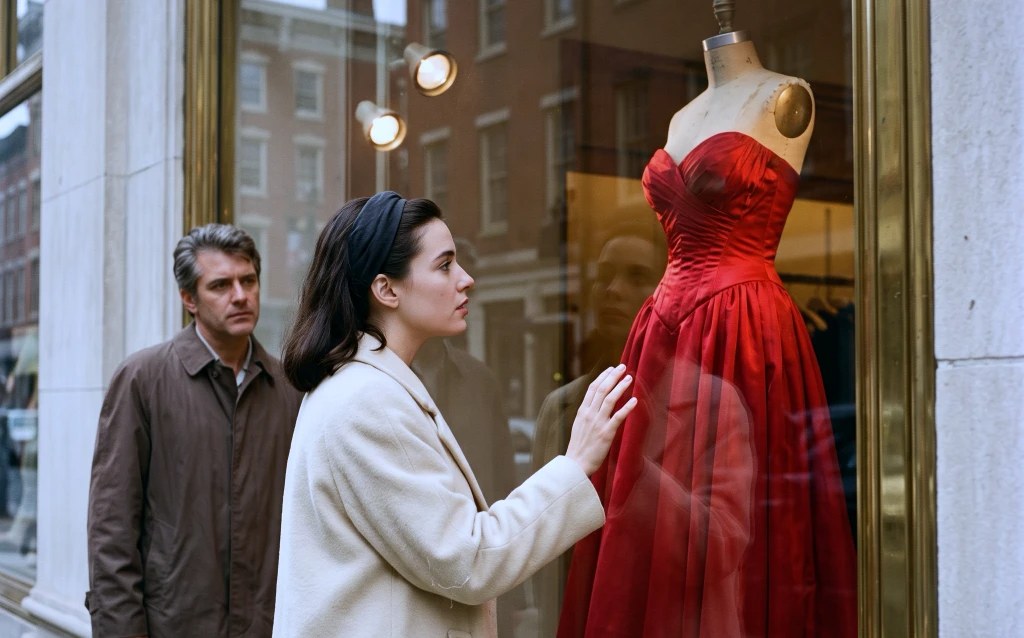
It was a Thursday in September 1990. Philadelphia had gone cool overnight, though the deliverymen on Darrow Avenue were still working in shirtsleeves. Lena stopped where she always stopped, a little beyond the reach of the revolving door, and studied the upper edge of the red bodice.
Aveline occupied a corner building with four floors of limestone, tall windows, and brass that somebody polished before the city woke up. Its display held one garment. There was room for a dozen, but the house seemed to regard an empty foot of space as something worth purchasing.
The red evening dress had no straps. Below its close-fitted bodice, silk descended in substantial, controlled folds. The color troubled Lena almost as much as the construction. She had seen reds that looked brown under artificial light, reds that looked orange in daylight. This one did neither.
The card at the mannequin’s feet read: Before Daybreak.
No price appeared. Lena knew it anyway. A customer at Vellori, the dress shop across the avenue, had announced that thirty-eight thousand dollars was an affront to decent people, then asked whether the same red was available in a scarf.
Lena made $15,200 a year. She had done the division while retrieving a hanger.
Two and a half years. Before rent, before groceries, before a single subway token.
Still, she came.
Thursday was her only day off. She left the third-floor apartment in Wexley late in the morning, took the train downtown, and bought coffee from a cart whose owner charged fifty-five cents instead of a dollar. She finished it before reaching Aveline. Her purse stayed home. Empty-handed, she could stand comfortably without looking as though she were waiting for someone to let her in.
She knew the door was available to her. People wandered through the showroom just to look, and nobody expelled them. But looking from the pavement required no explanation. Inside, she might have to say what she wanted, and she had already supplied herself with the answer she expected to hear.
Wearing the dress had scarcely occurred to her.
She wanted to know how it stayed up.
At Vellori she spent six days a week helping other women dress. The shop had a cream-painted front and narrow fitting rooms, and most of its stock cost between two and four hundred dollars. Lena could close a zipper without catching skin, recognize a poor shoulder fit before a customer reached the mirror, and advise against a purchase without making the woman feel foolish for considering it.
Mrs. Vellori said customers came back because Lena never made them feel hurried.
Lena liked the work. She also watched the alterations leave for the workroom with an attention she never gave the sales receipts.
Her mother’s sewing machine stood beside the window at home. Bianca Ferraro had bought it used in 1961 and kept it running through school uniforms, shortened trousers, bridesmaids’ dresses, and winter coats turned inside out to hide worn cloth. At seven, Lena had sat between her mother’s knees and guided scraps beneath the needle while Bianca controlled the speed.
She had moved from Harrisburg to Philadelphia in 1985, carrying one suitcase and her grandmother’s address. For part of that first year, she worked early shifts at a dry cleaner before reporting to Vellori. Her mother died the following year, when Lena was twenty-two. Afterward, the machine came to Philadelphia.
There was her grandmother, Vera. There was the machine. Lena took care of both.
At night she made clothes for neighbors: a blouse, a child’s party dress, a coat with pockets positioned for a woman whose fingers had stiffened. She always found a reason not to charge. The fabric had been left over. The pattern needed trying. It had hardly taken any time.
Four graph-paper notebooks lay beneath her bed. The oldest, begun in 1986, contained broad sketches with generous lettering. The later pages were crowded with small diagrams and measurements squeezed into corners. Her mother had drawn patterns without a ruler, and Lena did too, although she checked the arithmetic twice.
Every Thursday she brought home another possibility from the window.
She had attempted the red bodice in bargain cotton three times. Three times, its upper edge had buckled. During the fourth attempt she finally stopped blaming the boning. By the time she put down her scissors, the kitchen clock said four.
She did not think of the card in the window.
Upstairs at Aveline, Nathaniel Ashford had begun thinking about the woman outside.
He first noticed her on an August Thursday, when a column of figures had become intolerable and he turned toward the street. She wore a pale wool coat and stood unusually still. When he looked again much later, she had not moved on.
The next week, he pulled his chair closer to the window.
Most people used the display glass as a mirror. They inspected their own faces floating above the clothes, adjusted their hair, considered themselves in relation to the price. This woman tilted her head toward a concealed seam. She returned to the bodice after examining the skirt. Once, she leaned slightly sideways, as though a different angle might settle an argument.
Nathaniel knew that kind of concentration. He had entered his grandmother’s workroom at sixteen and had spent twenty-eight years learning what hands could persuade cloth to do.
At forty-four, he employed two hundred and ten people, operated a factory in Delaware, and owned five salons in three countries. He disliked being introduced as a businessman. On the rare occasions someone asked him what he did, he answered that he designed clothes.
Lately, the answer required some generosity.
His grandmother, Aveline, had arrived from Toulouse in 1921 with pattern books wrapped in clothing. She began above a notions shop. By the mid-fifties, she had moved into the corner building on Darrow Avenue. Nathaniel had inherited a thriving house and, for a while, made it more remarkable.
The red dress had been his.
In February 1986, Elise packed her belongings and ended their marriage with a composure he found harder to bear than anger. For weeks he slept badly, worked late, and went home to wait for morning. One night he abandoned the bed and went down to his worktable. He had no plan beyond sitting somewhere else.
An hour later, the dress existed in pencil.
Its construction came quickly. The color took three months. He rejected lengths of dyed silk until the workroom stopped asking what, precisely, was wrong with them. He recognized that sleepless winter in the finished dress, though he had never meant to leave it there.
The dress appeared in the spring 1987 show. Nine clients ordered it, each version built to its wearer over ten weeks. The first remained with the house. Nathaniel put it in the window and left it there.
Since then, collections had arrived on schedule, orders had increased, and the accounts had pleased everyone. His team developed the clothes. He refined them, removed a pocket, altered a neckline, signed the drawings.
Nothing wholly his had reached the cutting table in four years.
Sometimes he wondered whether this was what getting older felt like. His meetings concerned delivery dates and markets. Nobody asked him why he had placed a seam where it was.
On the last Thursday in August, he went downstairs to Denise Hartley, who had managed the showroom for nearly two decades.
“Do you know the woman outside?”
Denise followed his glance. “The one who studies that dress? She’s been doing it since April.”
“Has she ever come in?”
“No. She works for Mrs. Vellori.”
For several seconds he felt insulted on behalf of a piece of cloth. Then he felt embarrassed.
Manufacturers did send people to examine couture. A shoulder, a drape, a fastening could turn up months later in a badly made imitation. But this woman carried no sketchbook. She made no hurried notes. And someone stealing a pattern would hardly need five months of weekly visits.
The following Tuesday, Nathaniel crossed Darrow Avenue in a loose brown raincoat he rarely wore.
A young salesgirl approached him. He said he needed a gift for a niece and that someone had recommended Lena.
She appeared from behind a curtain carrying a box of pins. Up close, she was younger than he had expected, perhaps twenty-six, with dark hair pulled away from her face by a narrow cloth band. She set down the pins before speaking to him.
He had prepared an age for the niece. He had not prepared a life.
Lena asked where the young woman lived, what she wore to work, whether the gift marked an occasion, and what she had received the previous year. Nathaniel invented answers and felt increasingly conspicuous beneath his perfectly ordinary coat.
Lena brought three dresses. One she rejected before he could comment.
“No. With the hair you described, this will make her look tired.”
She laid out the other two. The more expensive dress had generous fabric inside the side seams. Lena turned it partly inside out so he could see.
“This gives her room to have it altered later. She’ll get several years out of it.”
He had heard garments sold through fantasy, status, seduction, and fear. Nobody had ever tried selling him the fabric hidden inside a seam.
He chose the less expensive dress. Spending freely suddenly seemed dangerous.
As she folded tissue around it, he asked how long she had worked there.
“Five years.”
“And before Philadelphia?”
“Harrisburg.”
She tucked in the tissue. He should have let her finish, thanked her, and gone.
“Was this always what you wanted to do?” he asked.
Her fingertips stopped at the edge of the paper.
“I want my own work on those hangers…”
To read the rest of the story – CLICK the NEXT button 👇👇👇