


The rubber foot of the piano bench squealed against the floor. Lucy Mercer looked up from her worksheet just as Ms. Voss pointed to the space she had cleared. “Let’s settle this fascination of yours. Come up here, Lucy.” Around her, pencils stopped moving. Someone in the second row twisted sideways for a better view. Lucy tucked her fingers into the stretched cuffs of her cardigan and wished the teacher would discover a more interesting person to call on.
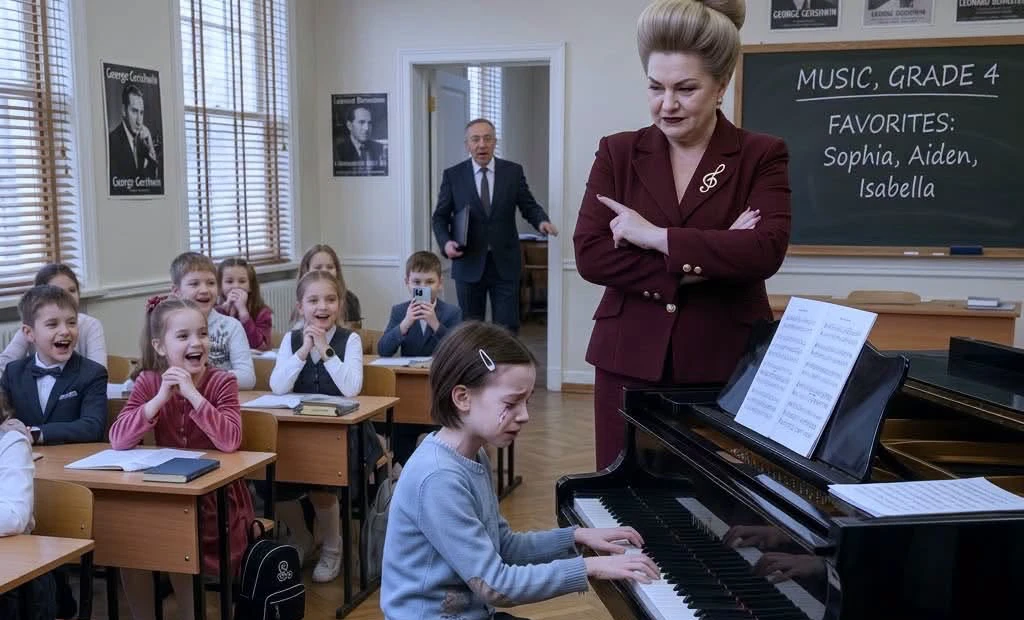
“Could I stay here?”
“You’ve had plenty of time to sit and observe.” Ms. Voss kept her hand on the bench. “Today you’ll participate.”
Lucy had been at Cedar Ridge Elementary for three weeks. The other twenty-five children knew where everything belonged and what Ms. Judith Voss expected. Lucy was still learning where to put her lunch bag.
The music room had made the new school bearable. Recorder cases filled a crate by the radiator; paper scraps marked the orchestra sections on a bulletin board. The grand stood beneath the windows, its lid facing the class. Lucy could feel its lowest notes through her shoes.
She had spotted a loose thread in the felt at the edge of the keyboard on her first morning. There was a cloudy spot on the brass hinge, too, where a hand must have rested for years. Those small signs of use had interested her more than the glossy finish.
Ms. Voss had caught her looking.
On her first morning, Lucy had kept touching the safety pin inside her cardigan pocket. Her father had sewn the pocket back on, but one corner still sagged. He had fixed her backpack zipper with a loop of cord. She’d arrived clean and on time, hoping nobody would ask about her.
That had worked in most classrooms. In music, it seemed to make the teacher more suspicious.
Simon Hale came early to unpack his violin, and Ms. Voss usually asked him to demonstrate whatever the class was learning. Paige Abbott had two piano lessons a week and knew how to accept praise without looking surprised. Tyler Finch could turn a pencil into a drumstick, but when he had to play an assigned rhythm, he watched the teacher so closely that he often lost his place.
“Again,” Ms. Voss would say, releasing a long breath before he could finish.
Tyler’s ears went red each time. Lucy had learned to study her worksheet during those moments, although her fingers kept the rhythm beneath her desk.
The spring concert was six weeks away. Ms. Voss spoke of soloists representing the school, but she seemed to be weighing their families, too.
“Wanting an audience isn’t preparation,” she told them. “Show me the work first.”
Her gaze usually settled on Simon or Paige. Lucy sang with the group and finished the exercises but never volunteered. On her way out, she passed close enough to touch the grand.
Since her mother died, attention meant lowered voices and questions about whether she was managing. Adults kept saying her mother would always be with her. At her old school, a girl had asked how that could be true when her mother’s body was buried.
Lucy answered because it was a fair question. The girl looked horrified, and Lucy spent the rest of the day wishing she’d kept quiet.
Eighteen months earlier, her mother had died a week after Lucy turned eight. Before the illness, they had lived outside Harrisburg in a small house with a lilac bush crowding the front steps. Her mother gave piano lessons in the living room, and Lucy sometimes did her homework on the rug while another child struggled through a piece.
Hannah Mercer could recognize a student by the way they knocked. She knew which ones needed a joke before they could begin and which ones would try something difficult if she pretended to be occupied with her tea. After the last lesson, Lucy got the place beside her on the bench.
At four, she had learned little patterns and songs with foolish words. Later came scales, short Bach pieces, and music that required her to stretch farther than she thought she could. Counting had to be right, but Hannah also expected her to hear where a phrase was going. Sometimes she sang it for Lucy, who listened and tried again.
“Easy wrists, sweetheart. Nobody’s chasing you.”
That was what Hannah said when Lucy tried too hard. She would wait until Lucy’s shoulders came down before they started again.
During the illness, lessons were canceled one by one. Her father began keeping appointment cards in the pocket where he used to carry loose screws. Some evenings Hannah sat on the bench in her coat because she was too tired to take it off, and Lucy played whatever they had been working on while her mother listened.
After Hannah died, Daniel Mercer returned to work owing time, money, and explanations he could barely manage to give. Four months later, he sold the piano. Two movers strapped it onto a dolly, and Lucy stood beside the living-room curtain while her father signed the receipt.
The house followed. By the time the lilacs bloomed again, someone else was living there.
There had been two moves since then. Their current apartment in Millhaven, Pennsylvania, had a bedroom for Lucy and a sofa bed her father unfolded after she went to sleep. Freight trucks used the road beyond the parking lot all night. Daniel maintained equipment at one of the distribution buildings outside town, where a breakdown could keep him working long after his scheduled shift.
He still packed her lunch every morning. Sometimes the note he slipped inside was only a crooked drawing of a cat. On difficult mornings, Lucy unfolded it twice before eating.
On their second evening in the first apartment, fourteen months earlier, he had cleared the table and joined five sheets of copier paper with tape. He borrowed her ruler, checked the spacing against a picture, and drew a keyboard large enough for her hands to use properly. The dark keys were shaded with a pencil; the outlines were green because his work pen was the only one that still wrote.
Lucy had watched him correct a section that was too narrow. When he finished, he moved her chair into place as carefully as if he had delivered a real instrument.
“Try that. See if the spaces feel right.”
They did.
After homework, she unfolded the pages and practiced from memory, keeping time while she supplied the sound in her head. Daniel washed dishes or sorted work clothes nearby. He never asked her to demonstrate what he couldn’t hear.
For fourteen months, that had been her practice.
She had thought being near the school’s piano would be enough. During her first week, she lingered by it after class and almost tried a key. The next time, she gave in. One fingertip pressed down, and middle C sounded through the empty chairs.
She let go immediately.
Ms. Voss had been at her desk, checking concert forms. Lucy hadn’t seen her behind the upright music folders. The teacher watched Lucy retreat, then resumed sorting the papers without saying anything.
At their next lesson, she asked whether somebody had taught Lucy to play. Lucy said she used to have lessons and bent over her assignment. The teacher wanted to know how far she had progressed.
“We stopped,” Lucy said.
Ms. Voss waited for the explanation Lucy couldn’t make herself give. Finally, she moved on, but after that Lucy became aware of being watched whenever someone performed.
Paige missed a raised note in a sonata one Tuesday. Lucy’s finger found the correction against her thigh before she realized it had moved. During Simon’s next violin exercise, she leaned toward the coming change in the accompaniment. When she glanced up, Ms. Voss was looking at her instead of Simon.
Now the bench was waiting, and Lucy understood what the teacher had decided to do.
Paige glanced from Lucy to the instrument, her mouth drawn tight. Simon examined the screw on his bow. Tyler sat forward with his forearms pressed against his desk. Across the aisle, Nora Price’s school tablet was still recording the percussion exercise they had started earlier; its screen showed the room from a low angle beside a pile of flash cards.
Ms. Voss tapped the bench once.
“It’s difficult to teach when someone keeps offering silent corrections. You seem to hear things the rest of us miss.”
“I wasn’t correcting anybody.”
“Then playing a little for us should clear things up.”
Lucy shook her head.
“You can’t spend every lesson making a study of that piano and refuse when I ask you to use it.” The teacher’s voice remained composed. “We can discover what you actually know, and then we can stop guessing.”
Lucy could hear somebody rubbing an eraser across a desk. Nobody laughed yet. The waiting was worse.
She looked toward the door and tried to imagine getting through the next school day if she refused again. Then she thought of the ruler lying across the kitchen table, her father checking the spaces a second time because he wanted the paper to be useful. Her mother had spent years teaching her hands to do something. Her father had helped them keep doing it.
Lucy pushed her chair back.
At the piano she could see a thin layer of dust beneath the strings, beyond the reach of the cloth used on its case. She put her bag on the floor and checked where the pedals were before sitting. The bench was too high, so she lowered it and brought herself forward until her feet were secure.
“You needn’t attempt anything elaborate,” Ms. Voss said. Lucy placed her left hand, then her right. Her mother’s instruction came back with the small adjustment of her wrists. Nobody’s chasing you. Ms. Voss often reminded them that she’d taught children for twenty-three years. Now she watched Lucy locate the pedals and settle her hands without searching for a place to start. The teacher opened her mouth, but the instruction didn’t come. Lucy played before she could find anything else to say…
To read the rest of the story – CLICK the NEXT button 👇👇👇