


Ellie Mercer was three. Since her mother’s attack, she’d answered adults with silence. Dana Fletcher watched the bailiff make space in the packed courtroom for a child and the dog she trusted. He had already turned a reporter away from the last stretch of bench. Now he checked the side entrance again. His usual courthouse patience had worn thin before the judge took her seat.
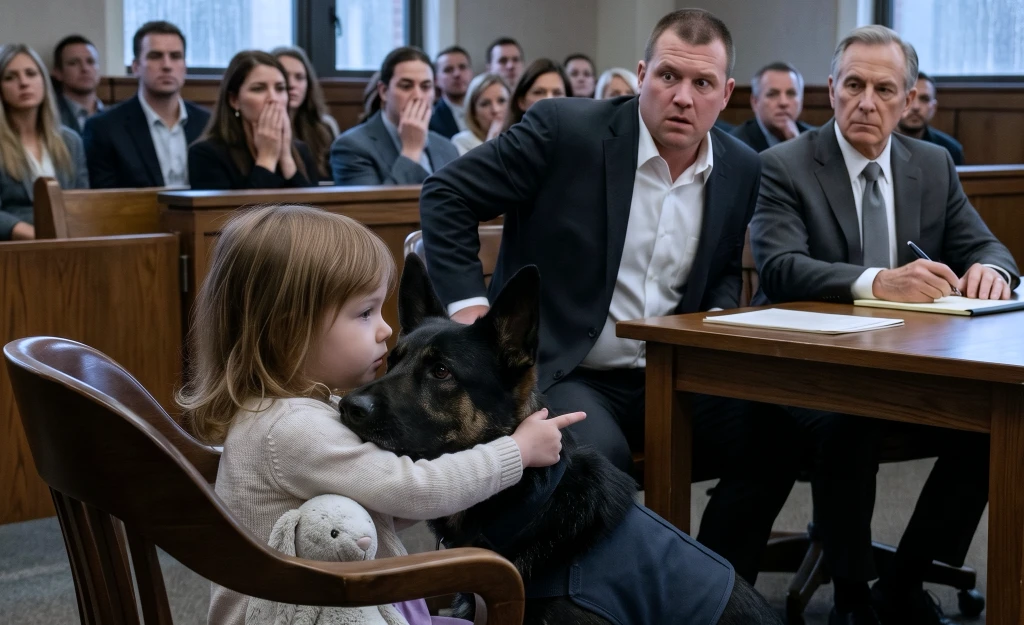
Outside, March rain darkened the stone steps of the Holloway County Courthouse. Inside Courtroom 2C, damp coats crowded the hooks, and a sketch artist kept brushing pencil shavings into an empty coffee lid. Oakmere had been talking about this trial for weeks. Now everybody wanted to hear a child who had given the adults around her almost nothing.
At the defense table, Owen Slater worked his thumb against the seam of his new suit trousers. Beside him, Grant Whitcomb laid out a pen, a legal pad, and his reading glasses in a straight line. He had already acknowledged two reporters with a slight inclination of his head. Owen hadn’t looked at anyone.
Bethany Mercer, Owen’s girlfriend, had been carried out of her apartment unconscious after an attack that left her fighting for her life. Ellie had been found in the same apartment.
Investigators had focused on Owen’s temper and the stretch of that evening he couldn’t account for. Dana had the injury reports, the apartment photographs, and a timeline to put before the jury. Ellie was the person who might be able to tell them what had happened inside.
Police and doctors had received no answers about the attack. Meera Shah, the foster mother who washed Ellie’s hair and checked her room at night, had learned to ask questions that could be answered with a nod.
Dana turned to the chair beside the witness stand. Someone had set a low footstool beneath it, though Ellie’s feet still wouldn’t reach. On the floor lay a folded mat for the other participant in the morning’s arrangements.
Judge Patricia Bell had required reports, separate hearings, and consultations before agreeing to let Ellie testify. Dana had attended them all. Nothing in those careful preparations had made the empty chair look like a place for a three-year-old.
The latch clicked at the side entrance, and the bailiff stepped back.
Meera came through holding a little girl’s hand. Ellie’s lavender dress had twisted slightly under her cardigan, and one sock had slipped toward the heel of her shoe. She carried a cloth rabbit called Pip, squeezed under her free arm so tightly that its long ears pointed behind her.
A German Shepherd followed them. Ranger wore a dark service vest, and his handler gave him enough leash to settle beside the witness chair. His nails sounded briefly on the floor before he reached the mat.
Ellie stopped where the aisle opened into the front of the room. Her gaze traveled up the high wooden bench, over the flags, and across rows of unfamiliar faces. Meera bent toward her, but the child was no longer watching the people.
She had found Ranger.
The dog had attended several of her therapy sessions. Ellie knew his ears, his breathing, the place under his jaw where the fur grew particularly thick. She released Meera’s hand and approached him, stopping just outside his reach.
Ranger lowered his head. Ellie knelt, put both hands into his coat, and leaned against his neck.
Dana had an entire folder of questions beside her. She left it closed while the child settled. Across the aisle, Grant glanced toward the jury, assessing what they were making of the dog.
Ellie whispered something Dana couldn’t hear. Then she raised her head and looked toward the defense table. Her fingers ceased moving in Ranger’s fur.
“He made Mommy hurt.”
Grant’s chair struck the rail behind him as he rose. He challenged the unsolicited statement, and Judge Bell immediately instructed the jury to set it aside. Dana kept her attention on Ellie, who had dropped her eyes to the dog again. From that angle, there was no telling which of the two men she had been looking at.
When the room settled, Meera helped Ellie into the chair. The child tucked one leg beneath herself and reached down until Ranger’s handler moved him close enough for her to touch his shoulder. Only then did Dana leave her table.
She stayed well back from the stand and crouched so Ellie wouldn’t have to look up at another adult.
“We used the crayons together once,” Dana said. “I’m Dana. If looking at Ranger helps, you can keep doing that.”
Ellie ran a fingernail around the edge of his tag. Dana waited, resisting the urge to offer a second question before the first introduction had even been accepted.
Dr. Victor Han had warned her about that urge. Adults could make silence into a demand without intending to. Ellie needed room to decide whether a word could safely leave her mouth.
“I already said it to him,” the child murmured.
“Then he’s had a chance to listen.” Dana let a moment pass. “Would you like to tell me any of it?”
Ellie bent toward the dog’s ear. The microphone caught a scrape of her cardigan, followed by two words.
“Too noisy.”
Someone shifted on a bench. Judge Bell looked toward the gallery, and the room became still again.
Dana asked where the noise had been. Ellie nodded toward the drawing space Dana had used with her before, then said, “Our kitchen. Mommy was crying. The table broke down.”
In the crime-scene photographs, one support had split and the tabletop leaned toward the floor. Dana had checked that Ellie hadn’t been shown those pictures. Meera hadn’t discussed the damage around her either.
“What do you remember next?” Dana asked.
Ellie worked a folded square of paper out of her cardigan pocket. She held it against Ranger’s muzzle for a moment, then reached toward Dana. Meera straightened on the front bench; apparently the paper was news to her, too.
Dana unfolded it at her own waist, keeping the movement small. A blue child crouched under a table. Above her stood a larger person with dark hair and red scribbles at the ends of both arms. Another object lay in separate pieces nearby.
“Tell me what you’ve made here.”
Ellie touched the blue figure first. “Me. Down there.”
“And this place?”
“Where we eat.” Her fingers returned to Ranger before she looked at the larger figure. “The shouting man.”
Owen was staring at his own hands. Grant watched Ellie with an expression Dana had often seen him present to vulnerable witnesses: grave concern, carefully measured.
He rose before she could ask anything else. A child’s drawing, he argued, could become whatever an adult wanted it to be. Dana answered that Ellie had brought it herself, without being asked, and that its layout included features independently documented in the apartment.
Judge Bell summoned them to the bench. After hearing both positions, she allowed the drawing to be marked for identification and gave the jury a caution about its limitations. Dana returned to the stand without enlarging the picture or inviting anyone to guess at the red marks.
For the rest of her questions, she let Ellie set the pace. A lamp had broken, and her mother had fallen and stayed on the floor. Ellie had hidden because making noise could bring more shouting. Between each fragment, she touched Ranger, sometimes putting the next words into his ear before allowing Dana to hear them.
Grant took his time crossing the room when his turn came. He stopped at a distance that satisfied the judge and smoothed the front of his jacket.
“I’m going to ask about remembering,” he told Ellie. “When you draw something, can it be something you’ve imagined?”
Ellie pulled Pip farther into her lap. Dana watched Grant keep his face pleasant while he waited.
“We also need to know whether you understand telling the truth,” he added. “Can you explain that for us?”
Ellie looked down. Grant prompted her again, and Dana stood to ask that the child be given time. Judge Bell directed him to wait.
The answer came eventually, directed toward Ranger.
“You say the real thing.”
Grant nodded as if they had agreed on something useful to him. He spoke about make-believe, about children getting mixed up, about the stories they told their toys. Ellie frowned. Her hand began pulling at the seam of the rabbit’s ear.
Ranger shifted his shoulder against her leg, and the fingers holding Pip loosened.
“Your dog wasn’t there when your mother got hurt,” Grant said. “He has no way of knowing what happened in that room, does he?” Ellie rubbed the short fur between Ranger’s eyes. “I was in the room…”
To read the rest of the story – CLICK the NEXT button 👇👇👇