


I tried to take a deeper breath. Pain stopped me halfway. My daughter, Hazel, was six weeks old. Her sitter had to leave at eleven, and Luke was hours away. Somebody needed to get to our house.
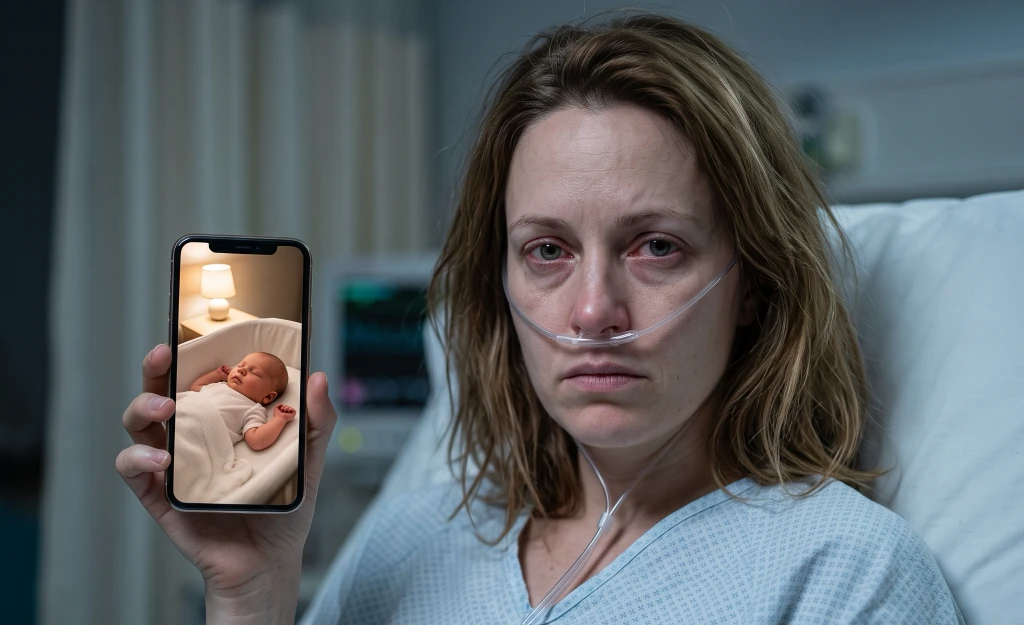
“Small ones for now,” the nurse said, adjusting the oxygen tubing beneath my nose. “We’ll work up to it.”
Above her shoulder, the curtain hung crooked on its track. My right arm had disappeared into a cast, and something taped to my side pulled whenever I moved. A truck had come through a red light on Trent Avenue while I was driving home from work. Three broken ribs, a collapsed lung, a broken forearm. Those were the injuries I could remember someone listing.
Luke’s voice came from the phone beside my pillow. He was in Minneapolis, trying to get onto a connection that would bring him home to Spokane.
“She can’t stay through the night,” he said. “She’s already stayed longer than she was supposed to.”
“Did you get Mom?”
He took a breath before answering.
“She says she can’t.”
A voice message Luke had forwarded arrived while we were talking. I played it with the volume low. Behind my mother’s voice, electronic bells rang, followed by a burst of recorded applause.
Luke had found her at Juniper Ridge Casino with her friends. She said she couldn’t help because Brooke was away on a cruise and somebody had to look after her cat.
“Brooke never puts us through anything like this.”
My mother lived twenty minutes from the hospital. My sister’s cat had food, water, and a heated house. Hazel had a sitter looking at the clock.
I reached for my phone. The nurse moved it closer before I could pull against the tube.
Before Hazel was born, Luke and I had interviewed an agency that supplied overnight newborn care. We’d saved the number and decided we could manage without the expense. I called it.
The woman who answered asked for our address, Hazel’s age, and whether she had any medical needs. I told her the baby was healthy, the sitter was still there, and I was the person who needed a hospital.
“Can you send someone tonight?”
She checked the schedule while I held the phone against my left ear. From the other side of the curtain came the squeak of a cart wheel and the sound of somebody opening a drawer.
“We have a nurse available. Your husband can give us access?”
“He can.”
I called Luke with the arrangements, and he gave the agency our door code. Less than an hour later, a nurse named Simone texted to say she’d arrived before the sitter left.
The next message was a photograph. Hazel lay on her back in her bassinet, one fist tucked beside her face. A clean bottle stood on the dresser behind her. Simone had turned on the little lamp we used for night feedings.
I enlarged the picture with my thumb. I could see the fine hairs along my daughter’s forehead.
The hospital nurse waited until I lowered the phone.
“Anybody coming to sit with you?” she asked.
“My husband’s on his way.”
“What about tonight?”
“I’ve got it.”
She studied my face for a moment, then checked the tubing again. I could tell she wanted to give me room to cry. I wanted her to leave the tray table within reach.
At thirty-four, I had become very good at arranging things other people preferred to leave to me. I could find a missing invoice, fix a budget, cover a bill, and make sure no one had to feel embarrassed about asking. Usually, by the time they asked, I’d already done it.
I grew up outside Cheney in a duplex where we kept towels along the bottom of the back door in winter. My mother called that place temporary for most of my childhood. My father worked, then got sick, then worked less, and there was always a payment that couldn’t wait.
After high school, I stocked shelves and closed a grocery store while taking classes at community college. A scholarship got me into a university finance program. I learned to eat dinner from a container over an open textbook and keep my work clothes clean without paying for the dorm laundry twice.
By thirty, I was a senior financial analyst in the downtown office of a large national company. When executives had a difficult meeting coming, they asked me to check the figures first. I liked following a problem until I understood it, being able to point to the place where things had gone wrong.
Luke and I married when I was twenty-six. We both worked, shared one used car, and paid our credit cards in full. For a long time, we said we’d have a baby when things settled down. Things kept finding reasons not to settle.
There was my father’s heart. There was the house my parents had moved into on property that had been in my grandparents’ family for years. Mom said they’d taken over a home loan along with it. I had never asked to see the deed.
Then there was my sister, five years younger, trying one more time to get her business going.
For nine years, four payments had left my personal account every month. Together, they came to $4,500.
Luke knew I helped my parents. I had never told him the monthly amount. I treated each transfer as its own obligation and kept them apart in my head: general support, housing, Dad’s treatment, Brooke’s allowance.
At twenty-five, when my father called about a hospital bill and couldn’t finish the sentence, I had been glad I could help. Each request after that arrived carrying some part of the first one. The fear in his voice made every later payment feel necessary.
I checked Hazel’s photograph again. Simone had sent a second message: the sitter was on her way home, and the baby had taken her bottle.
My daughter was safe. Luke knew where she was. The doctors were taking care of the things I couldn’t fix myself.
I opened the banking app.
Years earlier, Dad had added me to the family bill-paying account so I could help with his medical paperwork. I had access to its statements, although I generally checked that my deposits had arrived and left the spending to Mom. I had also authorized the bank to cover debit-card purchases when the balance ran out, a small cushion until the next deposit.
The account was nearly empty. Without that cushion, there wasn’t enough available to cover another substantial purchase.
I withdrew the authorization, then opened the scheduled payments.
Two thousand dollars in general support. Eleven hundred for the house. Nine hundred for Dad’s care. Five hundred for Brooke.
The date beside each one was October 1. I brought up the transfer history and let the app show me the sum I had spent nine years avoiding.
One hundred and eight months. Four thousand five hundred dollars each month.
$486,000.
I selected the first payment and confirmed its cancellation. The second took longer because my left thumb slipped and opened the details instead. I went back, checked the amount, and canceled that one too.
Dad’s medical transfer was third. For a few seconds, I held my finger above the confirmation button. I saw him standing at the pharmacy counter, waiting for a prescription. Then I looked at the receiving account.
There was no separate medical account. There had never been one.
I confirmed. Brooke’s allowance was last.
Four final taps, and the next month no longer belonged to them.
I waited for some feeling big enough to match the number. Instead, I noticed that I could unclench my jaw. My pulse kept its ordinary rhythm on the monitor.
Before I closed the app, I searched the family account for a payment I remembered from two years earlier. Mom had told me Dad’s surgery would cost $40,000. I found a transfer for that amount and opened the details, expecting a hospital or a specialist.
The recipient was my sister. In the memo field, my mother had written: Loan B…
To read the rest of the story – CLICK the NEXT button 👇👇👇