


The little sock had worked loose again. Nora Bennett found it beside the crib mattress, an empty curl of cotton no larger than the thumb of her winter glove.
She slipped it back over Eli’s foot. He didn’t pull away, didn’t kick against her palm. At six months, he should have been making a nuisance of socks. Instead, she tucked the yellow blanket around him and checked that none of the tubing had caught beneath the edge.
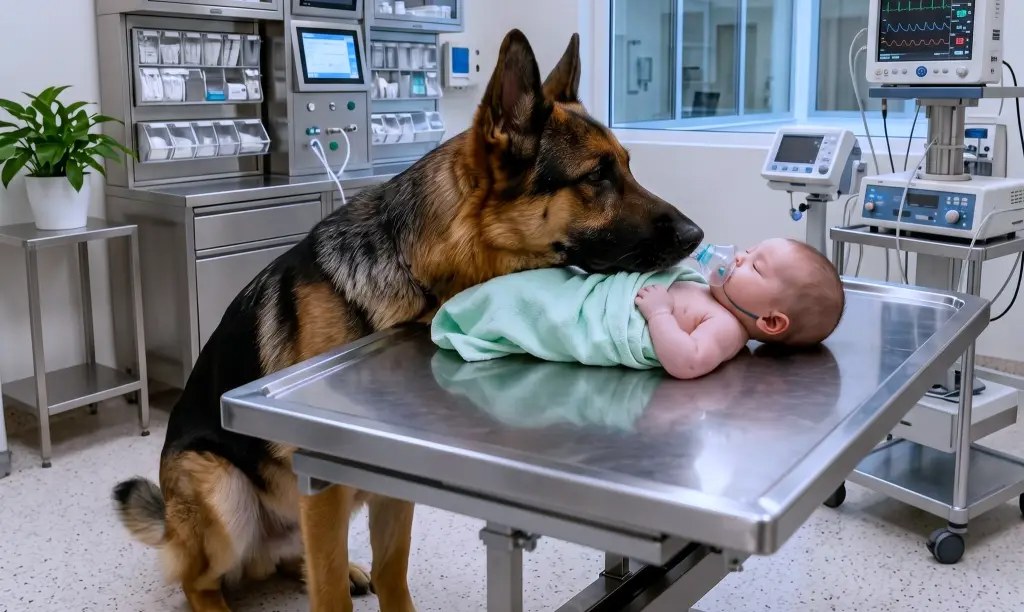
Three months in the pediatric intensive care unit had taught her where every line went. She could follow the feeding tube beneath his blanket without looking. She knew which sound belonged to the ventilator and which alarm might bring someone running. Sometimes a nurse would silence a harmless alert, and Nora would hear it for several seconds afterward.
Outside the window, the last week of August was turning chilly over northern Michigan. From this floor of the regional hospital in Veswick, she could see the upper deck of a parking garage and a strip of sky. She hadn’t been home long enough to notice whether anything in her yard was still alive.
“Your sock’s trying to leave without you,” she told him.
His eyes moved beneath their lids. The small cleft above his lip was hidden by tape, but she remembered it perfectly. At home she had kissed that spot whenever he fell asleep against her shoulder.
Ruth came in carrying the blood-pressure cuff wound neatly around itself. Her gray hair was clipped short, her shoes broad and plain. When newer nurses hurried, Ruth became more deliberate. Nora had learned to watch her instead of the monitor.
This morning, Ruth looked at Eli before she looked at the screen.
Nora drew her knees down from the chair. “Tell me what you’re seeing.”
“Let me get these readings.”
The cuff inflated around Eli’s thin arm. Ruth watched the result, made a note, then checked the infusion pump. She didn’t make the small conversation she sometimes offered about the weather or the cafeteria’s latest offense against breakfast.
“Is Dr. Mercer coming?” Nora asked.
“He’ll be here when rounds finish.” Ruth fastened the cuff to its hook. “I’m assigned right outside this morning.”
Nora nodded, though Ruth hadn’t answered the question she’d meant to ask.
After the door closed, she tried humming a tune she’d made up during Eli’s first weeks at home. There had never been proper words, only nonsense about his toes and his enormous appetite. She got through a few notes before her breath caught.
She leaned forward and rested her forehead against the crib rail.
Dr. Daniel Mercer brought a chair with him.
Until then, he had always stood beside the computer, one hand on the mouse, ready to move to the next patient. Nora watched him turn the chair toward hers. He settled into it slowly, with no chart between them.
“Don’t,” she said.
He stopped adjusting his sleeve.
“Whatever you’re going to say, don’t start that way.”
“All right.” His hands rested open on his knees. “Eli’s kidneys are struggling more this morning. We’re seeing more trouble with his liver, too. The infection hasn’t responded enough, despite the treatments we’ve used and the specialists we’ve brought in.”
“Bring in different ones.”
“We’ve reviewed his case with three other children’s centers. I wanted another answer as much as you did.”
Nora looked toward the crib. Two mornings earlier, someone had drawn a small upward arrow beside Eli’s blood-pressure reading. She could still see the ink.
“You said he’d improved.”
“For a few hours, he did.”
“Then there’s something that works.” She heard herself speaking faster. “There has to be. Find out what was different that night.”
Mercer rubbed the heel of one hand against his knee. “We can continue supporting his breathing and circulation. We can treat pain. But I no longer have a treatment I can honestly tell you will reverse what’s happening.”
Nora’s hand closed around the folded sock cuff.
“You want me to agree to let him die.”
“I want us to talk about keeping him comfortable. About whether another invasive procedure will help him, or only hurt him.”
Through the glass, a respiratory therapist rolled a machine past the doorway. Nora followed it with her eyes until it disappeared. Beyond that door, people still had tasks that could be finished.
“How much time?” she asked.
“I can’t give you an exact number.”
She didn’t ask again. The way he had moved his chair told her enough about the size of the number.
For a while she listened to the ventilator. She thought about the high chair still in its box at home, bought early because it had been on sale. Eli had never sat in it.
“Could Bruno come?”
Mercer looked up.
“The German shepherd. The therapy dog.” She set the sock straight on Eli’s ankle. “Before the visits stopped, he came every week. Eli watched for him. His pulse would settle. There are notes about it.”
“I remember.”
“Then let him come back.”
Mercer sat very still.
Nora turned to him. “You’re telling me you can’t make him better. I’m asking for twenty minutes with something he likes.”
“The animal program was suspended during the infection-control review.”
“Bruno didn’t bring Eli’s infection in here.”
“No. That isn’t what I’m saying.”
He reached toward the computer, then let his hand fall. Nora could see him considering whom he would have to call.
“Administration has tightened everything ahead of the foundation’s review this week,” he said. “I’ll speak directly to Dr. Kessler.”
“Don’t send her a message she can ignore.”
“I’ll go to her office.”
Nora loosened her grip on the sock. A narrow red mark crossed her palm where the rail had pressed against it.
Through the rest of the morning, she watched people pass the room. Ruth checked Eli’s lines. The respiratory therapist changed a connection. Somewhere nearby, a parent was crying behind a closed door. When the lunch tray arrived, Nora moved it onto the windowsill without lifting the cover.
Dr. Sylvia Kessler came after two.
Nora knew her by the way staff made room in the corridor. Kessler carried no medical equipment. Her tablet was tucked into a fitted gray jacket, and her badge identified her as the hospital’s chief administrative officer. Nora had seen her stop at rooms during tours, always angled toward whoever had come with her.
Today, she came alone.
“Dr. Mercer tells me you’d like an exception to the animal restriction,” she said.
Nora rose. Her legs had stiffened in the chair, and she steadied herself against its arm before answering.
“His handler will follow every cleaning requirement. They’ve done this before. They know this unit.”
“The suspension applies to the whole program.”
“He may not have another week.”
Kessler glanced toward Eli, then returned her attention to Nora. “I’m aware of his condition.”
Nora waited for something to follow that. Nothing did.
“He smiled at that dog,” she said. “I have a picture. I can show you.”
“That won’t be necessary.”
“It seems necessary to me.”
“We cannot make critical-care policy around individual requests, however understandable they may be. There are other vulnerable patients on this floor.”
Nora took a breath through her nose. She knew what happened when a mother raised her voice. People stopped listening to the words and began discussing whether she needed a break.
“Tell me what would make it safe enough,” she said. “A bath? A different entrance? Five minutes instead of twenty? I’ll do whatever you ask.”
Kessler shifted the tablet beneath her arm.
“The Bellamy family foundation is evaluating a grant for staffing, equipment, and the renovation of this wing. An avoidable incident during that process could jeopardize improvements that benefit hundreds of children.”
For a moment, Nora could hear only the pump beside her.
“You’re afraid someone will see him.”
“I’m responsible for this hospital’s standing as well as its safety.”
“My son has to spend whatever time he has left in this room. You’re telling me how the room needs to look.”
Kessler’s expression became more precise. “I’m allowing for the strain you’re under, Ms. Bennett. But distress cannot determine our procedures.”
Nora looked down at Eli. A dark tuft of hair had escaped the tape near his temple. She had washed it with a little cup of water while Ruth held the tubing out of the way.
“Have you ever sat where I’m sitting?” she asked.
“My personal life has no bearing on this decision.”
“That’s an answer.”
Kessler drew herself back from the crib. “The restriction will remain in place.”
She left with her tablet still tucked against her side.
Nora stayed standing until Ruth returned and put the chair behind her knees.
“Sit before you fall.”
Nora sat. Her mouth trembled, and she pressed her sleeve against it.
“I wasn’t asking for a cure.”
Ruth took the untouched lunch tray off the windowsill. She set it near the door, then came back to the infusion pump.
“No,” she said.
“He can’t understand any of this. He can’t know why I keep letting people hurt him.” Nora wiped beneath her eyes. “He knew that dog was gentle. That much he knew.”
Ruth checked the door’s narrow window.
“His handler’s a retired fire captain,” she said. “Frank Donnelly. He and Bruno did rescue work before the hospital program. Frank took the suspension hard.”
Nora lifted her head.
“I’m not permitted to hand out a volunteer’s private contact information.” Ruth straightened a label on the pump. “And I’d appreciate it if nobody suggested otherwise.”
“I wouldn’t.”
“My phone’s been giving me trouble. Screen stays open half the time.” She picked up the tray. “I’m going to leave it in the staff room while I get coffee. The little room across from the family restroom. Door doesn’t quite latch.”
Nora looked at her.
Ruth gave Eli’s blanket a quick smoothing stroke. “I’ll be at the desk for a quarter of an hour.”
A few minutes later, Nora found the phone beside a jar of plastic spoons. Frank Donnelly’s contact was open on the screen.
She copied the number into her own phone.
The latch on the family restroom door caught only after Nora lifted the handle. She checked it twice, then stood beside the sink and placed the call.
A man answered with a wary, gravelly hello.
“My name’s Nora Bennett. My son is Eli. You used to bring Bruno to see him.”
She heard a chair scrape at the other end.
“The baby with the yellow kites on his blanket.”
“Yes.”
“How is he?”
Nora watched water drip from the faucet into a brown stain around the drain. She told Frank about Mercer’s chair, the worsening lab results, the request and the refusal. Once she started, she couldn’t leave anything out.
“I don’t expect him to do anything,” she finished. “I just want Eli to have his friend.”
Frank was quiet long enough that she braced for an apology.
“Can you get outside tomorrow afternoon?” he asked. “We ought to talk where you can breathe…”
To read the rest of the story – CLICK the NEXT button 👇👇👇