


Louise Bennett turned the sign in the window before I had taken three steps into her shop. I stopped beside a rack of linen jackets. It was Thursday afternoon, and Bellamy’s never closed before six. Through the glass, people were still moving along the Devon sidewalk with shopping bags and iced coffees.
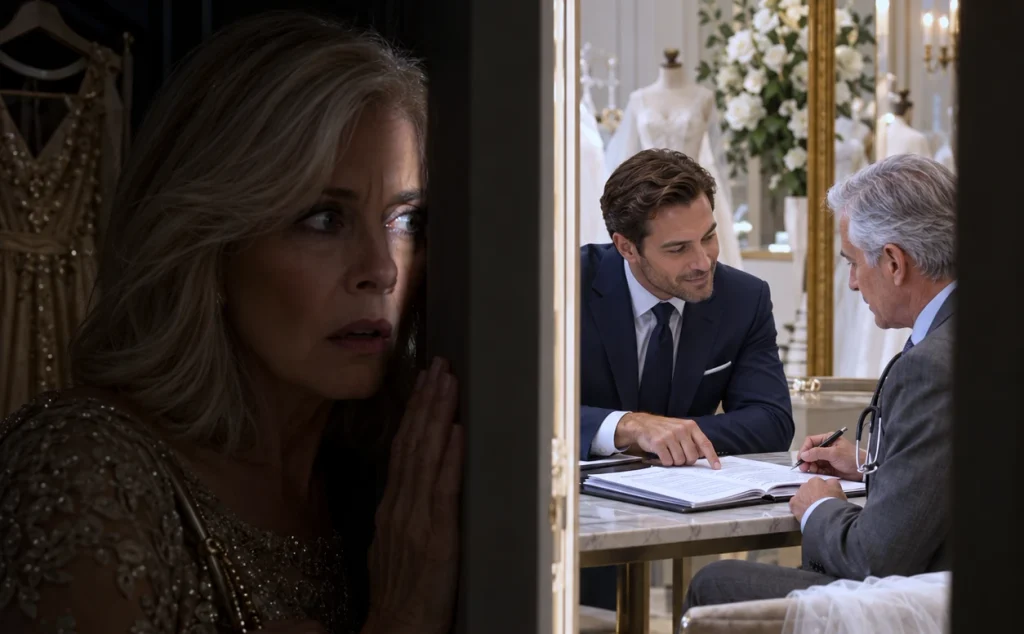
Louise tested the lock twice.
“Did I come at a bad time?”
She looked at the garment bag hanging behind the counter, then at me. A pin was caught in the cuff of her sleeve. Her fingers worried at it without managing to pull it free.
“Elaine. Come with me.”
I had known her since we were nineteen. She had fitted the dress I wore when I married Arthur in 1983, kneeling at my feet with pins between her lips while I worried about the weather. Three months earlier, she had stood beside me while my daughter turned in front of the fitting-room mirror, delighted with the way her wedding gown moved.
Today I had come for my own dress. Pale gold, modest neckline, sleeves Louise had insisted on adjusting herself.
Natalie’s wedding was in two days.
Louise took my wrist and led me past the alteration counter. When I began to ask what was wrong, she pressed one finger to her mouth. We went through a narrow passage and into a small fitting room used for private appointments.
She closed the door without letting the latch snap.
The room held a padded stool, a full-length mirror, and three empty hooks. Louise switched off the light, leaving us with the dim glow coming through the frosted transom.
Then I heard Grant Sutton.
“The signature needs to happen after the dance,” he said. “She’ll be relaxed by then. Let her see the gift letter first. The revised authority is farther back, on the seventh page.”
I knew that voice well. Grant used the same smooth confidence with clients, servers, and anyone whose hesitation he wanted to remove.
He was marrying my daughter on Saturday.
“Couldn’t we handle this another way?” Natalie asked.
I put my hand against the wall.
“Your mother listens to you,” Grant said. “We’ve been over that. If you explain it, she’ll cooperate.”
A third man spoke, slower than the other two.
“There’s sufficient documentation. Five episodes over the last quarter. The capacity provisions won’t be difficult to support.”
Dr. Philip Hargrove.
I had been his patient for five years. He had treated Arthur long before that, and after my husband’s death he had checked on me with such apparent kindness that I had never questioned the place he occupied in our lives.
“The trust worries me,” Natalie said. “Dad’s trust alone is fifteen million.”
“You’re thinking beyond what you need to sign,” Grant replied. “The portion we discussed is the portion you should be concerned with.”
Something rustled. Natalie said she needed to collect her veil from the front of the shop. A chair moved, and footsteps crossed the adjoining room.
I waited for her to return.
Instead, Grant spoke again, his voice lower.
“The company interests and the trust assets together are worth forty-seven million. Once the assignments go through Northcross, we can finish moving the proceeds.”
“And the permanent assessment?”
“Monday morning. Eight.”
Hargrove gave a small, businesslike cough.
“Placement should follow within a few months. Brookhaven can accommodate her quietly. We don’t want her making a scene before everything is settled.”
Louise’s fingers closed around mine.
I stared at the faint outline of my reflection. My mouth was open, but I could not draw enough air to speak. On the other side of the wall, two men were arranging the removal of my life, while my daughter waited somewhere beyond them in the dress she would wear to promise herself to one of them.
The men stood. Grant said something about seeing Hargrove at the rehearsal dinner. Their voices grew faint, followed by the sound of the front door opening.
Louise stayed still until the shop was quiet. When she turned the light on, she could barely look at me.
“They met here last Thursday,” she said. “June sixth. Natalie had an appointment. I heard enough to know it wasn’t right, but I kept telling myself I must have misunderstood.”
“Why were they here again?”
“He said they needed somewhere private before the final fittings. I put them next door. Then you came.”
She finally freed the pin from her sleeve and dropped it on the stool.
“I should have called you.”
“You brought me in here.”
“That doesn’t make up for waiting.”
I stood in the little room with my purse still on my shoulder, trying to understand what I would do when I stepped outside.
“Could I have my dress?”
She searched my face. “Elaine, you heard them.”
“I need to leave with what I came for.”
Louise nodded. In the front room, she fetched the garment bag and carefully zipped it. Before handing it over, she opened a drawer beneath the register.
“I took a picture of a page they left on the table last week. I didn’t know what else to do.”
“Send it to me.”
She did. My phone vibrated in my purse.
At the door, she caught my sleeve.
“What happens now?”
“I haven’t decided.”
Outside, a commuter train was pulling away from the station. Someone was laughing at the café on the corner. A woman waited at the crosswalk with a little dog tucked under her arm.
I carried the dress to my car.
The hanger caught on the seat belt as I laid the bag across the back seat. I untangled it, smoothed the plastic, and closed the door. Then I sat behind the wheel.
On Saturday I was supposed to walk Natalie down the aisle. I had chosen the flowers with her, approved the menu, argued gently over whether we needed another table for Grant’s colleagues. I had written a speech about the privilege of watching a child grow into a woman.
After the first dance, they intended to hand me papers.
By the time I understood what I had signed, my daughter would have control of the company, Grant would have control of her, and my doctor would have supplied a medical explanation for why nobody should listen to me.
I pressed my palms against my knees until the trembling eased.
Arthur had died on June 10, 2009, five days before Natalie’s twentieth birthday. He had been fifty-two. One moment he was working at his desk; the next, a heart attack had ended every plan we thought we had time to make.
I had married him at nineteen. He was twenty-six, already serious about business and still capable of making me laugh in the middle of an argument. By the time I lost him, we had been married twenty-six years.
At the funeral, Natalie’s hand had remained in mine through the entire service.
“We’ll manage the next day,” I told her afterward. “Then we’ll manage the one after that.”
Whitaker Advisory had been in trouble before his death. Afterward, lenders began asking questions they had never asked while Arthur was alive. We owed close to eight hundred thousand dollars, and several clients were preparing to leave.
The advice was unanimous: sell what remained.
I stayed.
For years, I worked whatever hours the company required. I learned which contracts could be renegotiated and which expenses had become habits. I made calls from hospital waiting rooms, grocery-store parking lots, and Natalie’s college campus.
She graduated in 2011 and joined us as an analyst.
I refused to hand her a title she hadn’t earned. She took the difficult accounts, stayed late, and learned the work from people who were not inclined to flatter the owner’s daughter. By 2014, our revenue had reached twelve million dollars. Five years later, it was twenty-five million.
Natalie became vice president of operations.
That was also the year Wesley Drake asked me to marry him.
He was an architect, a thoughtful man who had known Arthur and respected the life I had built after him. Over dinner, he told me he had spent three years waiting for me to notice that his interest in me went beyond friendship.
I turned him down.
Natalie was furious when I told her.
“You can’t keep living inside the office, Mom.”
“I have a life.”
“You have responsibilities. That’s different.”
I remembered answering that I had her, the company, and work that mattered to me. At the time, those things had seemed sufficient.
In 2020, I made her chief operating officer. She was thirty-one and had spent nine years proving that she could do the job. Leonard Price, Arthur’s college roommate and our longtime senior vice president, asked whether I was certain.
I told him to look at her work. He did, and he supported the appointment.
Grant arrived in January 2022. Natalie brought him to a board meeting as an outside financial consultant. He had an MBA from Chicago and twelve years with Ralston Partners. He was prepared, persuasive, and quick enough to answer Leonard’s hardest questions without losing his smile.
I hired him as chief financial officer in March. By June, he and Natalie were dating. In December, they were engaged.
After that, his suggestions began arriving in the language of concern.
Let Natalie take the next trip. Let somebody else review the details. Surely, after everything I had done, I deserved an easier life.
When I spoke in meetings, he sometimes rested a hand on her shoulder. I had read it as affection. Sitting outside Louise’s shop, I remembered how often the gesture came immediately after Natalie disagreed with me.
The previous November, she had interrupted a financial presentation.
“We already covered that, Mom.”
I checked my notes. I was almost certain we hadn’t, but her expression made certainty feel rude.
In January, a client’s name escaped me for a few seconds. Natalie supplied it. Grant waited until afterward to suggest that I make an appointment with Hargrove.
In March, I arrived fifteen minutes late to a meeting because the time had been entered incorrectly on my calendar. Grant was waiting outside the conference room.
“People are starting to notice,” he said.
I had begun writing down everything. I checked dates twice, then checked whether I had checked them. A moment’s distraction had become evidence against me before I could decide what it meant.
A driver behind me tapped his horn. I had been sitting with the engine off for nearly half an hour.
I started the car and drove home.
Arthur and I had bought our house in 1995, when the company finally made enough profit to let us imagine a life beyond keeping it afloat. The slate roof, broad porch, and old stone walls had appealed to him at once. We brought Natalie’s oak tree with us, transplanting the sapling he had planted when she was born.
It had survived the move better than we had expected. Now its branches reached beyond the porch roof.
Beatriz Ortiz was setting the dining-room table when I came inside. She had worked for us since Natalie was fifteen and knew the house well enough to recognize an unsettled day by the way I put down my keys.
“Did Louise finish everything, Mrs. Whitaker?”
“Yes. She did.”
I lifted the garment bag so she could see it, then carried it upstairs.
Back in the living room, the reception seating plan occupied most of the coffee table. I found Hargrove’s name at table twelve. For a moment, I considered tearing the card in half.
Instead, I sent Natalie a message.
Only two days now. I’m looking forward to being with you. Love you.
Her answer came quickly.
Love you too, Mom. Saturday can’t get here fast enough.
I put the phone facedown.
Beatriz asked whether I wanted dinner served early. I told her the usual time would be fine. We discussed the delivery of the wedding flowers, and I helped move a stack of place cards out of the way.
At six, my phone lit up again.
This time it was Leonard.
I need to show you something. Several transfers in the second-quarter records carry Grant’s approval. I can’t account for them.
I read the message twice, then answered. Tomorrow. Don’t discuss it with anyone else yet…
To read the rest of the story – CLICK the NEXT button 👇👇👇