


Claire Donovan could feel the lift shudder through the tires of her chair. The driver raised it a few inches, tried again, and finally brought the platform level with the wet curb.
“Easy does it,” he called over the rain.
She waited for the gate to open. Her sketchbook lay beneath both palms, protected by the front of her coat. When the lift stopped, she tucked it farther inside and pushed toward the school entrance, keeping clear of a puddle where runoff had buried the yellow curb paint.
Her hood slid sideways. She pushed it off her face and let the rain hit her hair.
At nine, Claire knew the trouble a little water could cause. Wet rims needed a firmer grip. A threshold that looked flat might catch a front caster. Grown-ups sometimes took hold of her chair as though handles were an invitation.
She’d used a wheelchair since she was four. Her father had taught her to ask for help when she wanted it and to say something when she didn’t. He also said nobody should mistake an inaccessible doorway for a failure on her part.
Alderwick sat below the wooded foothills in western Washington, where school buses passed horse pastures on their morning routes. Rain had followed them into town for days. Inside the school, shallow trays stood beneath a bench crowded with wet boots, and the custodian was mopping a trail of footprints toward the office.
Claire kept one arm pressed against her coat until she reached her classroom.
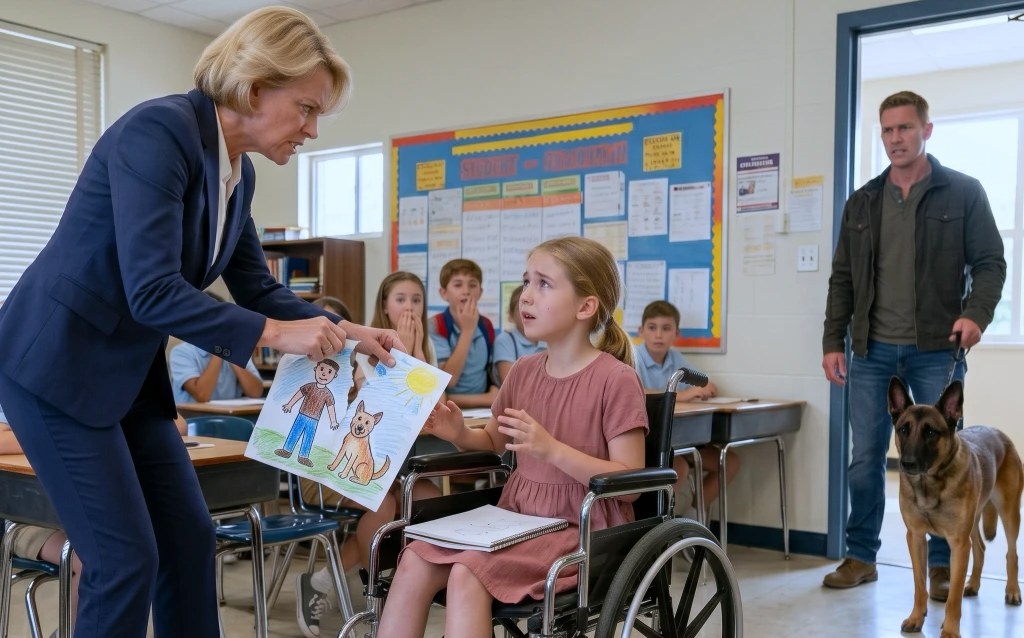
The picture had taken her four days. She’d ruined the first version on Thursday, bearing down too hard while trying to fix her father’s jaw. On Sunday night she’d decided that further improvements would probably make everything worse.
His face still looked a little too square. Kestrel’s ears took up more room than they ought to. But her father was looking at the dog the way he really did, with his whole attention, and Kestrel stood close enough that their outlines nearly touched.
For two weeks, the third graders had been working on presentations about someone they admired. Mrs. Patricia Haskett had told them to choose an actual person and get their facts right. Claire had known her subject before the teacher finished explaining.
She slid the sketchbook facedown onto her desk. Her place was beside the windows, with turning room at the end of the row. The desks surrounded an open carpeted space where the speakers would present.
Jonah Pike was arranging small medals beneath a photograph of his grandfather. Across the room, Simone Okafor kept opening and closing the cardboard doors on a display about her mother’s job at the hospital. Lucas Baird had brought a report with a glossy cover and a plastic binding. Usually he needed reminding that an assignment existed.
Claire rubbed a pencil stain with her thumbnail and waited.
Mrs. Haskett used the edge of a ruler against the whiteboard to quiet the room.
“Everything else can wait while a classmate is speaking. I expect the preparation you’ve done to show.”
Jonah went first. His grandfather had served in the navy, and Jonah knew the names of the ships almost without checking his notes. Mrs. Haskett started the applause when he finished.
Simone described her mother leaving a holiday dinner to answer a call from the emergency department. The dinner had already been in trouble before the telephone rang. As Simone explained this, one of the little doors swung open and knocked another one loose. She caught it against her sleeve, laughing with the class.
Lucas’s subject was a baseball player. Claire understood the fancy report then. Baseball was one thing Lucas never seemed to forget.
She listened to how loudly they spoke and where they paused. Dad called that reading the room. It helped to know what kind of attention people were giving before you asked for some yourself.
Mrs. Haskett turned toward her desk.
“Claire, let’s have yours.”
She backed away from the windows, crossed to the open space, and raised the drawing. At home she’d practiced getting it high enough without hiding her mouth behind it.
“I chose my dad, Daniel Donovan. He works with military dogs. This is his partner, Kestrel.”
She angled the book toward Jonah’s side of the room.
“Kestrel’s a Belgian Malinois. He and Dad have worked together for six years. They search for missing people, among other things. Some of their work can’t go in my report.”
Lucas stopped fiddling with his binder.
“A scent can still be there after three days. Longer sometimes, depending on what’s happened to it. I’ve seen one of their timed exercises. Kestrel searched a little building in under four minutes. They’ve found children who’d been missing several days.”
Mrs. Haskett’s chair creaked as she leaned back.
“Let’s stop there.”
Claire held the book steady.
“A story can be impressive without being factual,” the teacher said. “That’s why we talked about checking what you bring into class.”
“I checked it with Dad.”
“Claire, trained dogs aren’t the dogs you see in action movies.”
“I watched the exercise. There was a timer.”
The teacher held out her hand, but Claire hadn’t finished speaking.
“If you want, he could tell you about—”
“You were responsible for bringing reliable information today.”
Mrs. Haskett got up and took a thick red marker from the supply shelf. Claire watched her pull off the cap. She’d seen that marker used to label bins and make signs for the classroom door.
“This is his job,” Claire said.
The teacher lifted the book out of her hands. Claire’s fingers closed after it was gone.
Across the cover, Mrs. Haskett wrote two large words.
NOT FACTUAL.
A laugh came from the back of the room. One quick burst, then silence.
“You owe your classmates an apology for making up information.”
Claire brought her hands down to her lap.
“I told the truth.”
Mrs. Haskett dropped the sketchbook into the recycling bin beside the board. It landed on a heap of old math pages.
“Jonah, we have a few minutes. Perhaps you can explain another of your grandfather’s medals.”
Jonah looked at Claire, then at his display. He began speaking so softly that the teacher asked him to use his presentation voice.
Claire turned around and returned to her desk.
From the windows she could see a corner of the sketchbook above the rim of the bin. The cover had bent backward. She couldn’t work out which way the drawing was facing.
On Saturday evening, Dad had called over a connection that kept breaking apart. For a while she’d heard only scraps of his voice and wind hitting the microphone. When the sound cleared, he’d asked whether she needed an audience for her project.
“I don’t need the cards anymore,” she’d told him.
“Already putting me out of a job?”
She remembered laughing at that.
Now she pressed her hands down on her thighs. If she stayed very still, perhaps nobody would see what she was trying not to do.
Fractions filled the board. Then a reading worksheet appeared on her desk. At lunch, the space beside her remained empty after the other seats were taken.
A boy across the table asked, “Was any of it real?”
Claire peeled back the wrapping on her sandwich.
“Which part?”
“Your dad doing army things.”
“Yes.”
“Then why’d she say you made it up?”
“You heard what I heard.”
He looked away. Claire took a bite and watched the parking lot through the cafeteria glass. Rain collected in the tire grooves beside the parked buses.
Her book was still in the classroom bin. She could have gone for it. She kept imagining the trip across the carpet, everyone watching while she reached down into the discarded paper.
She didn’t go.
By the afternoon, children she didn’t know were talking about it. Outside the office, two older boys disagreed over whether she’d been punished. A girl passing the water fountain said somebody had invented a father who was famous.
Claire’s emergency phone vibrated in her bag. Dad had been held up at work. Aunt Ruth would collect her.
She waited beneath the entrance canopy, out of the main flow of children. A change in pickup plans didn’t require any thinking. That happened all the time.
Ruth arrived with the heater on and space cleared for the chair. She steadied the frame while Claire transferred, then folded it into the back.
They had gone a block before her aunt said, “That’s quite a face you’re wearing.”
“I’m not wearing anything.”
“Then it must be your regular one.”
Claire watched a leaf cling to the passenger window.
Ruth drove a little farther. “Today was the project, wasn’t it?”
“Yes.”
“How did it go?”
“It’s over.”
Her aunt waited through a traffic light.
“You don’t have to save everything for when your dad gets home. He keeps his phone for a reason.”
“I know where his phone is.”
Ruth glanced over, then let the subject rest. At the next intersection she waited for a delivery truck to finish backing into a narrow lot.
At home, Claire unpacked the things she had brought back: homework, library book, lunch container. She put them where they belonged. There would be a spelling test to discuss. She could ask about Kestrel’s hip. Dad didn’t need another problem after a long day.
He came through the garage a little before eight, boots dangling from one hand. He left them on the mat, kissed her hair, and washed up. Kestrel was staying at the unit for a planned veterinary check.
For a while, supper went exactly as Claire had intended. Dad told her about a program he’d been listening to on an old naval campaign. She described her library book. He made tea, giving hers less time to steep and adding honey before he set it beside her.
Then he noticed the school things on the counter.
“I was promised a picture,” he said.
Claire turned her cup by the handle.
“It stayed at school.”
“On display?”
“No.”
He brought his plate to the table but didn’t pick up his fork.
She could hear the kettle cooling on the stove. Dad sat across from her, leaving her the space to answer. After a while, she couldn’t look at the cup anymore.
“Mrs. Haskett said I was lying.”
He didn’t interrupt while she told him. When she reached the part about the recycling bin, he moved his mug farther from his elbow.
“And that was in front of everyone?”
Claire nodded.
“Did anybody say anything?”
She told him about the laugh. Her voice gave out before she finished.
Dad got a fresh dish towel from the drawer and put it in her hand. He didn’t hurry her or tell her she’d had enough crying. She held it over her face until she could swallow without hurting.
“Tomorrow morning,” he said, “I’m coming inside with you.”
“Please don’t turn this into something.”
He waited until she looked at him.
“She already did.”
Then he pulled his plate closer to hers. “We’re going in together…”
To read the rest of the story – CLICK the NEXT button 👇👇👇