


Ada Mercer had almost finished emptying the stove when she heard it. The ash scoop hung above the bucket, spilling a thin gray trickle onto her boot.
She waited. Beyond the kitchen door, wind worried the loose screen on the porch. Then came another cry, low and scraped raw, from somewhere beneath the floorboards.
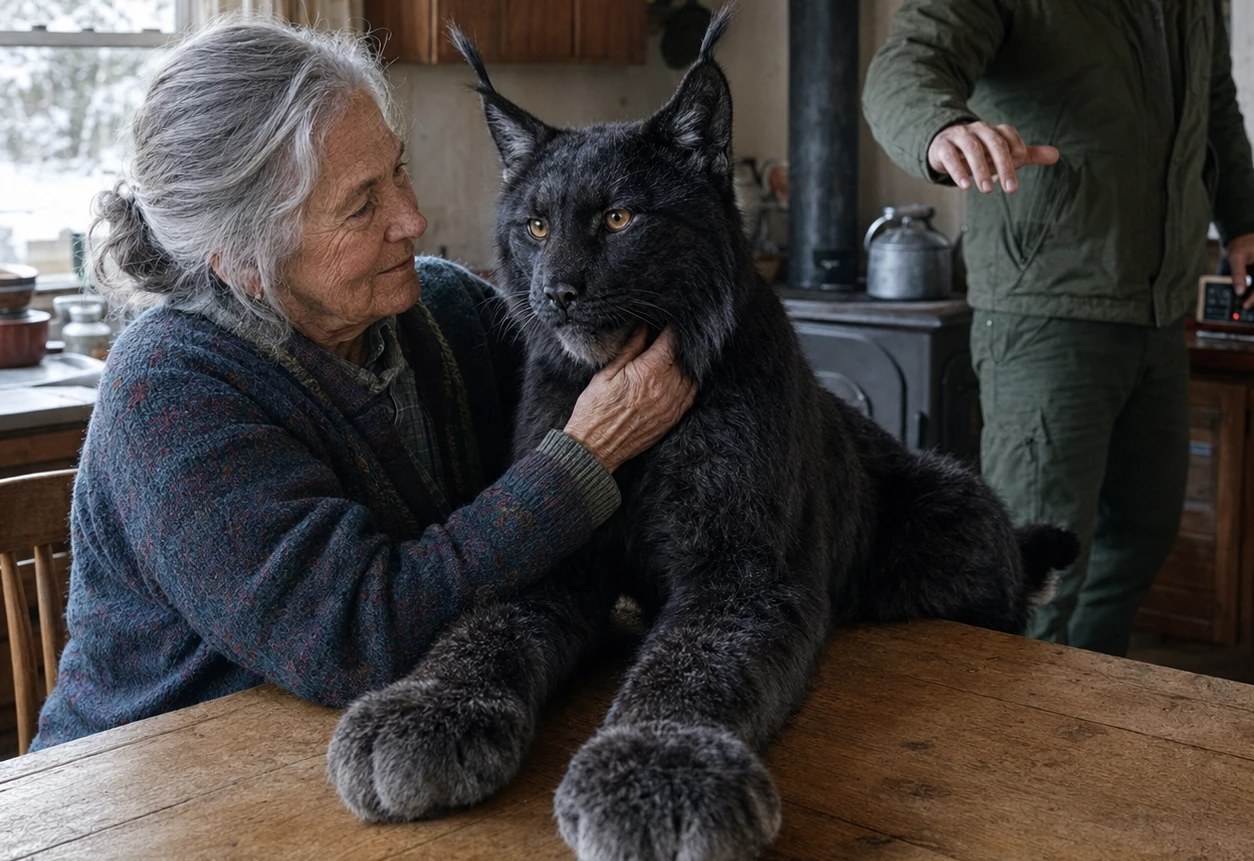
At eighty-five, Ada needed a lamp to thread a needle and daylight to read the labels on her medicine. Her hearing still served her. Thirty-one years behind the wheel of a school bus had taught her which noises could wait and which ones meant she ought to pull over.
She put the scoop down.
“Keep that up. I’m coming.”
The electricity had failed while she was cutting potatoes for supper. Now the only light in the kitchen came through the stove door, and snow was blowing sideways across the window. She found her flashlight by touch, pulled on her mittens, and went outside.
Getting down beside the porch required more planning than it once had. She braced a hand against the bottom step, lowered one knee, then the other, and directed the beam through a broken section of lattice.
Two eyes reflected back. Below them was a small black muzzle, motionless except for the trembling whiskers.
Ada removed a mitten and reached into the opening. The animal neither struck nor retreated. Ice had fastened its fur into hard little ridges. Beneath that coat she felt ribs, an empty belly, and scarcely enough strength to hold its head up.
Its feet were too big for the rest of it. Its tail ended almost as soon as it began.
“Well, they shorted you on the tail.”
She worked her other hand under its chest and drew it free. Long back legs dangled against her wrists. The pointed ears had small wet tassels, but she had seen plenty of large, peculiar barn cats in her time. A longhaired father could account for some of that. So could a rough beginning.
Inside, she lined a wicker laundry basket with towels and set it beyond the hottest reach of the stove. Walter had always insisted that a chilled creature needed time, not a roasting. She fetched his old green wool overshirt from the chest in the bedroom and folded it around the animal.
For a while she did nothing but sit nearby. When the shivering changed, she dampened its gums with warm water. Only after it could raise its head did she offer tiny pieces of cooked chicken from the refrigerator.
The first piece fell from its mouth. The second disappeared.
Ada brought her chair closer.
There was no ordinary kitten chatter. The sound beneath her hand was rough and sustained, so faint she could feel it through the wool more clearly than she could hear it. Each time she began to doze, she checked for it again.
Dawn found her with one slipper against the basket and her neck bent painfully to one side.
The animal was watching her.
“Well,” she said, straightening slowly. “You’ve outlasted the lights.”
Snow had closed the spur road. The telephone had gone dead sometime in the night. In the quiet kitchen, the little black face followed every movement she made, from the stove to the sink and back again.
She named him Nook. He had found the smallest sheltered place on the property, and it was a name she could say without raising her voice.
Walter had been dead seven years. Their tabby had lived two years longer, sleeping through most of his last winter in Walter’s chair. For five years afterward, Ada had come home to rooms exactly as she had left them.
That morning she took down a second dish.
The plow arrived the following afternoon. Ada heard the blade well before she saw the truck, a long scrape followed by the rattle of tire chains. Gordon Voss backed into the yard far enough to leave her a walking path to the woodshed.
At fifty-eight, Gordon could put that truck into spaces Ada would not have attempted with her old station wagon. He brought a bag of salt to the porch and stood looking over her shoulder while he asked what she needed from Darsen.
“Nothing worth another trip,” she told him.
“Something was carrying on out here during the storm. You hear it?”
“The porch makes plenty of noise.”
His gaze dropped to the snow beside her boots. Nook had ventured out that morning, gone no farther than the steps, and returned indignantly to the kitchen. His round prints remained plain in the fresh powder.
“Your porch has feet?” Gordon asked.
Ada took the salt. “You charging extra for questions now?”
He gave a short laugh. Before climbing into the cab, he mentioned that something had been nosing around his rabbit hutches over on the next road.
She stood outside until the truck cleared the bend.
By then the telephone worked again. The veterinary clinic’s number was written inside the cupboard door, beneath the plumber’s. Ada looked at it while she put the salt away.
If Nook seemed worse, she would call.
He did not seem worse.
Within a week and a half, he was reaching the top of the tall kitchen cupboard in a single spring. Ada watched him do it with her dishtowel still raised. His hindquarters gathered, his paws left the linoleum, and suddenly he was looking down at her from beside the canning jars.
She made him a litter pan from an old basin. He used it, though he never troubled to cover anything. Little toys she sewed from Walter’s socks came apart between his feet. At the window, the sight of a snowshoe hare brought a short, breathy sound from his throat and a stillness that lasted until the animal vanished.
On Sundays, Denise called from Duluth, where she ran a hospital pharmacy. Her questions came neatly arranged, as if Ada were one more prescription requiring a final check.
“Tell me the road’s open.”
“Gordon’s been through.”
“And the power?”
“I’m looking at a lamp, Denise.”
“Good. How about the emergency pendant?”
Ada glanced at the unopened box beside the flour canister.
“It hasn’t wandered off.”
Her daughter let that pass. “I’m trying to get a weekend clear after Thanksgiving.”
“Then get one clear. Don’t come up with your coat half on to leave again.”
A metal bowl fell from the counter. Nook followed it to the floor, batting it under the stove.
“What just happened?” Denise asked.
Ada pressed her free hand against the countertop. “My elbow caught a bowl.”
She shortened the rest of the call. Afterward, she retrieved the bowl with the poker and held it while Nook rubbed his cheek against the table leg.
By Christmas, he weighed about twenty-one pounds. Much of him seemed to be legs and feet. His winter coat had developed a pale underfur that showed when he stretched, and his face had widened beneath a thick ruff. The ear tassels no longer admitted any comfortable explanation.
Ada had stopped calling him a kitten, even to herself.
Ada had baked the anise cookies Denise used to steal from the cooling rack. They were waiting in a closed tin on the counter on Christmas Eve when her daughter arrived with groceries and a battery lantern.
But Denise stopped in the mudroom, looking at the marks around the door.
She ran one finger near a set of deep scratches. “What’s been trying to get through here?”
“Old frame. It sticks.”
“Those aren’t weather cracks.”
“Put the cold things away before you inspect the rest of the building.”
Denise turned toward the hall.
Nook stood at its far end. He had come out without a sound, and now his ears angled toward the visitor. Denise stopped with the grocery bag against her hip.
He approached slowly, passed close to Ada’s skirt, and stopped in the space between the two women.
“Don’t move toward him,” Denise said.
Ada reached down. Her fingers settled into the thick fur behind his jaw.
Denise stared at that hand. “How long?”
“Since the big storm.”
“More than five weeks.” Her grip tightened around the paper handles. “All those calls, and you let me think—”
Nook’s ears flattened. The growl was quiet, but Denise stopped speaking.
Ada moved her fingers once against his neck. He fell silent.
“You can lower your voice,” she said. “He doesn’t know you.”
“Mom, he’s wild.”
“He was nearly frozen.”
“You should have told me.”
“So you could start on where I ought to be living?”
Denise looked at her, then lowered the bag too quickly. Glass broke inside. Applesauce seeped through the bottom and onto her boot.
For a few seconds, neither woman spoke. Denise carried the leaking bag to the sink and began picking out the unbroken jars.
“Keep him away from the mudroom,” she said at last. “I need some air.”
Through the kitchen window, Ada saw her daughter beside the car, holding a phone. She stood with her back to the wind and one hand clamped around her opposite elbow.
When she returned, she said she had booked a room in town. The weather was getting bad again.
“Suit yourself,” Ada said.
Denise left the lantern on the table.
Another vehicle came up the spur on Christmas morning. Ada recognized the state truck before Ben Sutter got out. She had once stopped her school bus because a frog had escaped from his lunch tin. He had spent the rest of that ride insisting it had climbed in by itself.
At forty-five, with gray showing above his ears, he approached her porch wearing the expression she remembered from that day.
“I’m not here to argue with you,” he said when she opened the door.
“That makes one of us. Denise called.”
“She asked for help figuring out what’s in your house.”
“You could have telephoned.”
Ben wiped his boots and waited. After a moment, Ada let him inside.
Nook stepped out from behind a kitchen chair.
Ben’s hand started toward his radio, then stopped. He lowered it to his side and turned slightly, presenting less of himself to the animal. For several seconds he said nothing at all.
His eyes moved from Nook’s broad feet to his ears, then to the short tail.
Ada’s hand found the ruff before Ben could caution her.
He looked up at her. “Ada. You’ve got a Canada lynx in here.”
“I’d figured that much…”
To read the rest of the story – CLICK the NEXT button 👇👇👇