


Nora saw Audrey watching her in the dark curve of the piano lid. She tucked her hand beneath her thigh, but Ms. Hensley had already turned from the music stand.
“Apparently someone in the back row has been rehearsing along with you.”
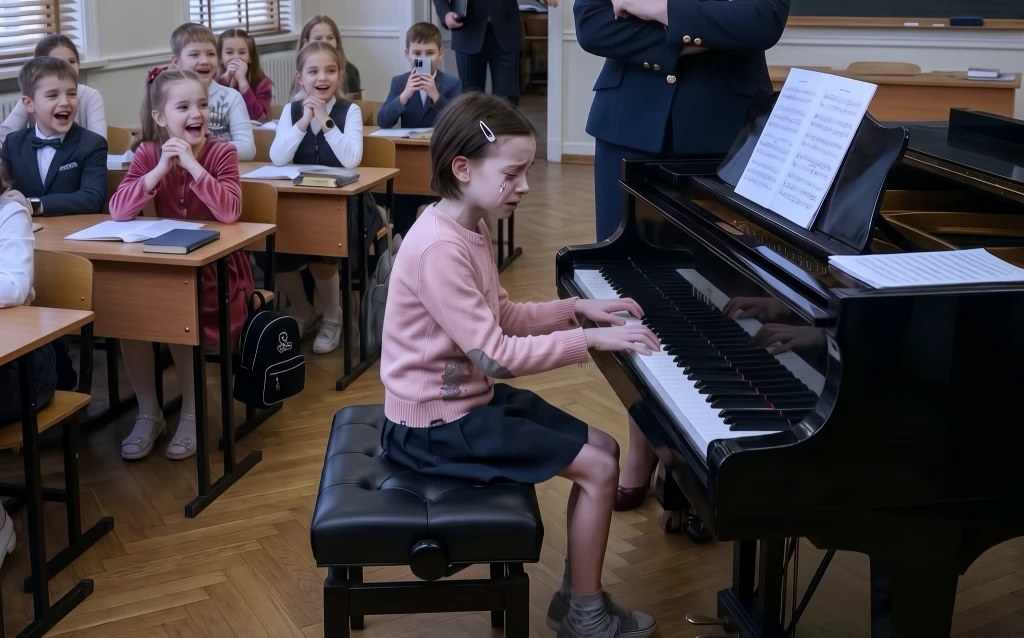
Audrey’s final chord was still sounding. She pulled her hands into her lap as the teacher caught one end of the bench and shifted it across the tile. Twenty-four children looked toward Nora.
“I was just moving my fingers,” Nora said.
“Whenever I play,” Audrey said. “You always do it.”
Nora glanced at the knee of her jeans. Her fourth finger had been searching for the F-sharp Audrey had left out of her sonata, checking a distance Nora could no longer test at home. She hadn’t meant for anybody to notice.
Ms. Hensley set the bench square with the keyboard. Beside her, spare recorder parts stood sorted in clear bins, each bin marked with a strip of neat handwriting. Nothing in the room was ever allowed to drift far from where she thought it belonged.
Nora had been at the elementary school in Taverton, Michigan, for three weeks. That was long enough to learn that Ms. Hensley could pick an untuned string out of a roomful of ukuleles. She could also hear Mateo Cruz fall behind the percussion group and make him lose another beat with the breath she let out afterward.
“You’ve paid more attention to this instrument than to anything I’ve assigned,” the teacher said. “You’ve used it without permission. And now Audrey has to watch you correcting her from your seat.”
“I only pressed middle C.”
“The notice applies to one note, too.”
A card inside the open keyboard cover read: GET PERMISSION BEFORE USING THE PIANO.
On Nora’s fourth day, she had waited until the others were at the door. She’d reached past that card and pressed a key with one finger. For a moment she had felt it travel down and return, something no drawing could do. Ms. Hensley had looked up from her attendance book before Nora could get away.
Now the teacher held out a hand toward the bench.
“Let’s hear what you’ve been practicing.”
Nora pressed her palms flat beneath her legs. “Please don’t make me.”
“It should be easy enough to show us, considering how closely you follow Audrey.”
“I don’t want to.”
Mateo lowered his eyes to the drumsticks on his desk. Near the windows, a girl stopped peeling the corner of a name label.
“You’re being asked to come forward, Nora.”
There was a door to the hall and another to the instrument cupboard. Nora looked at both. To reach the hall, she would have to pass the teacher; the cupboard had shelves on three sides and nowhere else to go.
She could stay seated. There would be an office visit, perhaps a phone call that pulled her father away from the warehouse. Ben would come. She knew that.
Audrey got off the bench, dragging the toe of one shoe across the rug. Her mouth was tight, and she wouldn’t look at Nora now. For three weeks, she’d been able to see the fingers moving under Nora’s desk. She hadn’t been able to hear what Nora was afraid of forgetting.
Nora stood, catching her repaired sweatshirt cuff on the desk screw.
“I can’t play all of it.”
“A beginner’s piece will do,” Ms. Hensley said.
The piano smelled faintly of furniture polish. Close up, Nora could see dust settled between the hinges of the lid and a nick where somebody had bumped the front leg with a chair. She had studied this grand from the last row since her first morning, wondering how much heavier its keys would feel than the upright they used to own.
Her mother’s piano had lived beside a heat register in their house outside Kalamazoo. In winter, Mara laid a folded towel over the warm metal so it wouldn’t rattle during lessons. Students came after school with cold hands and books tucked inside grocery bags; sometimes a choir director telephoned about an accompaniment job, or somebody needed a pianist for an audition.
Nora had started at four, standing between her mother’s knees to reach the keys. Little songs came first. Then there were scales and baroque inventions, and music with foreign titles that Mara made her say aloud before she played.
During her mother’s last winter, the stool beside Nora’s bench was often empty. Mara taught from the couch, with a blanket pulled over her feet and the score propped on her stomach. On better days she came over for a few minutes and laid two fingers on Nora’s wrist.
“Get there before you need it,” she would say. “Then you won’t have to hit.”
Seventeen months had passed since her mother died.
For four of them, the upright remained against the wall. Then a moving dolly stood in the doorway, and Nora watched a man take the piano’s weight against his hip while another guided its wheels over the threshold. Ben signed the sale receipt on the roof of the car.
The money covered some hospital bills and bought them four more months in the house. After that came an apartment, a cheaper apartment, and finally Taverton, where Ben had found regular maintenance work at a refrigerated warehouse.
The evening the piano left, he cleared the kitchen table and spread out six sheets of paper. He had brought keyboard measurements home from the public library. He worked with a ruler and a pencil first, rubbing out a crooked section before going over the lines in blue ink.
Nora had fallen asleep before he finished shading the black keys. In the morning, the sheets were taped together across the table.
There was no way to practice how far a key should sink, or how to make one finger louder than another. Her foot could only move against the floor where a pedal ought to be. But the distances were right. She could keep the fingerings, tap through the rhythms, and follow what she remembered of her mother’s scores.
Except for the stolen middle C, she hadn’t played an actual instrument in thirteen months.
Nora turned the bench’s side handle. The seat rose unevenly before settling, and she moved forward until her heels could rest on the floor. Her sneakers had a shiny line of repair glue along one sole.
Ms. Hensley stood at the end of the keyboard.
“You may start with scales, if that’s easier.”
Nora put both hands over the opening chords of her mother’s favorite nocturne.
She knew the arrangement of her fingers before she knew what to do with the resistance beneath them. The first chord struck out too loudly. She flinched, leaving the pedal down long enough for the next harmony to run into it.
A sleeve brushed a desktop behind her.
She almost lifted her hands and went back to her seat. Instead, she felt one key return against her fingertip and let her wrist move with it. The next chord was quieter.
The tune emerged under her right hand. A note in the middle didn’t sound, and her thumb felt clumsy, but she could hear which voice needed room. She tried again within the next phrase, changing the pressure rather than beginning over.
This instrument answered differently from the upright. The low notes lasted longer. Near the center, a tone she expected to be soft came out clear and hard, and she had to ease her hand before the following one.
By the second page, her forearms ached. She lowered her elbows a little and stopped trying to hold her fingers rigid between notes.
Mateo’s drumsticks were motionless on his desk. Somewhere near the back, somebody’s chair gave a short squeak. Nora heard it without losing her place.
Then came the passage her mother had counted from the couch. Nora could remember Mara’s hand moving above the blanket, keeping time even when she no longer had enough breath to count every measure.
Nora missed the highest note of a broken chord. She found the bass beneath it and carried the phrase forward.
A few measures later, she reached the place they had never gone beyond.
She had heard her mother play the rest. She could have hummed it. But her fingers waited over a chord for which she had no practiced route, and the next change required a reach she had never learned.
Ms. Hensley’s shoes were visible beside the pedal. Audrey sat close enough to see Nora hesitate.
She could try to guess. She could stumble through until the teacher told her to stop.
Nora released the pedal and drew her hands back into her lap.
The last harmony faded before it had found its answer. She looked at a small worn place in the bench upholstery, keeping her chin down.
Mateo clapped first. He had to put his drumsticks aside to do it, and the two sharp sounds seemed much too loud. Others joined him, some tentatively, until Nora could no longer pretend she hadn’t heard.
Audrey stood beside her chair. For several seconds she watched the keyboard. Then she clapped, too.
Ms. Hensley had stepped away from the piano.
“You’ve had lessons,” she said. “Who taught you?”
Nora reached for her backpack. “Mom. At our house.”
“Is she teaching here in Taverton?”
The folder inside Nora’s bag had caught against the zipper. She pulled at it, and the folded strip underneath came free with a dry snapping sound. One end landed beside the pedal; the rest unfolded across the rug.
The blue keys were smudged where she used them most. Tape had gone amber along two edges, and Ben had mended a torn join with the same clear glue he used on her sneakers.
Ms. Hensley bent slightly, then stopped.
“Nora, what have you brought?”
Nora crouched and smoothed a curled corner with her palm.
“I practice here…”
To read the rest of the story – CLICK the NEXT button 👇👇👇