


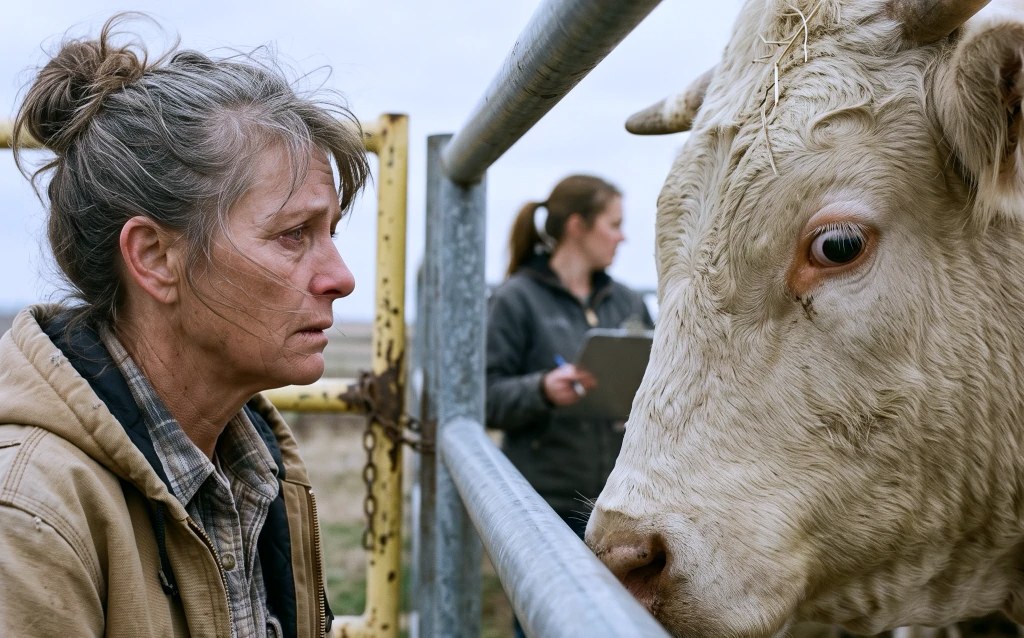
The trailer floor drummed under the bull’s hooves. Ruth Calder could see only his hindquarters and one pale eye; he had turned his head so far toward the ramp that the skin along his neck lay in thick folds. Outside the unloading fence, the driver slapped a rail and shouted again.
“Kill the engine,” Ruth said.
“He’s got to get clear first.”
“Turn it off. Now.”
The driver looked past her to Warren Pike. Warren gave permission with a small movement of his chin. When the diesel stopped, the shuddering floor went still, and the bull eased his shoulder away from the trailer wall.
Ruth stayed in the protected passage. She shifted along the rails until he could see her without twisting, then planted her boots. A rear hoof found the ramp, withdrew, and tried again. The driver opened his mouth, but Warren held up a hand.
The bull backed down. Once his last foot reached the pen, the driver secured the trailer gate from outside. Ruth watched the animal turn toward the trough. Below his right horn, a dark crust marked the place where loading had cost him some hide.
“His name’s Otis.”
The young man standing beside Warren had a brace on his right wrist and a jacket bunched under his other arm. His fingers were still swollen.
“Cole Mercer,” Warren said. “One of our employees. He was involved in the incident.”
“The gate hit me,” Cole said.
Ruth took the jacket before it slipped. She held the left sleeve open for him and settled the rest over his shoulders, leaving the braced arm free.
“You could’ve stayed home.”
“I wanted to know where he was going.” Cole watched Otis lower his muzzle to the water. “Make sure your help shows him the feed bucket. Coming around a post with it surprises him.”
Ruth slid Warren’s clipboard onto the top rail and added the instruction to the intake sheet. Cole leaned closer to see what she had written, then supplied the spelling of Mercer.
The papers described a five-year-old Charolais cross, roughly twenty-three hundred pounds. Ten days earlier, at Veltrin’s breeding facility, Otis had forced a handling gate out of place and driven it into Cole. Two later loading attempts had left bent equipment and men who no longer wanted to try.
Warren had bought twenty-one days of boarding and assessment. Before those days ran out, Ruth had to find a placement the veterinarians could approve. Without one, Warren would authorize euthanasia. Selling Otis at auction and letting an unsuspecting crew discover his difficulties was not an option.
On the telephone, Ruth had objected to the deadline and what would follow it. Cole was trying to straighten the collar of his jacket with one hand. She looked back at the paperwork.
“I don’t want anybody offering him a breeding season because they like his looks,” Warren said. “And I don’t want children posed beside him.”
“You won’t get that from me.”
“You said you were equipped.”
“For keeping him contained while we learn what we’re dealing with.”
Her answer sounded narrower here than it had on the telephone.
At fifty-nine, Ruth could still hear herself trying to make a business arrangement sound firmer than she felt. Warren’s check was in her pocket. It would cover a month in which both the property tax and the insurance bill had to be paid.
Her receiving yard lay outside Norbeck, Nebraska, well off the route most overnight cattle haulers now preferred. She operated four pens, rented out the pasture behind them, and hired help only when a job paid enough to allow it.
The old handling alley stood beyond the occupied pens. Its yellow gate was chained back, with a summer’s growth of grass pressing through cracks beside the curb. Nothing had gone down that alley since her son died there seven years ago.
Warren’s attention rested on it briefly. Ruth turned the clipboard toward him before he could ask anything.
After the trucks pulled out, Otis made a slow circuit of his enclosure. He tested the trough with his muzzle, investigated the lower rails, and chose a corner from which he could watch nearly everything. Ruth waited until he began eating, then went to the office.
She used her daughter’s private number. The clinic line had already taken one message from her that morning.
“Is it your wrist?” Elaine asked when she answered.
“No. I’ve got a bull I’d like you to see.”
Someone near Elaine asked where the clean towels had gone. Her reply came muffled, with the telephone turned away.
“Send the history,” she told Ruth. “I’ll look between calls.”
“He’s already unloaded.”
The silence lasted long enough for Ruth to hear the refrigerator switch off.
“I needed that call before you took him.”
“Yes,” Ruth said. By then, Elaine was speaking to someone else.
That afternoon, the clinic truck stopped well clear of the loading area. Dr. Elaine Calder walked the fence first, checking latches as she came. She was thirty-seven, with a line of sun-reddened scalp showing through her tied-back hair. Ruth waited on the office step beside two mugs.
Elaine stopped below her.
“Your message made this sound like a boarding job.”
“It is a boarding job.”
“With an injured handler attached to it.”
“His account was in what I sent.”
“After your signature was on the agreement.”
Ruth moved aside, leaving the office door open. Elaine put her bag on the outdoor bench instead. Neither woman mentioned the coffee.
They had not stopped speaking over the years. Elaine called about medical appointments. Ruth left extra beans and squash at her daughter’s back door. But nearly a year had passed since Elaine had walked into the livestock yard. Even visits to the house began with her truck turned toward the road.
Now she looked beyond Ruth toward the yellow gate and tightened the shoulder strap of her bag.
“That alley stays closed,” Ruth said.
“Then we’ll need to know how he gets to your dock.”
“We’re a way from loading him yet.”
“Which gives us time to answer that.”
They went to the outside walkway. Elaine asked about feed, manure, the wound beneath his horn, and any unevenness in his stride. Ruth had answers for those questions. She could give them without watching her daughter’s face.
Wind caught the lid of the empty grain bin. The metal slammed hard enough to send a little dust down its side. Ruth flinched. Otis pulled another mouthful of hay loose.
Elaine stayed still, studying him.
“Have you seen him respond to noises?”
“Not much of anything.”
Elaine walked beyond his field of view. She spoke to him, then raised her voice. He continued eating. When she stepped back into sight, his head came up at once.
She returned along the walkway. “We need to consider significant hearing loss.”
“The truck,” Ruth said. “He settled when it quit.”
“The vibration quit. That’s something we saw. We can’t say yet what he heard.”
“Cole wanted the bucket where he could see it.”
“Put all of that down. We’ll keep the conclusions separate.”
Hay and manure had collected beneath the feeder. To clear it, they needed Otis in the adjoining pen. Ruth opened the connecting gate from behind the barrier and fastened it fully back. Elaine stood where he could see her beyond the opening.
Otis approached until the roof cast a dark band across the ground. He lowered his head at the edge of it and held one foot suspended.
Ruth’s hand went toward the blue sorting cloth on its hook. She stopped before pulling it free.
“Hay where he can see the way through,” Elaine said.
They brought a small amount around from outside. Otis studied the opening, stretched his neck, and finally stepped over the shadow. Ruth did not touch the gate until his whole body had cleared it.
While he ate in the clean pen, she rested a boot on the bottom rail. Her legs had begun to shake, although there had been no collision, no shout, no person scrambling out of his way.
Elaine sat on the porch bench with a temporary care form across her bag. She recorded the observations and drew a firm line beneath the handling restrictions.
“This applies to you too,” she said. “Nobody inside his pen. No close work until we have suitable restraint and another veterinarian here.”
“You’ve made it clear.”
Elaine held the pen above the signature space. Across the yard, the chain on the yellow gate stirred against a post.
“Ben made it clear too.”
Ruth looked at her daughter.
“He told you that gate wasn’t safe,” Elaine said.
The office door stood open. Ruth could have found a reason to go through it. She had found enough reasons before.
“He said the post shifted under pressure,” she said. “I told him we’d inspect it after that load.”
Elaine set the pen down.
“What did you tell the investigator?”
To read the rest of the story – CLICK the NEXT button 👇👇👇