


Daniel Reeves still cut toast into strips because Nora liked to build a fence around her eggs. On good mornings, she left an opening for him to steal a bite. On bad ones, she was too busy trying to breathe.
He was usually dressed for work before the kettle boiled. His jeans smelled faintly of sawdust no matter how often he washed them, and a pale line circled the finger where his wedding band used to be.
Nora had been two when her mother died. In the three years since, Daniel had learned how to braid hair badly, remove a splinter without making it an occasion, and hear a change in his daughter’s breathing from the next room.
That last skill kept him awake through much of the winter.
Their apartment occupied the second floor of a narrow brick house in Vensett, Pennsylvania. The windows rattled when trucks passed, and cold air slipped beneath the kitchen door. Daniel packed towels against it. He vacuumed, washed bedding, kept smoke and strong cleaners away from Nora, and followed the instructions printed on her prescriptions.
Still, some nights she sat upright in bed, pulling for air that wouldn’t come easily. He would start her breathing treatment, settle beside her, and sing the songs her mother had sung. Nora pressed her palm against his throat to feel the humming.
Construction work paid the rent until rain, frozen ground, or a delayed delivery shut down a job. It never seemed to pay enough for the rent and the pharmacy.
First he sold the car. Then the watch his father had given him. The ring went last, wrapped in a scrap of tissue so he wouldn’t have to watch it slide across the pawnshop counter.
On a Tuesday near the end of March, he woke to Nora calling from her room.
She wasn’t loud. That frightened him more than a cry would have.
“Daddy? Can you come here?”
Her hair was damp against her forehead. When he put a hand beneath her chin, she leaned into it without opening her eyes.
“My chest feels too small.”
Daniel checked the little supply box beside her bed. There was one treatment left. He gave it to her, took her temperature, and waited for her breathing to ease. It did, a little. The fever stayed.
By afternoon, he had called the pharmacy twice. Her refill was ready, but the price hadn’t changed between calls. Neither had the amount in his wallet. He’d spent his remaining eighteen dollars on groceries the day before.
He called his supervisor from the kitchen, keeping his voice low.
“Gerald, I’ve got hours coming Friday. I just need part of it now. Nora’s sick.”
The man on the other end paused long enough for Daniel to hear equipment running behind him.
“I can’t authorize it. Payroll won’t advance wages.”
“Then take it out of mine yourself. Whatever paperwork—”
“Daniel. I asked before. They won’t do it.”
He thanked him because he didn’t know what else to say.
A hospital bill from Nora’s last emergency visit lay under a magnet on the refrigerator. He had no insurance and no idea how to pay it. He remembered the forms at admissions and the bill that followed. In his panic, owing the hospital became the same thing as being unable to go back.
Instead of calling for help, he kept looking for money.
By evening, Nora had exhausted herself. She slept in short stretches, waking to cough. When she stirred, Daniel saw a dusky shade around her mouth and bent over her until she opened her eyes.
“I’ll be right back,” he told her. “I’m getting what you need.”
She caught his sleeve.
“The medicine?”
“Yes.”
He stayed until her fingers loosened, then pulled on his coat.
Outside, wind blew salt dust along the pavement. The pharmacy stood several blocks away, bright enough that he could see customers moving between the aisles before he reached the door.
Daniel stopped beneath the awning. Through the glass, someone was buying shampoo. A woman searched her purse for a prescription card. Ordinary errands, completed by people who could walk back out with what they came for.
He went inside before he could turn around.
At the pickup counter, the clerk found Nora’s prescription. Daniel added a bottle of children’s fever medicine. When the total appeared on the register, he stared at it as though there might be a mistake he could point to.
The clerk turned to answer a question from the pharmacist. The small paper bag and the bottle were within Daniel’s reach.
He put them inside his coat.
He remembered almost nothing about crossing the store except the effort of keeping his pace ordinary. His hand had reached the exit when someone touched his shoulder.
“Sir. Stay here a moment.”
The security guard stood close enough to block the door without raising his voice.
Daniel looked at him, then down at his own coat. He took out the bag and the bottle and set them on a nearby display.
“My daughter needs those,” he said. “I’m not asking you to believe I didn’t take them. I did. But she can’t breathe right, and I don’t have anything left.”
The guard glanced toward the prescription label.
“Is someone with her?”
Daniel shook his head. He began to cry then, quietly and without being able to stop.
“Please let me take it to her. I’ll come back. You can keep my wallet.”
“I have to report this,” the guard said. His expression changed, but he reached for his radio. “Tell the officers exactly where she is.”
Daniel did. He repeated the address while an officer fastened handcuffs around his wrists. Outside, two shoppers had stopped beside their cars to watch.
He turned toward the officer opening the back door.
“Her name’s Nora. She’s only five. Please make sure somebody goes.”
Alma Dorsey, who lived in the apartment below them, reached Nora first. An officer’s call had sent her upstairs with her spare key. She found the little girl sitting against her pillows, frightened and struggling, and called an ambulance.
At the hospital, Nora received the treatment Daniel had tried to steal. Once she was stable, a caseworker explained that she couldn’t return to an empty apartment. A temporary foster placement would be necessary while her father remained in custody.
Alma objected until her voice wore thin. Then she filled out the forms required to be considered as a temporary caregiver herself.
Unable to post even the modest bail set in his case, Daniel stayed in the county jail. Alma sent word through his public defender: Nora was breathing well again. Nora was eating. Nora asked when Daddy was coming home.
He folded each message and kept it beneath his pillow.
By the morning his case came before the court, nearly three weeks had passed.
People had opinions about it all over Vensett. At the diner counter, outside the lumberyard, in the pharmacy line, the facts were discussed as though they belonged to everyone. Some spoke of the child. Others spoke of the theft. Plenty spoke of both, then reached opposite conclusions.
They filled the courtroom in Lorwick County.
Daniel sat beside Helen Price, his public defender, wearing a borrowed jacket that pulled across his shoulders. Helen had spent the few minutes before the hearing sorting through notes with tabs made from torn paper.
“No prior record,” she murmured. “Your work history. The hospital records. We have all of it.”
Daniel nodded, watching the door.
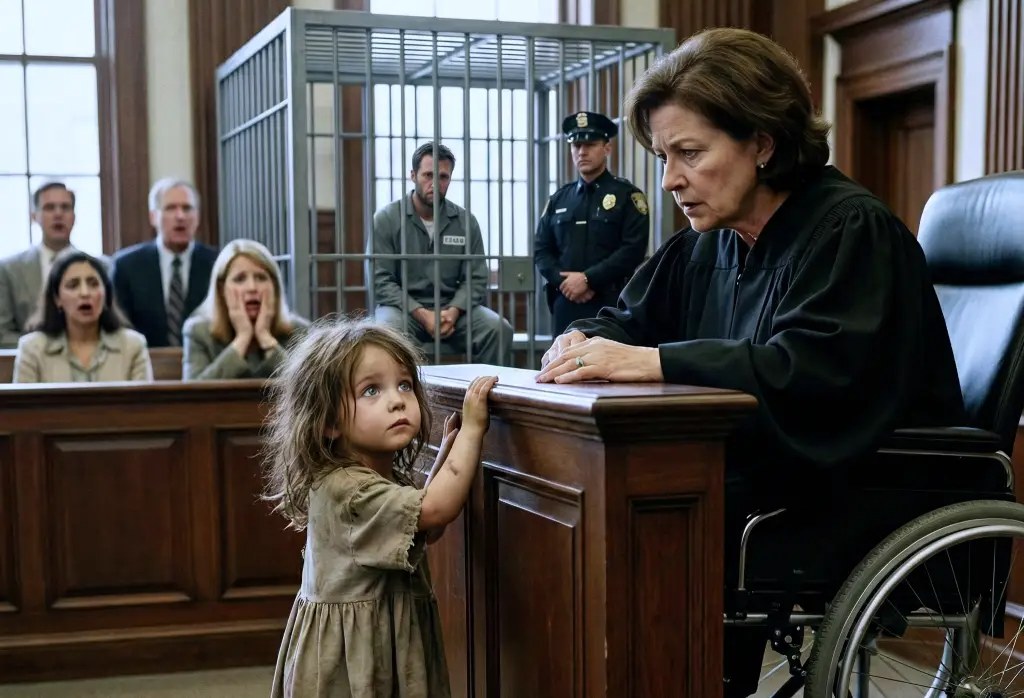
Judge Evelyn Sutter entered by the side ramp, guiding her wheelchair behind the bench. Twenty years of hearing other people’s explanations had given her a stillness that made nervous witnesses talk too much.
Since the collision that had injured her spine three years earlier, she had taken on more work, not less. Lawyers knew she read every filing. They also knew sympathy alone rarely persuaded her.
The bailiff called the room to order. Daniel rose with everyone else, then sat when instructed, his hands locked between his knees.
Marcus Ibarra spoke for the prosecution. He was young enough to look ambitious even while standing still, with a carefully knotted tie and a habit of squaring his papers before speaking.
“The defendant’s circumstances are difficult,” he told the judge. “The state doesn’t dispute that. But the store lost merchandise valued at nearly three hundred dollars. Need cannot become permission to take whatever someone cannot afford.”
Helen stood before Marcus had finished settling into his chair.
“The merchandise was recovered. Mr. Reeves admitted what he’d done. There was no threat, no force, no attempt to harm anyone. His child was in respiratory distress, and his judgment failed him under circumstances most of us have never faced.”
She placed the medical report where Evelyn could see it.
“He has already spent almost three weeks away from her. I’m asking the court to consider what further confinement would accomplish.”
Evelyn looked from the report to Daniel. He tried to hold her gaze, but his eyes kept going to the door.
“Mr. Reeves,” she began.
At the back of the room, a hinge complained.
Alma stood in the doorway with a little girl in a dress too large for her, its cuffs folded twice. Nora’s dark hair had worked loose from a crooked clip. She searched the room, looking past the uniforms and the rows of strangers.
Then she saw Daniel.
“Daddy!”
To read the rest of the story – CLICK the NEXT button 👇👇👇