


Lydia Rowan was straightening a bent hinge with a hammer when the pickup rolled into her yard. She kept working. The man behind the windshield could wait through three more blows, and she needed the gate to close before her calves discovered it didn’t.
Cole Sutter stayed in the cab until she put the hammer down. His truck was clean beneath the running boards, an unusual distinction on a cattle place in southern Montana in July. He lowered his window and rested an unmarked wrist on the door.
“Wesley asked me to bring you another proposal.”
“That makes four.”
“Then you’ve had plenty of practice reading them.”
Beyond his truck, Rowan Ranch spread across nearly twelve hundred acres of sage flats and broken grassland. Lydia’s grandfather had bought the first piece in 1942. Her father had added the rest, slowly, with cattle checks and winters spent fixing other people’s equipment. Two dry summers had undone more of that work than Lydia could bear to calculate.
The east fence leaned wherever the ground softened. A patch on the barn roof lifted in a wind from the southwest. From the house, the country rose toward a timbered ridge, and almost everything between Lydia’s north boundary and that ridge now belonged to Sutter Land & Range.
The Sutters had acquired ranches across Cinder County for forty years. Their offers usually arrived after a funeral, a bad calf crop, or the second letter from a lender. They were courteous about it. Courtesy cost them nothing.
Cole was thirty-nine and good-looking, with a salesman’s patience for pauses. He handled purchases for the family. Lydia had learned that he never stood anywhere by accident.
“The number’s better,” he said. “Wesley doesn’t want another poor season to leave you without choices.”
“I still have one.”
He studied the loose roof patch. “Your dad knew when an animal wasn’t going to get back up. I’m surprised you didn’t learn that much from him.”
The hammer handle creaked in her grip. She could have thrown it through his expensive windshield, but she needed the hammer.
“Get your truck turned around, Cole.”
He waited, perhaps hoping for more. She went back to the hinge, and eventually he left.
That afternoon she drove to Dry Crossing for a pump part she had put off buying twice. The livestock trailer was still hitched behind her pickup from a repair trip the previous week. On the way home, she took Dry Bench Road, where the county pavement ended and the old gravel route bent through low cuts of chalky earth.
She nearly passed the horse.
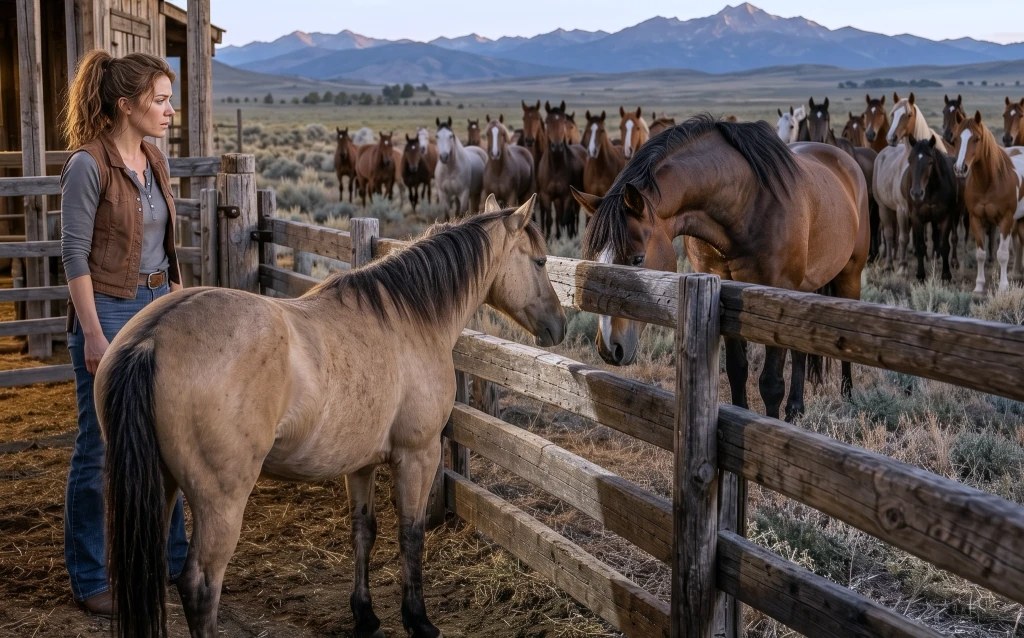
Sage partly hid the mare below the road shoulder. Lydia caught sight of one moving ear before she could make out the rest of the horse. Lydia braked, backed carefully, and switched off the engine.
The animal was dun, with a dark line running the length of her back. Mud had dried along her belly and hind legs. Her ribs showed, but she had the hard joints and dense muscle of a horse that had covered country, not one that had spent its life waiting beside a feed bunk.
Lydia took a lead rope from behind the seat. She approached at an angle, speaking quietly, leaving the mare room to move. The horse watched her without retreating.
Up close, Lydia saw the neck. A narrow strip of hair had been rubbed away almost all the way around it. The skin underneath was tender and ridged.
She walked a slow circle, looking for a brand, an ear tag, a halter rubbed through by use. Nothing identified an owner.
The sensible thing was to phone the county. A rancher behind on her payments did not need another mouth to feed, especially one carrying a story she couldn’t read. Lydia stood beside the trailer while she considered that, then lowered the ramp.
The mare sniffed the opening. Lydia had expected to spend an hour persuading her, if she could persuade her at all. Instead, the horse placed a front hoof on the ramp, tested it, and walked inside.
Lydia stayed where she was for a moment, holding a rope that had scarcely tightened.
At home, she backed the mare into the small corral beside the barn. Before Lydia had fastened the gate, the horse turned toward the northern hills. She remained there through the unloading of the pump part and the evening feeding, looking past the rails.
A patch of bracken grew beneath the cottonwoods near that gate, kept alive by runoff from the stock tank. Lydia named the mare for it. A name made it easier to call to an animal she had already decided, foolishly or otherwise, to keep for the night.
Vernon Pike arrived the following morning with a veterinary bag, a thermos, and no question about how soon she could pay him. At fifty-eight, he had been treating large animals in the county long enough to know which questions embarrassed people without producing useful answers.
For fifteen years he had also consulted on wild-horse gathers. Lydia had watched him examine plenty of neglected stock. He was usually brisk about the diagnosis and gentle about everything else.
This time he took longer.
He checked the mare’s mouth, listened to her gut, felt beneath the jaw, and examined the damaged skin around her neck. Then he lifted each foot in turn. Bracken tolerated him, although she kept shifting her attention north whenever he straightened.
“How long has she looked this poor?” Lydia asked.
He let the last hoof down. “The weight loss looks recent. Some dehydration, too. This isn’t the pattern I’d expect from months without proper feed.”
“Could she have been turned out?”
“Could have.” He rubbed dust from his palms. “But these feet have been wearing against rock, all four of them. She’s been traveling. A lot.”
He looked over the mare’s shoulder toward the hills.
“Lydia, what makes you think she came from a ranch?”
She glanced at the empty place where a brand should have been.
“Nothing,” she said.
That evening Bracken followed her toward the barn, then stopped with her front feet on the threshold. Lydia offered hay and waited. The mare leaned away from the doorway and swung her head toward the northern boundary.
“All right. Outside, then.”
Lydia left her in the corral under the stars. There was water, shelter along the barn wall, and grass hay she could eat without competition. It ought to have been enough to settle a tired horse.
Near midnight, Lydia was still on the porch. Her coffee had gone bitter in the mug. Bracken stood at the north side of the enclosure, pale against the dark boards, facing the country Sutter Land & Range had bought six months earlier.
The mare called once.
It was lower than the calls Lydia knew from her own horses, a rough sound that carried beyond the yard. She listened to it die away over the sage. Several seconds passed before a distant horse answered from the hills.
Lydia set the mug beside her chair.
She finally went to bed around three. Less than an hour later, repeated blows against wood brought her upright. The stove clock read 3:42 when she crossed the kitchen barefoot.
Outside, Bracken was striking the corral gate. Her head was high, nostrils open, ears fixed ahead. She had room to move away from the boards but kept returning to them.
Lydia swept a flashlight beyond the enclosure. She expected a predator, or somebody fool enough to enter a ranch yard in the dark. The beam caught a row of eyes.
She lowered the light.
Moonlight showed horses beyond her north fence. She counted twenty, lost her place, and counted again. They stood in an uneven line, facing the corral about thirty yards away. None lowered its head to graze.
Wild bands occasionally crossed distant slopes around the ranch. Usually Lydia saw them only long enough to notice them leaving. These horses held their ground.
A bay stallion stood ahead of the others. His neck was heavy, and his broad blaze had yellowed along the edges. He advanced until the fence wire touched his chest, then lowered his head, slowly, almost to the dirt.
Bracken made a faint answering sound. Her next hoof came down without striking the gate.
Lydia watched the mare’s flanks stop quivering. She watched the stallion remain bowed at the wire. Whatever else had happened, these animals knew one another.
And someone had restrained that mare long enough to damage her neck.
At daylight, Lydia drove back to Dry Bench Road. She left the pickup on the shoulder and searched on foot, moving outward from the place where Bracken had stood.
Behind a screen of sage, wide tire tracks curved backward toward four holes set in a rough square. A dually hauling a trailer could have made them. Inside the square, hoofprints cut deep into the hardpan, circling over one another without going anywhere.
She found three pieces of nylon rope. Their ends were cleanly severed.
A single trail of hoofprints broke away toward the road. The spacing lengthened sharply. Bracken had run out of there.
Lydia photographed the holes, the rope, and the tracks. On the drive home, she kept returning to the same difficulty: an escaped range horse had open hills to run toward. This one had ended up beside a county road.
The band was still at her fence when she returned.
By afternoon, pickups were parked along the shoulder. People leaned on doors and counted horses. Vernon came back and stood beside Lydia at the wire, watching the bay stallion keep an eye on the corral.
“An animal changes its habits for a reason,” he said. “We ought to find the reason before everybody supplies one.”
Cole returned on Friday. This time he got out and walked far enough into the yard to inspect the audience along the road.
“Well,” he said, smiling. “You’ve found a use for a cattle ranch without cattle money.”
Lydia said nothing.
His smile disappeared. Wesley was willing to pay substantially more, he told her. The offer would remain open for seventy-two hours.
The figure was close enough to the ranch’s fair value that she looked at him carefully. Sutter purchases had always depended on waiting. A deadline that short did not fit their habits.
Twice, while discussing the land, Cole asked what she planned to do with the dun mare. He made each question sound incidental. Each time, he stopped speaking until Lydia answered.
“She’s here for now,” she told him.
When he drove past the corral to leave, Bracken backed so violently that her hindquarters struck the far rails. The boards groaned. The mare held herself there with her eyes wide and fixed on the truck.
She had tolerated strangers all afternoon…
To read the rest of the story – CLICK the NEXT button 👇👇👇