


The bidder had brought a measuring tape. Evan Rourke watched him hold it against the front of a kennel, then turn to a second man and make a small, dismissive motion with his thumb.
“Too much dog for that run,” the man said. “And look at the hips.”
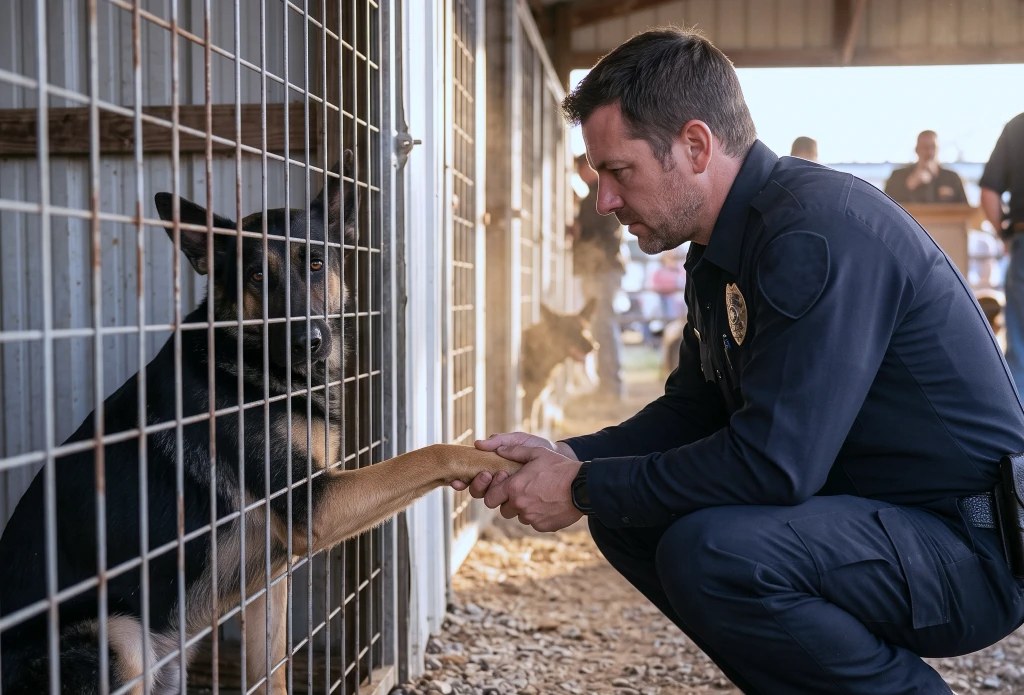
Behind the wire, a German shepherd shifted his hind feet beneath him. The effort made his collar tag strike the empty water bowl. He kept his ears turned toward the entrance to the sheriff’s auction yard, where Evan had just stopped with one hand on the gate.
There were twelve kennels, six along each wall of the old equipment shed. Someone had fastened lot numbers to them with baling wire. Above the cashier’s window, a sheet of painted plywood identified the afternoon’s offering as surplus county canines.
Evan stood long enough for the gate spring to press against his palm.
He had attended county sales before. Usually there were old patrol vehicles, seized tools, fencing rolls nobody could identify. The annual sale of retired working dogs had always bothered him, but the notices spoke of screened homes and responsible placement. From the gate, he could see a man testing the strength of a kennel door with his boot.
“Don’t do that,” Evan said.
The man looked at his uniform, withdrew his foot, and wandered toward the platform at the end of the yard.
Late-summer heat lingered against the shed’s siding. Beyond Belloran, the dry country of eastern Oregon lay under a pale haze, and the breeze carried the smell of cut hay from somebody’s second crop. Here, close to the kennels, Evan smelled old bedding, hot metal, and the sourness of frightened animals.
A woman carrying a folded sale sheet stood beside two ranchers. Farther down, a man discussed putting one of the shepherds behind a salvage yard fence. Another wanted to know whether a female had ever been bred.
The dogs watched mouths and hands, but their attention kept returning to the gate. A heel striking gravel would bring up three heads. A radio would crackle, and ears would lift along the row. Then the strangers moved on, leaving the dogs to settle again.
One large male had wet tracks beneath both eyes. Dust clung to the damp fur beside his nose. Evan couldn’t know what had started the tearing, but he knew the tucked tail, the shallow panting, the repeated glance toward an exit. He had spent too many hours beside working dogs to mistake those signs.
Near the shed, several officers from neighboring departments stood in a loose group. Ordinarily somebody would have called out to him. They had trained together, borrowed equipment from one another, argued over coffee about tracking methods. Today one officer found something urgent on his phone. Another turned his badge away as he bent to tie a boot.
Evan walked farther into the yard.
“Look at that one’s eyes,” an older bidder said to the auctioneer. “Something wrong with him?”
“New surroundings,” the auctioneer replied. “They settle once somebody takes them.”
His name was Pelham. Evan knew him from equipment auctions, where he could make a damaged trailer sound indispensable. Today he wore a clean short-sleeved shirt and carried a clipboard thick with forms. He spoke without looking at the dog.
A shepherd near the platform barked at a passing deputy. The sound was abrupt and hopeful. When the deputy continued past, the dog pushed his nose against the wire and gave a thin, descending whine.
Pelham glanced at his watch.
“We’ll get underway shortly. Take your last look. Buyer takes responsibility at the close of the sale.”
Evan approached him before he could climb the platform steps.
“Where are their handlers?”
Pelham’s pen paused above the sheet. “Afternoon to you, too, Rourke.”
“I heard dogs from our training district were on this list. Nobody told me there were twelve.”
“Regional consolidation. Changes to the canine program.” Pelham tucked the clipboard beneath his arm. “You know how budgets go.”
Evan let the answer sit. His gaze had caught on a pale crescent in a shepherd’s left ear.
The dog was lying toward the back of the third kennel, one foreleg stretched ahead of him. At Evan’s voice, his head came up. He stared for a second, then scrambled forward so quickly that his shoulder struck the door.
“Flint?”
The dog made a breathy sound and pressed his cheek against the mesh.
Evan dropped into a crouch. His knee landed beside a sharp stone, but he scarcely felt it. He moved his hand close enough for Flint to smell him without pushing his fingers through.
The shepherd’s nose worked furiously. Then a paw came out beneath the door, toes spread, scraping for purchase on the gravel.
Evan took it.
Three years earlier, he had spent weeks coaxing weight back onto that leg. He remembered the little notch in one nail and the way Flint would turn his head rather than let anybody see him struggle to stand.
“You were placed,” Evan said quietly. “They told me you had a family.”
Flint leaned harder against the door. Moisture gathered at the lower edges of his reddened eyes and ran into the fur Evan’s hand was touching.
Behind him, somebody stopped talking.
Evan rose too fast. His hand caught the kennel frame, making it jump, and Flint flinched. Evan immediately loosened his grip and rested his palm against the wire instead.
Then he turned toward the officers.
“Who brought him back?”
One of them looked toward Pelham. Another shook his head without answering.
“Whose decision was it?”
“Above our level,” the first officer said.
Evan looked down the rest of the row. Under the dirt and flattened coats, more faces became familiar. A broad-headed male who always stood with his right front foot slightly ahead of the left. A narrow-faced dog with an old scar at his shoulder. Animals whose working habits Evan could have identified in the dark by the pull on a training line.
He had left the canine assignment for regular patrol after Daniel Mercer’s death. He still helped with rehabilitation when asked, still signed off on training hours. But during the last few months, the reports had arrived neatly summarized, and he had believed the people sending them.
Flint had been among the dogs he had asked about by name.
Evan stepped aside, took out his phone, and called a number he had saved months earlier after a training conference. When the call went to voicemail, he kept his voice low.
“This is Officer Evan Rourke in Tavener County. I’m at the canine auction. A dog listed as placed with a foster family is in a sale kennel, and they won’t tell me why. There are others I know. Please call me.”
He sent the location, put the phone away, and turned toward the second row.
Boone was already on his feet.
The shepherd had once cleared a broken warehouse window on command, taken a cut across his chest, and kept going until the suspect was contained. Evan remembered having to sit on the treatment-room floor afterward because Boone wouldn’t let the technician work while Evan stood near the door.
Now the big dog’s back legs trembled. He pushed his forehead between two uprights as far as the wire allowed.
Evan stopped close to him.
“There you are, big fellow.”
Boone’s claws scraped the floor tray. He gave a low whine, swallowing between breaths, and lifted one paw as though reaching for a familiar harness buckle.
In the next kennel, Otis stretched his long muzzle toward Evan’s sleeve. The explosives dog had worked busy public buildings without losing focus, ignoring dropped food and shouting children while he searched. He was panting now, tongue pulled tight, unable to settle his feet.
Keel paced behind him. Three steps to the wall, turn, three steps back. His left hind leg shortened each turn. Evan had seen him work through smoke to find people who couldn’t reach a door. The little circle he was making now barely gave him room to move.
As Evan passed, dogs rose along the row. Some knew him from shared deployments; others knew his voice from the training ground. They pressed forward, noses searching the air, and the men nearest the kennels stepped back.
Evan moved slowly enough to let each dog catch his scent. He touched wire beside a nose, waited for a breath to ease, then moved on. Every time he left one kennel, the dog inside followed him to the end of it.
Across the yard, Flint lifted his head and howled.
The sound carried beyond the shed. A woman at the cashier’s window stopped with her wallet open. Even Pelham looked up from his forms.
Evan turned back toward Flint, and several dogs began whining at once.
“Why are they all doing that?” the man with the measuring tape asked.
“They know him,” somebody answered.
Boone pushed against the wire until Evan put his hand flat beside the dog’s forehead.
“What happened here?” Evan murmured.
Pelham climbed the platform steps. The microphone squealed when he switched it on, making Keel duck his head.
“Before anybody bids, we need to get through the conditions.” Pelham adjusted the microphone away from his mouth. “Payment completes the transfer. There are no returns, and the county accepts no liability after purchase.”
Evan stayed beside Boone.
“The second condition concerns prior assignments. Former handlers and participating departments are not eligible to receive these animals.”
A deputy near the back lowered his chin.
Evan looked toward him, then toward the platform. First refusal normally went to a handler. He had helped prepare those retirement packets himself.
Pelham continued before anybody could speak.
“Veterinary files are not included in the sale. Future treatment is entirely the buyer’s expense.”
The older woman unfolded her sale sheet and searched it, as if she might have missed a page.
“You’re selling them without their records?” she asked.
“That’s the condition.”
Evan stepped away from Boone’s kennel.
“Show us the directive.”
Pelham tapped the microphone, although it was working perfectly. “County business, Rourke. I’m not taking questions during the terms.”
“Somebody signed it. Put the signature where we can see it.”
The auctioneer’s mouth tightened. Keel began pacing faster behind Evan, and two other dogs barked at the change in his voice.
Evan forced his hands open at his sides. He had already startled Flint once.
Pelham looked down at his clipboard.
“There is one final condition. Unplaced animals will be sent for processing tonight…”
To read the rest of the story – CLICK the NEXT button 👇👇👇