


The bidding paddle kept slipping against Leah Mercer’s damp palm. She tucked it beneath the folder she carried and wiped her hand on her jeans before anyone could notice.
Across the warehouse, a dog struck the side of a steel pen hard enough to rattle the latches. Nobody looked up. The men seated near the auction platform were studying work histories, bite records, and veterinary reports, deciding what each animal might be worth behind a fence or beside an armed guard.
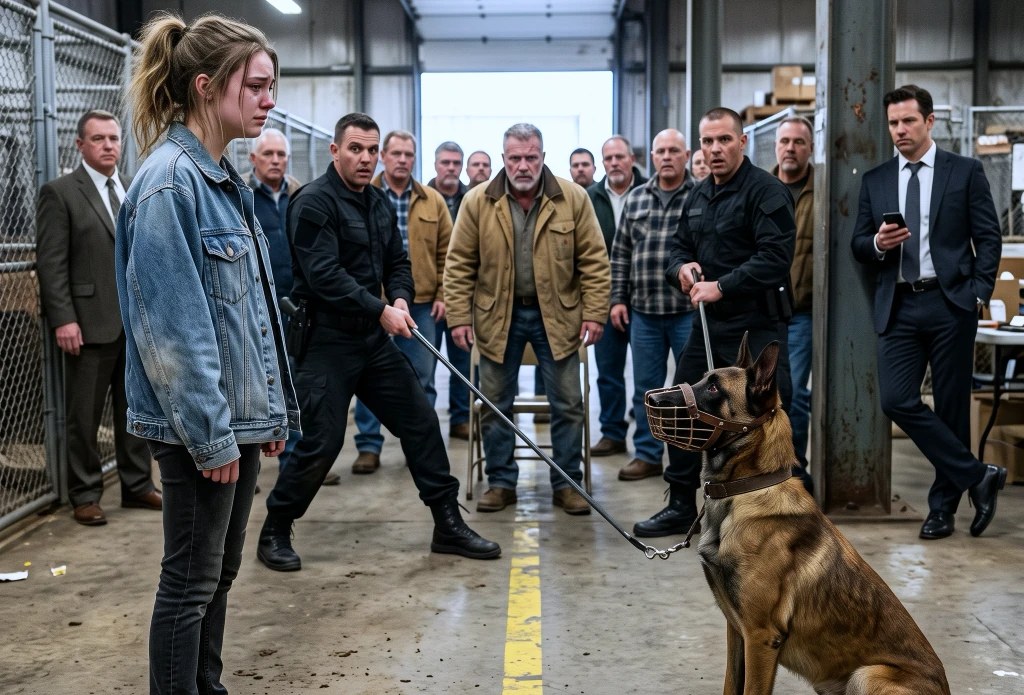
Leah checked the number on her paddle again. She was nineteen, and the sleeves of her father’s old denim jacket covered half her hands.
The sale was being held in Portsmouth, Virginia, inside a warehouse that still had a freight scale bolted to the floor. A private vendor had assembled dogs whose records led through military units, federal agencies, and security contractors. Some had aged out of demanding work. Others had failed evaluations. A few, according to the catalog, could no longer be safely handled without specialized equipment.
Admission required approval. Leah had spent two days getting hers.
At the registration desk, the clerk had examined her identification, glanced at her folder, and asked whether someone would be joining her.
“No,” she’d said.
Inside that folder was a cashier’s check for $2,680. She had earned it carrying breakfast plates and refilling coffee at a diner near the naval installation, taking extra shifts whenever somebody called out. There wasn’t a separate account for emergencies, tuition, or rent anymore. She had brought all of it.
She needed lot thirty-seven.
On the catalog page, he was listed as a seven-year-old Belgian Malinois, approximately seventy-two pounds. His name appeared in small print beneath a series of identification numbers.
Ranger.
Leah rubbed her thumb over the printed word until the paper softened.
She remembered him at two, all legs and appetite, dragging a length of washed-up rope down the beach while gulls hopped away from him. Her father could call once, and Ranger would abandon anything. Birds, a thrown ball, even a dropped sandwich ceased to matter when Chief Petty Officer Andrew Mercer wanted his dog.
At fourteen, Leah had considered that both impressive and deeply unfair.
“He knows who makes the rules,” her father had told her.
“He knows who carries the good treats.”
Her father had considered that, then handed her the pouch from his belt.
On evenings when he was home, they crowded onto the little back porch of their rental in Hampton. Ranger usually claimed the space between Leah’s chair and her father’s boots, though eventually his head would land across her knees. She would work her fingers through the thick fur behind his ears while her father told stories that somehow made deployment sound mostly like bad meals and men losing their gloves.
She had known he was leaving things out. She had let him.
Ranger went where her father went. They trained together, traveled together, and slept close enough that, in photographs, some piece of the dog was usually touching him.
Then, three years before the auction, two uniformed men came to the house.
What Leah and her mother learned afterward arrived in fragments. There had been a night operation in the mountains of northern Iraq. An ambush. Her father had stayed behind to cover his team’s withdrawal. He never reached the aircraft.
The reports they were permitted to see contained more blocked-out passages than explanations. One fact survived every version: when help reached Andrew Mercer’s position, Ranger was still there.
The dog had been wounded. Her father was dead. Ranger would not leave him.
After the funeral, Leah wrote letters asking for him. Her mother made calls. Leah learned the names of offices she had never known existed, along with the difference between a sympathetic answer and an actual decision.
Ranger was still considered fit for further duty, they were told. His training represented years of work. He would be treated, evaluated, and returned to service.
He went first to a reconnaissance unit and later to a federal tactical team. Leah followed what she could through her father’s old friends. At first there were reassuring phrases about recovery. Then the updates became less frequent.
He wouldn’t settle with a new handler. He woke violently. He guarded places no one else could identify as dangerous. Men trying to work with him were bitten.
Eventually, he passed into a contractor’s custody, and his record acquired a recommendation against placement in an ordinary home.
Leah might never have learned what came next if Owen Talbot hadn’t called.
Owen had been a sniper on her father’s team. He spoke slowly on the phone, as though trying to keep her from hearing the anger underneath.
“There’s a sale,” he said. “Private. I’ve been chasing the paperwork since yesterday.”
“Ranger?”
A pause answered her before he did.
“I’ll get you the details.”
Now she stood close to the buyer’s barrier, listening to prices that made her check seem smaller every minute.
The auctioneer, Wade Dempsey, had the economical movements of somebody who had spent years handling dogs before learning to sell them. Faded tattoos showed below his rolled sleeves. He could read a report, watch a bidder, and keep one eye on a restless shepherd without appearing to turn his head.
“Ninety-two hundred from Zenvora,” he called. “Who’s at ten?”
A man near Leah raised two fingers.
Ten thousand dollars, committed with less attention than she gave a week’s grocery money.
She shifted the folder beneath her arm. That morning, before driving to Portsmouth, she had stopped at the national cemetery. Rainwater had gathered in the lettering on her father’s stone. She had wiped it away with her sleeve and told him she was going to bring Ranger home.
She had not said she would try.
A latch banged behind the platform.
One of the kennel attendants looked toward the opening, and Leah knew before she saw the dog.
Two handlers came through backward, each braced against a control pole. Between them, Ranger fought for enough space to turn. His nails skidded, caught, then scraped loose again. A broad leather muzzle enclosed his jaws.
Leah’s fingers opened around the folder. She caught it against her stomach before it fell.
The dog’s coat had lost its clean reddish sheen. Fur stood unevenly along his back, and an old scar pulled at one side of his muzzle. The tip of his right ear was gone. When one handler changed his grip, Ranger whipped toward him so abruptly that the man’s heel slid off the edge of the ramp.
“Hold there,” Dempsey told them, away from the microphone.
The handlers stopped.
Ranger’s chest worked against the straps. A growl came through the muzzle, low enough that Leah felt it before she separated it from the rest of the warehouse noise.
He had once slept with his nose beneath her hand.
Dempsey waited until both men had secure footing, then addressed the buyers.
“Lot thirty-seven. Male Malinois, seven years. Three deployments. A unit citation for valor is included in his history.”
He turned a page. The salesmanship left his voice.
“You’ll want the behavioral report before you lift a paddle. Two bites involving his last three handlers. Severe trauma-related symptoms, high reactivity, poor handler attachment. He’s not being represented as suitable for patrol, detection work with a new team, or household placement.”
A bidder in the second row put his catalog down.
“Restricted perimeter work is the recommendation,” Dempsey continued. “Secure site. Experienced personnel. We’ll open at nine hundred.”
No one moved.
Leah could hear the breath forcing its way through Ranger’s nose. A handler said something to him, and the dog drove against the restraint again.
She raised her paddle.
“Nine hundred.”
Dempsey found her in the front and hesitated just long enough for her face to grow hot.
“I have nine from the young woman.”
“Eighteen hundred.”
The answer came from a man leaning against a support column with a phone in his hand. Curtis Voss. Leah knew his name from the registration list and the way other buyers had greeted him. He arranged overseas logistics for a large security company.
He hadn’t bothered to step forward for a better look.
Leah did the subtraction she had already done a dozen times. If she left eighty dollars, she could buy food and enough fuel to get home. Everything after that would have to wait.
“Twenty-six hundred,” she said.
Voss looked up.
His gaze traveled from her worn sneakers to the folder pressed against her ribs. For the first time, he seemed interested in the sale.
He put his phone away.
“Fifty-five hundred…”
To read the rest of the story – CLICK the NEXT button 👇👇👇