


Caleb Danner noticed the handler’s boots first. They had stopped moving, heels dug into the auction-yard gravel, while the chestnut at the other end of the rope searched for somewhere else to go.
The horse would let the man stroke his neck. That wasn’t the trouble. But whenever the man turned toward the narrow gate, the gelding’s head rose and his hind feet began working backward. Caleb could see daylight beyond the far fence. The horse kept looking that way.
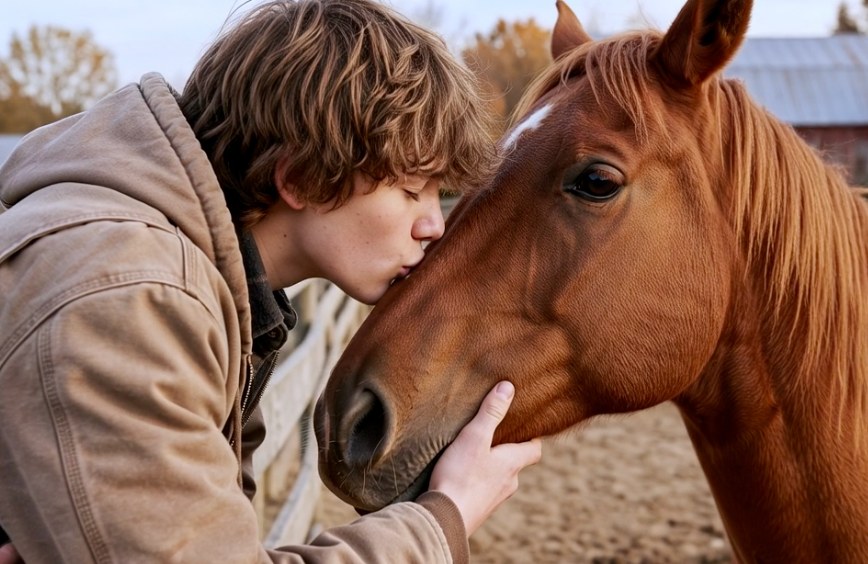
Two buyers moved on without asking a price.
Orange sale marks identified eleven horses in that back enclosure. Dale Voss, who ran the auction in Delver County, said a truck would collect whatever remained on Monday. It was going north. Caleb had heard enough talk around sale barns to understand the rest.
His own ride home was waiting five miles away, provided he could find somebody to replace its fuel pump. That September morning in 2009, though, the money meant for a pickup was inside his jacket: $3,060 in an envelope softened by repeated counting. He was sixteen. Three summers of setting posts, stacking hay, and pitching out other people’s stalls had gone into it.
He circled the enclosure instead of leaving.
A little bay mare shortened her stride on the left side. An old scar crossed that shoulder, but Caleb couldn’t tell whether the scar explained the way she moved. A sorrel jerked away when a worker reached for a front foot. Farther down the fence, a black mare tolerated a hand on her face, then flinched when a loose strap touched her side. Two others needed flesh before a West Virginia winter. The chestnut was still willing to have his neck rubbed.
Arthur Danner would have looked at every one of them.
People had brought Caleb’s grandfather horses they couldn’t handle and sometimes gone home embarrassed by a sharp tooth or a saddle that pinched. Sometimes Arthur had simply taken longer than the owner wanted. There were horses he hadn’t helped, too. Ruth never forgot those.
Arthur had been dead two winters now. He’d collapsed while tending a gelding’s bruised hoof. Caleb remembered the horse standing quietly afterward and his grandfather’s little stool lying on its side under the partition.
Dale found him by the chestnut’s pen.
“Your grandmother know you’re shopping?”
“Not yet. What’s the whole pen worth?”
Dale looked at him properly then. “An adult signs. No exceptions.”
“I’d ask her.”
After a pause, Dale gave him a figure: $2,590. Someone buying by the load had offered nearly that much. Caleb could have until noon Monday, no longer.
He walked home with $470 left in every calculation he made.
Ruth had just returned from the breakfast shift at Vellora, the diner in Bellwick. She was loosening her apron strings when he laid the envelope on the kitchen table. She counted the bills without taking off the apron, then reached past the pepper tin for her blue account book.
A folded tax notice marked one page. Another held the price of repairing Arthur’s tractor, which had sat useless since spring. Water was getting through the barn roof above the south stalls. Their own hay wouldn’t carry eleven horses through the cold months, and six early shifts a week bought groceries and kept the lights on for two people.
Caleb waited while she ran a finger down the figures.
“Warren might trade hay for fence work,” he said.
“Warren’s hay has mouths waiting for it.”
“I can ask how much he’d sell me.”
She closed the book over her finger. “Start with the horses. What did you see?”
He told her about the feet, the shoulder, the black mare’s sudden flinch. He spent longest on the chestnut. Ruth listened, then wanted to know what treatment each needed, what feed would cost, and when there would be room in the paddocks again.
He could describe what had caught his attention. He couldn’t answer the rest.
“I’ll get them placed by spring,” he said. “Most of them.”
Ruth gave him time to qualify it. Outside the window, the barn’s weathered doors stood shut. People still stopped her in town to say how much Arthur had known. Some of those same people had paid his bills months late.
Finally she rose and took the telephone off its hook.
Warren Beck could haul the horses. He could also advance some hay against work on his fences, though not enough to cover a whole winter. Dr. Mara Ellis agreed to examine them once they arrived. Ruth wrote down both arrangements before she reached for a pen to sign anything.
“We look at the money again in January,” she said. “School comes first. Mara decides what’s fit to work. And if I call a halt, you halt. We can discuss it afterward.”
Caleb nodded.
“Say it.”
“I’ll stop.”
Her pen remained above the page. “Spring’s a long way off. Don’t spend it twice.”
On Monday, her signature bought the eleven horses. Warren’s trailer brought them home in three loads. At the auction Caleb watched the empty space grow behind the back gate; at the farm he kept finding another bucket, another length of fence, another place that needed checking.
Victor Harlan was there when they loaded the last group. Arthur had occasionally worked horses at his stable, a place with an indoor arena, hired help, and riders who expected to enjoy their weekends. Victor tested the trailer latch before stepping aside.
“Arthur was worth what he charged,” he said. “Make sure you’ve saved something for feed.”
Caleb bent over the lead he was tying. By the time he finished the knot, Victor had gone to his truck.
That evening the barn sounded occupied again. Hay rustled against boards. A bucket handle rang when a horse nosed it. Caleb made one unnecessary trip down the aisle after the feeding was finished, carrying an empty scoop.
At daylight he found the little brown gelding guarding a bad hoof. The bay loosened up with movement, though the first few strides still troubled him. The chestnut’s papers called him Jasper. Loose in the paddock, Jasper followed Caleb willingly. Asked to enter a stall, he threw himself backward, dragging rope across Caleb’s palm.
Mara made two visits that week. She treated the brown gelding, checked the thin pair, and helped Caleb separate observations from guesses in a notebook. The sorrel’s front foot was sore. Whether that accounted for all his resistance to having it held up wasn’t clear yet.
Caleb tried cleaning it before school three mornings later. The horse leaned away. Caleb hung on, determined to get the job done before the bus.
A hoof hit the wall. A plank broke, and its edge opened a cut on the horse’s leg.
Mara came back. Ruth recorded the extra charge while Caleb carried a replacement board to the stall. After the veterinarian left, he put his tools away one at a time. The new plank still smelled of the lumberyard.
With Jasper, he fell back on what Arthur had taught him about asking lightly through a lead rope and giving the horse relief for the smallest correct response. At the doorway he kept waiting for that response. Jasper kept backing away.
Before the fortnight was out, the gelding would lift his head from his feed and leave when Caleb appeared carrying the halter.
School papers began collecting on the kitchen table. One algebra sheet hadn’t even been started; a history teacher wanted Ruth’s signature on a note. She read them, set a chair out for Caleb, and took the water buckets herself.
He was still working when her boots scraped across the back porch in the dark. Her alarm would ring before five.
During a dry spell in October, he brought the black mare into the round pen. He’d begun calling her Tess. A blanket settled on her back without trouble. He eased a saddle over it and waited with his hand resting on the seat.
She stood. Along her flank, the coat quivered.
Caleb reached under her for the girth. He drew it up, expecting the familiar pressure to settle her.
Tess reared and fell backward. The saddle struck close enough that he felt dirt hit his leg. He scrambled away from her feet, and she struggled up, trembling so hard the stirrups shook.
Ruth was at the gate by the time he got the saddle free. She took it from him and carried it outside the pen. Tess walked a few stiff steps along the rail. They let her go.
Ruth turned back to Caleb.
“When did the shaking start?”
To read the rest of the story – CLICK the NEXT button 👇👇👇