


Silas Mercer had loosened his reins for the turn into the yard when he saw the child and pulled his horse up short.
The boy stood against a red cow, his cheek buried in the rough hair below her jaw. A loose rope trailed from his fist. The cow could have walked away whenever she pleased, but she remained beside him, flicking an ear at the flies. On the cabin porch, a woman twisted a corner of her apron without seeming to know she was doing it.
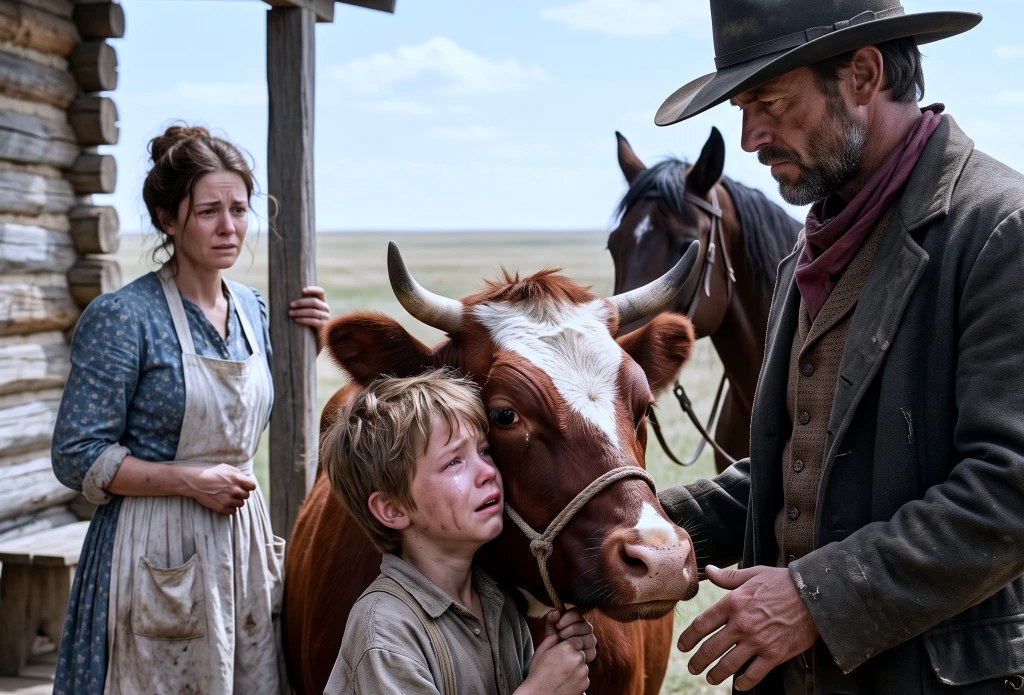
Forty dollars rested in Silas’s inside pocket. He had come nine miles to spend it. Now he sat looking at the little boy’s shoulders, which were trembling beneath a shirt carefully mended at both elbows.
Lydia Voss had hoped the buyer would arrive while Eli was feeding the hens.
She had arranged work for him all morning, small things he could manage alone. He had done each task and returned to Mallow. At seven, he was old enough to understand a sale and too young to understand why understanding didn’t help.
The farm had belonged to Lydia’s father. He had settled those hundred and sixty acres of Dakota prairie in the early seventies, choosing the ground for its spring rather than its soil. There was a root cellar, a narrow barn, and a cabin whose floor Lydia had worn nearly colorless with scrubbing. The deed had passed to her when he died.
Warren had left the rest.
In September of 1884, he had taken his rifle and a saddlebag, leaving a few lines on the table. He was sorry. That was the whole of what he offered her. Eli, then four, had spent weeks asking whether each rider on the road might be his father.
The divorce came the following year. Lydia kept the decree with her father’s deed in a biscuit tin. Beneath them lay papers Warren had left behind, papers she preferred not to handle.
There had been a bank debt, too. To prevent the loss of the farm, she had gone into Valdren and signed a new note in her own name. Gideon Sutter, who ran the bank, had watched her signature dry before he handed over her copy. Since then, she had carried in whatever she could spare.
Mallow supplied most of it.
The seven-year-old shorthorn cross produced nearly four gallons a day. Lydia salted butter, pressed small cheeses, and cooled them beside the spring. Every Thursday she took a covered basket to town. The money bought flour and lamp oil, kept Eli in schoolbooks, and reduced the bank note a few dollars at a time.
Then came a poor spring and a payment she could not meet. Thirty-six dollars was due June first. She had twelve.
For three weeks she had opened the tobacco tin each evening and arranged the coins again. Finally, she wrote a notice for the livery wall: a sound, gentle milk cow, available at the Voss place.
Eli had endured worse things without complaint. He could fix his own breakfast and carry a pail without spilling much. He occasionally forgot the hens and could ask enough questions to wear out a schoolteacher, but he had never demanded a better supper or a warmer coat.
Mallow heard the complaints he spared his mother. He told her about school, about unfair games, about the fox tracks by the creek. When rain kept him indoors, he took his primer to the barn and sounded out the lessons beside her stall.
The night before the buyer came, Lydia told him what must happen.
He drew himself straight and answered, “I understand, Mama.”
Later she found him asleep in the hay. His hand rested between Mallow’s horns, and the cow had lowered her head so he could keep it there. Lydia held the lantern away from the straw and stood until her arm began to ache.
Back in the cabin, she set the tobacco tin on the table. She tried to count again. Tears blurred the little stacks before she reached twelve.
Now Eli turned from the cow toward the stranger.
“Let her stay, sir. Please.”
Lydia gripped the porch post. “Eli. Come here.”
He kept his eyes on Silas.
“There isn’t anybody else left.”
Silas dismounted without securing the reins. His horse stood while he took off his hat and approached the child.
He was thirty-nine, with gray already showing through his beard, and men who traded cattle knew him for an exacting buyer. He ran eighteen hundred head and employed fourteen hands. Once, angry over a badly set fence, he had withheld a man’s wages. By breakfast the next morning, the money had been returned with a written apology. He had never mentioned the matter afterward.
He had no experience with a child who looked at him this way.
Getting down on one knee felt clumsy. He did it anyway.
“What do you call her?”
“Mallow.”
The cow swung her broad white-marked face toward him.
“Would she mind if I touched her?”
“Behind this ear.” Eli showed him the left one. “She doesn’t care for the other side.”
Silas scratched where the boy indicated. Mallow leaned into his fingers.
Eli’s mouth quivered. “You’re still taking her, aren’t you?”
Silas let his hand fall. Over the boy’s head, he saw Lydia waiting on the porch. She had offered no explanation, no appeal. She looked prepared to make her son let go.
“Mrs. Voss, could we talk in the house? Perhaps Eli would keep her company a little longer.”
She opened the door for him.
Inside, the coffee smelled faintly scorched. A primer lay facedown on a stool, and the curtains had been patched with cloth of a slightly different shade. Lydia set a cup before him and remained standing until he moved his hat off the second chair.
“I ought to apologize for that,” she said, glancing toward the window.
“For a boy loving his cow?”
“For putting you in an awkward position.”
He considered the untouched coffee. “I put myself here. I thought buying an animal was all the thinking required.”
She sat, warily.
“Our cook left in March. The fellow who replaced him believes a pot of boiling water can improve anything. Fourteen men have been living chiefly on beans and salt pork. I wanted milk and butter at the ranch.”
“Mallow gives good milk.”
“I believe it. But nobody there knows how to manage a dairy cow. I’d get her home and discover I’d bought another job we don’t know how to do.”
Lydia folded her hands on the table. “Then we needn’t finish the sale.”
“No. We need a different agreement.” He looked directly at her. “Four pounds of butter each week. Two small cheeses. You charge what you charge your customers in town. I’ll advance forty dollars against the first ten weeks.”
Her hands tightened together.
“What bill has to be met?” he asked. “You needn’t tell me anything else. Only whether forty will cover it.”
“The bank. Thirty-six dollars, by June first.”
He nodded once.
“Mr. Mercer, I can’t take a kindness disguised as wages.”
“Then give me good butter.”
She stared at him.
“I’m serious. I’ll expect the amount we agree on, delivered when we agree on it. Spoiled butter won’t do. Neither will promises in place of cheese. Can you supply us?”
“Yes.”
“That’s what I came here needing, even if I didn’t know it.”
The shelf clock ticked through the silence. Outside, Eli was saying something to Mallow, his voice too low for words to carry.
“I won’t spend money I haven’t earned without a proper obligation behind it,” Lydia said.
“Then put me under an obligation, too…”
To read the rest of the story – CLICK the NEXT button 👇👇👇