


Rachel had climbed onto the truck’s running board before the driver found the parking brake. Rainwater poured from her sleeves as she reached through the open door for a crate. I caught its lower edge, and together we lifted out a lion cub scarcely bigger than a house cat.
My daughter had driven from her zoo hospital in Richmond without changing out of her scrubs. She’d been back at Avelune for perhaps twelve minutes. We hadn’t touched except to keep the crate level.
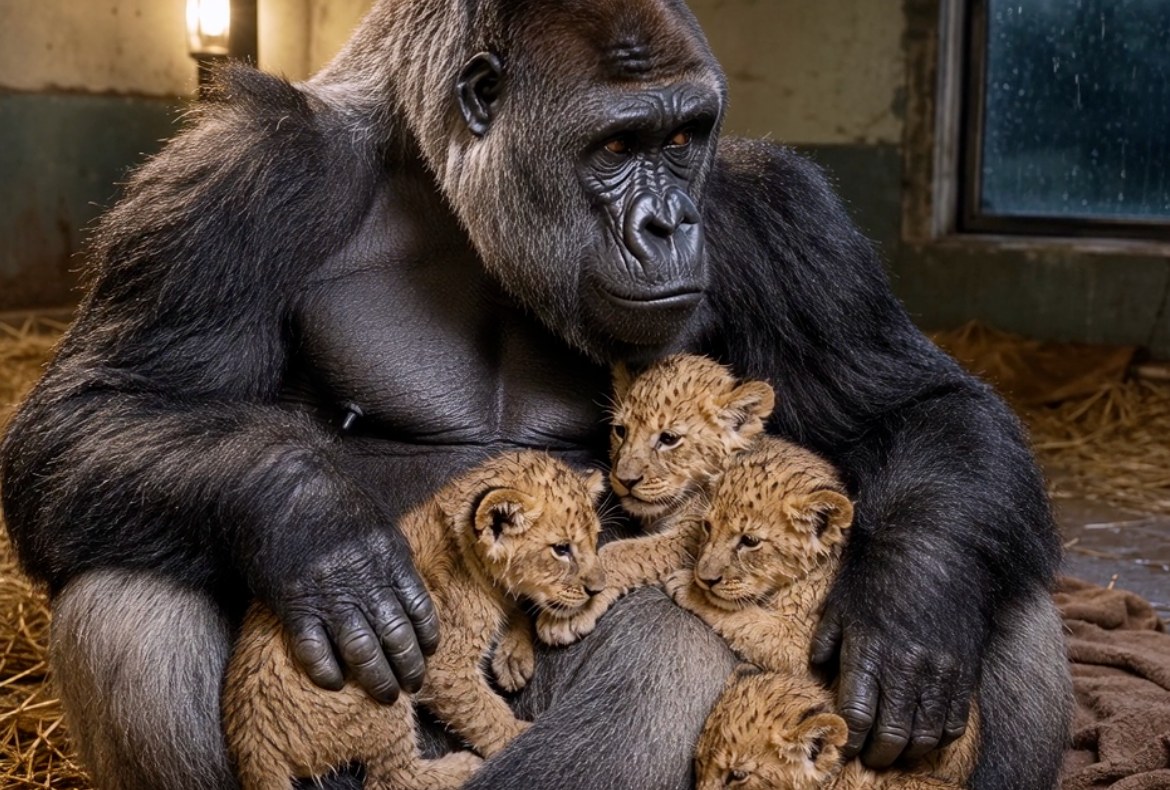
Behind us, the generator sputtered, recovered, and drowned out whatever the driver was trying to say. The cub’s cries carried above it. Three knocks answered from inside the old ape building.
Rachel turned her head toward the sound. Then she looked into the truck again.
“Show me the one who won’t eat.”
“Small female. That crate in the corner. Pale mark on her left hind foot.”
“Anything coming back up?”
“Nothing since Fairmont.”
She held my gaze until I added, “Once before that. They said there wasn’t much in her stomach.”
Rachel passed me the crate and climbed farther inside.
The storm had settled over our part of West Virginia two days earlier and refused to move. By midnight, a fallen sycamore had opened the intake building’s roof. The lower nursery was dark, two drainage crossings had washed out, and water was running down the refuge road where gravel ought to have been.
The truck had brought four five-week-old lions from a flooded roadside animal park. Their mother was already dead when the sheriff’s deputies got inside. While an inspector and the remaining staff tried to match animals to handwritten cards, the cubs had waited in a shed used for feed.
I’d called Rachel as soon as I knew they were coming.
Eight years earlier, she’d left Avelune with a veterinary degree, a packed car, and a distinction she’d asked me to respect: being my daughter wasn’t the same job as working for me. At twenty-nine, she had given up trying to do both. Her number was still at the top of our emergency sheet.
She answered every time. Without an injured animal between us, we had much less to say.
Calvin Mercer was waiting at the ape-house entrance with towels folded over his arm. They were warm enough to steam in the wet air. At fifty-two, our senior keeper had hands that could adjust a stubborn hydraulic door and then hold perfectly still while a frightened macaque decided whether to approach.
He counted the crates. Through the doorway behind him, an open viewing shutter left a bright rectangle in the wall.
“You’ve got that up?” he asked me quietly.
“He’s awake.”
“That wasn’t what I asked.”
The little female cried again, a dry, failing sound. From the next room came three deliberate taps.
Daniel had taught Gideon that greeting. Before stepping into the keeper aisle, my husband always knocked so the gorilla wouldn’t be surprised by a man at his barrier. Daniel had been gone five years. Familiar footsteps still brought an answer.
Room three had once been an ape nursery. Now it was the only dry, usable space we could heat. A concrete partition separated it from Gideon’s sleeping quarters, with a protected viewing opening built through the wall. Two fine welded-mesh barriers stood twenty inches apart; a fixed clear panel within the opening kept the rooms’ air systems separate. A steel shutter ordinarily blocked the view.
I had raised it before the truck arrived.
Rachel stopped just inside.
“Miriam. The shutter.”
“Let’s get them out of the rain.”
She looked down at the crate moving in her hands, then carried it to the rubber mat Calvin had laid on the floor.
We shut the outer door and began. Rachel unlatched carriers while Calvin warmed formula. I found the scale, towels, gloves, and the whiteboard marker that had rolled beneath a cabinet.
Two males, two females. Rachel checked gums and bellies, listened to lungs, took temperatures. One male had an abrasion over his muzzle. The larger female worked her front paws against a towel even while Rachel held her off the floor.
All four needed fluids. The small female needed warmth most urgently.
Rachel tucked her inside a fresh towel and offered a bottle. The cub pushed the nipple aside. Her head turned toward the viewing opening.
Gideon was sitting there.
He was thirty-five, an aging silverback whose broad back had begun to lose muscle beneath the silver. For twenty-one years, a now-closed amusement park had kept him without another gorilla. Later attempts at introductions had brought panic, not companionship. Specialists had helped us make changes, reassess, and try again without pretending his history could be undone by opening a door.
He had forest to watch, rooms he could choose between, food to find, things to dismantle, and people who knew his routines. At night, his nest still held one gorilla.
He brought his lips together and breathed out a soft sound.
The cub went quiet.
Rachel kept one hand beneath her chest. “We’re closing that.”
“Wait just a moment.”
“You’ve put unexamined cats beside a great ape.”
“They can’t reach each other. Nothing’s shared.”
“You don’t know that yet.”
The cub wriggled out of the towel. Rachel let her feet meet the mat rather than risk dropping her. With her head low, she made her way toward the first mesh panel.
Gideon bent forward. His right hand settled at floor level, fingers gathering loosely toward his palm against the steel. There was no way for that hand to reach the cub. She leaned against the barrier anyway.
The kneading female joined the male with the injured muzzle when he left his carrier; a towel corner came out with him. A brief, quiet grunt from Gideon finally drew their brother from under the lip of the last open crate.
Then all four were at the divider.
Rachel crouched beside the little female and brought the bottle down to her. This time, the cub took it.
Nobody spoke while she swallowed. Rachel adjusted the angle with two fingers, careful not to let the milk run too quickly. She drank less than an ounce before her mouth loosened and her head grew heavy.
It was the first feeding she’d kept down in hours.
Calvin took the larger female. I settled the rubbed-nose male against my knees, and Rachel moved to the last cub. On the other side, Gideon lowered himself onto his side, one arm extended beside the mesh.
I watched the milk level fall. Rain rattled a metal vent outside. Every so often, the generator missed a beat and made us all lift our heads.
I had worked with captive wild animals for thirty years. I’d seen people mistake stillness for trust, hunger for affection, and a tolerable arrangement for an animal’s choice. I kept my eyes on the cub’s throat and counted swallows.
When the feeding ended, Rachel marked amounts on the board and showed Calvin what to prepare next. The smallest female fell asleep with her marked foot tucked under her sister. Gideon’s arm remained where he’d put it.
I took soiled towels to the sealed laundry bin. Behind me, Rachel’s flashlight clicked on.
Its beam moved from the shutter’s orange handle to the little metal record tag below it. No date. No initials. No reason entered for opening the barrier.
The light dropped to the track.
I had forgotten the blue-handled screwdriver. Earlier that day, the shutter had stuck halfway. I’d worked the tool beneath its bent guide and forced it past the obstruction. The storm had worsened before I went back to it.
Rachel bent and picked it up by the clean end of the handle.
“How long before I got here did you do this?”
To read the rest of the story – CLICK the NEXT button 👇👇👇