


Victor Alden had put his briefcase on the empty aisle seat, and he was beginning to hope nobody would claim it.
From 18B, he could see very little of the airport outside Raleigh except a baggage tractor passing beneath the window and a strip of pale October sky. His laptop balanced badly on the tray. Every time someone bumped the row behind him, a column of figures jumped beneath his fingers.
The flight was already seventeen minutes late.
He checked the meeting invitation again, although nothing about it had changed. Portland, a rental car, a drive across town, then an afternoon spent explaining why another department’s delays had become his problem. His company had recently decided that operations directors didn’t need extra legroom. Apparently, they didn’t need aisle seats, either.
A hand settled on the end of his row.
Victor looked first at the fingers. There was a pale seam across the knuckles, and the hand stayed braced against the seat as though its owner needed a moment before taking another step.
“Eighteen C,” a woman said. “I think your bag’s in my spot.”
He pulled the briefcase toward him with one foot. His knees were angled into her space, too, and he drew them back just far enough to clear the way without getting up.
She waited until he’d finished.
The woman wore a faded navy hoodie despite the warm cabin. Its collar was gathered high on one side, and her short hair had gone nearly white above her ears. Victor guessed she was around fifty. She carried a sand-colored canvas duffel with worn handles and a lighter rectangle where somebody had removed a name strip.
There was no wheeled suitcase behind her. No purse cutting across her shoulder. Just that one bag, held close enough that the canvas pressed a crease into her sleeve.
Getting into the seat required care. She turned her left foot first, lowered herself a little, stopped, then tried again. Victor lifted his laptop out of her way, more to protect it than to help.
Once seated, she drew the duffel onto her thighs and worked her foot beneath the row ahead. Her mouth tightened. She waited for it to ease before reaching for the belt.
Victor returned to his figures.
He had seen exhausted passengers before. People with bad knees, people frightened of flying, people who brought too much into a cabin and expected everyone else to accommodate it. He was good at making himself unavailable. A screen, a pair of earbuds, the right degree of absorption usually did the job.
Beside him, the woman rested both forearms across her bag.
Two rows forward, First Lieutenant Peter Walsh was trying to free a twist from the collar of his service dress shirt without loosening his tie.
“Next time,” he said, “I’m changing before we leave the base.”
Captain Nathan Mercer had been about to answer. They had spent the morning finishing a round of training business, and Peter had already made three complaints about traveling in uniform. Nathan had enjoyed all three. A commercial seat, even one with a reluctant recline, felt generous after a cockpit.
Then the boarding line opened for a moment, giving him a clear view down the aisle.
He saw the woman’s profile.
His hand stopped on the buckle in his lap.
Peter tugged once more at his collar. “You listening?”
Nathan leaned slightly into the aisle. The woman in 18C was looking down, but the light above her row fell across her jaw. An old burn drew an uneven line from below her ear into the neck of her sweatshirt.
He knew that face from a classroom photograph taken before the injury. He knew where the burns had been described in the case study. Most of all, he knew the eyes when she briefly glanced toward the boarding door.
“Peter.” His voice had lost its ease. “Behind us. Aisle seat.”
Peter looked, then looked back at him.
“The scarred woman?”
“Major Dana Kessler.”
Peter’s fingers left his collar.
For a few seconds, neither officer spoke.
They had learned her mission in blocks: the ground team’s position, the weapons she had left, the fuel calculation, the final turn. Instructors had stopped the recording and asked young pilots what they would do. There had never been much comfort in knowing what she had done.
Her call sign was Rook.
In training rooms at desert bases and squadrons overseas, her name still came up whenever someone tried to make combat decisions sound tidy. The available gun-camera footage was poor, the last section badly disrupted, but it was shown anyway. Students watched the terrain rise toward the lens. Then the recording ended.
The accounts that followed were less consistent. Nathan had heard one version in which the pilot never survived the wreck and another in which she recovered almost completely. A man at a training course had insisted she’d gone back to flying somewhere nobody could discuss.
None of those stories included a stiff-legged woman guarding a battered duffel in the economy cabin of Flight 671.
Peter looked again. “Are you sure?”
Nathan was already unfastening his belt.
Victor noticed the officers when the nearer one stood. He assumed they needed something from an overhead compartment and bent closer to his laptop, prepared to ignore the interruption.
But no compartment opened.
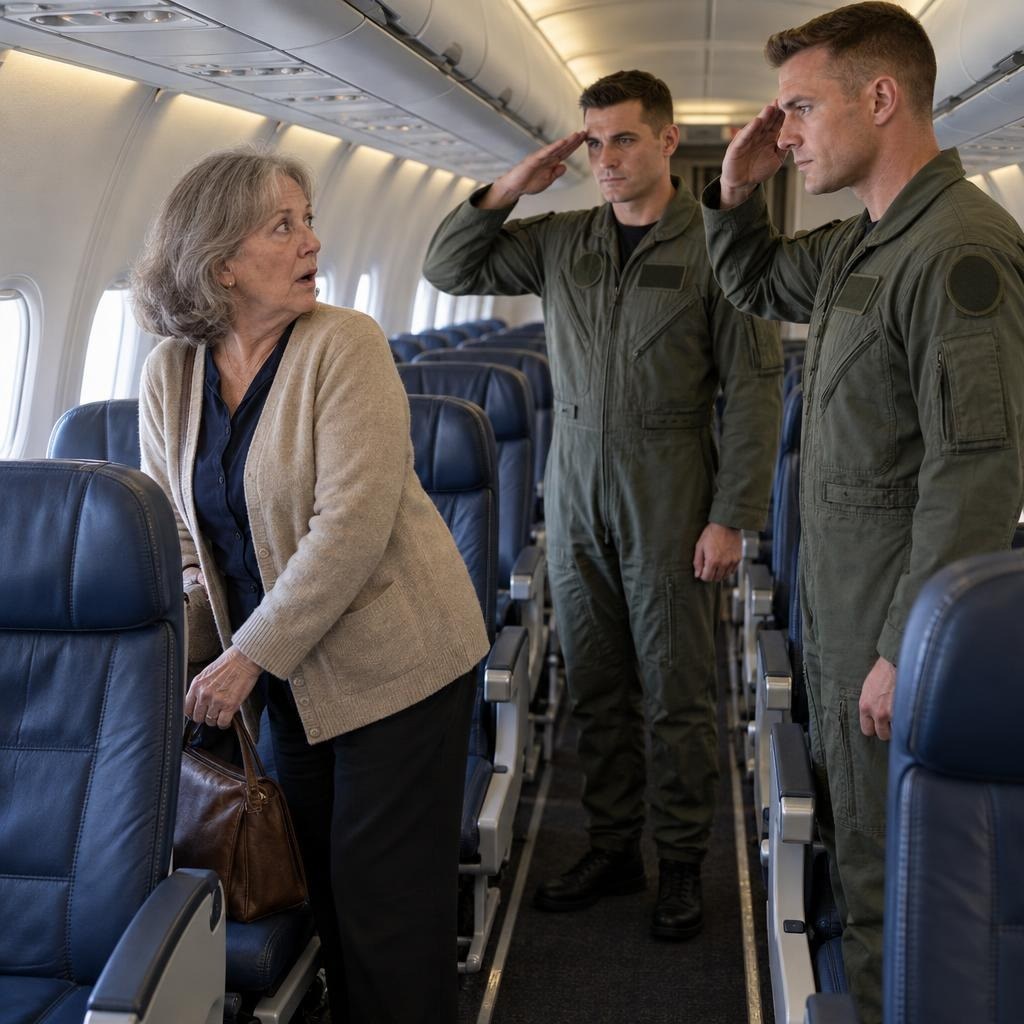
Nathan turned toward row eighteen. Peter stood beside him, all the loose humor gone from his face. Their heels settled. Nathan brought his hand to his brow, and Peter followed.
“Major Kessler, ma’am.”
The words were spoken with enough precision that the conversations nearest them stopped. A flight attendant carrying a stack of napkins paused beside the galley. Farther back, someone removed an earbud.
Victor looked at the woman beside him.
Her head had come up sharply. She stared at the two uniforms, then past them, as though searching for a door she might still use. One hand tightened around a duffel handle until the tendons stood out beneath the damaged skin.
The officers held their salutes.
The silence spread toward the rear of the aircraft. A child asked a question and was gently hushed. The woman’s eyes moved over the faces now turned toward her, and she pulled her collar closer with her free hand.
“Captain, I’m retired. Please don’t do this.”
Nathan held the salute.
Victor’s spreadsheet dimmed from inactivity. He had one finger resting on a number he could no longer remember entering.
The woman looked at Peter, perhaps hoping he would be easier to persuade. His expression was solemn, almost bewildered. Neither officer appeared to notice the passengers watching them.
She swallowed.
“You’re making a mistake,” she said, but there was no conviction in it. Her voice had become thin with the effort of keeping it steady.
Nathan’s chin lifted a fraction.
“No mistake, ma’am. We owe you this…”
To read the rest of the story – CLICK the NEXT button 👇👇👇