


Water crept beneath the lid of Mabel Danner’s cardboard box. She lifted it off the table, too late to save one corner, and held it against her chest.
The lawyer’s blow had sent the pitcher skidding. Now he was leaning across the divider, one hand planted beside her purse, telling her what she ought to do. Mabel could see a pale thread caught in his cuff. For most of her life, she would have reached for her scissors and snipped it away.
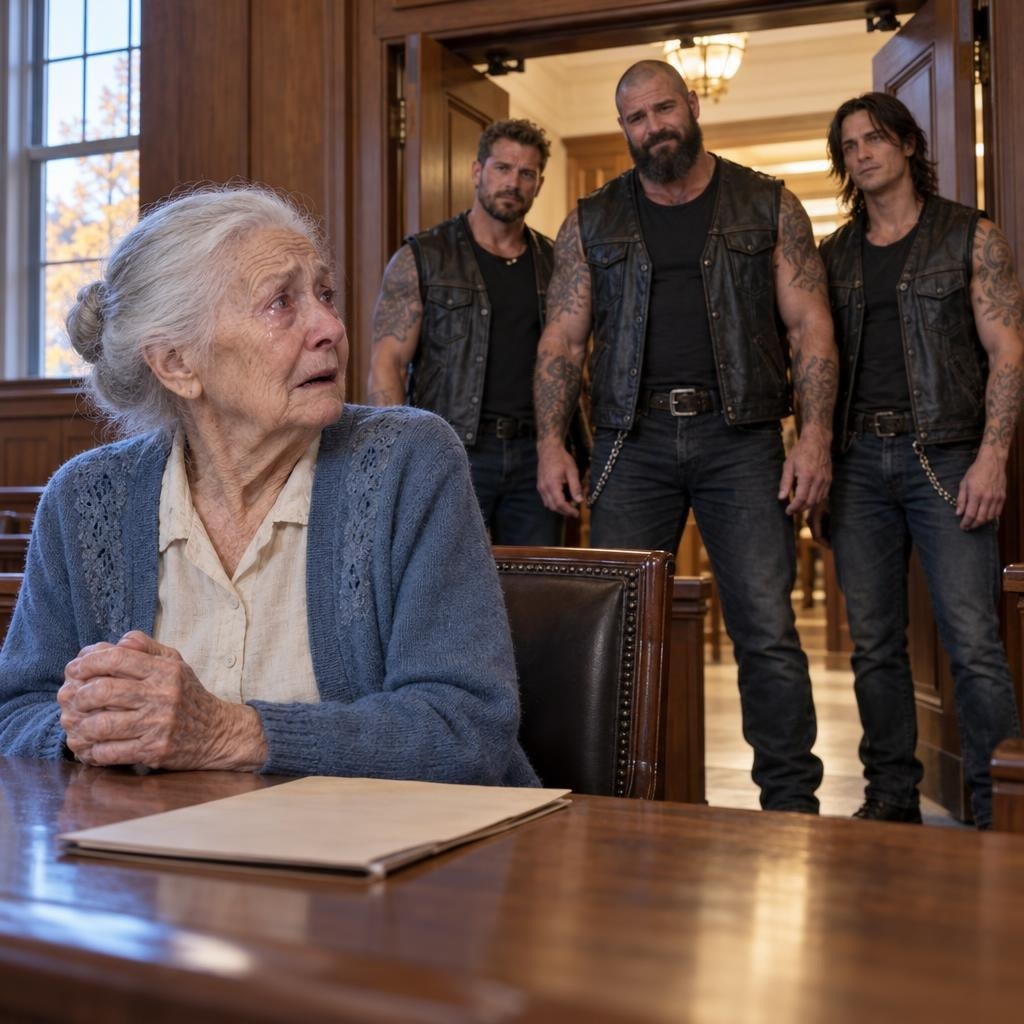
She kept her hands on the box instead.
At the other table, Victor Kessler eased back in his chair. Behind Mabel, three rows of benches stood empty except for a man waiting on an unrelated case.
The lawyer tapped the table beside her.
“Are you listening to me?”
Long before anyone questioned her right to it, the house on Fulton Street had announced itself by the sound of Mabel’s sewing machine. In summer, with the windows raised, neighbors could hear it from the sidewalk: a quick run of stitches, a pause, then the little metallic click of her scissors.
Dunley, Pennsylvania, had once run on a louder rhythm. The mill beside the river had brought men home with grit in their collars and pay envelopes in their pockets. It had been closed for almost three decades. Now the town’s only traffic signal blinked amber through the night, and weeds grew through the loading yard.
Mabel had lived in her white clapboard house for fifty years. Her husband had added the back room, cutting boards on sawhorses in the yard and carrying every scrap inside himself. Years afterward, the dust he’d breathed at the mill finished its work in his lungs.
His workbench remained in the garage. Mabel’s sewing machine stayed by the front window.
People brought her trouble in grocery sacks: split seams, broken zippers, trousers worn thin at the knees. A bride once arrived with a gown that wouldn’t close and a wedding three days away. Mabel moved the fastenings, let out what she could, and worked a strip of matching fabric into the back so neatly that the bride cried when she saw it.
Payment went into an old tea tin on the windowsill.
“Whatever you’ve got,” Mabel would say, sliding it within reach.
She never shook it afterward to hear how much had landed. Sometimes nothing did.
For thirty years, she repaired one millworker’s overalls. After he died, his daughter brought over a clean shirt with a torn cuff. Mabel finished it that evening, pressed it, and carried it to the funeral home herself.
The three brothers came into her life through a conversation beside the church coat rack.
Their parents’ car had slid off an icy county road. Russell Pike was twelve, Nolan nine, and Wade had just turned six. No relatives offered a home. The county had found placements, but not together; each boy would be sent to a different town.
Russell had gone silent when someone explained that to him. For three weeks he answered no one, not even his brothers. His file acquired a note about his refusal to communicate.
Mabel asked where the boys were staying.
She was fifty-four then, a widow with two bedrooms and savings that needed to last. The county worker who came to inspect the house stood in the spare room with her clipboard tucked against her ribs.
“Three grieving children will need more than beds, Mrs. Danner. Especially the oldest.”
Mabel moved a basket of folded fabric off the second bed.
“There’s room for a third in here.”
“I need you to understand what you’re taking on.”
“Then explain it. But don’t send me one without the others.”
When the placement papers were ready, she signed for all three.
Russell tested the house first.
He sent a baseball through a window while looking straight at it. Mabel swept the glass into a dustpan and put plywood over the opening until she could afford a replacement. Twice he ran away. The second time, she walked the county road in rain that soaked through her coat, calling until her throat hurt.
She found him on the guardrail near the curve where the car had gone over.
He wouldn’t look at her. Water dripped from his hair onto his clasped hands.
Mabel sat beside him. When a truck passed, she put her arm across his chest and held him back from the road. They stayed there until he let her take him home.
Nolan’s grief made less noise. He woke in wet sheets and tried to wash them himself before anyone noticed. Mabel began leaving clean bedding where he could reach it. If she heard him crying for his mother, she came in without turning on the overhead light.
Wade woke screaming. Sometimes he shoved at her because, for a few frightened seconds, he didn’t know who she was.
She learned to speak before touching him.
“It’s Mabel. Your brothers are right here.”
Then she sat on the floor, one hand resting between his shoulder blades, and told him about a foolish hen she’d known as a girl. He wanted the same story every night. She told it until he slept, then returned to the sewing machine.
Some nights the needle was still moving at two in the morning.
Three boys could empty a pantry with astonishing speed. Mabel doubled her orders. She wore the same two dresses until the cuffs shone and bought shoes for feet that seemed to grow overnight. When winter coats became necessary, her husband’s good watch disappeared from its little case.
The boys never saw her sell it.
After Russell’s first school fight, she cleaned the cut above his eye at the kitchen sink. He kept jerking his face away, furious with her for seeing him hurt.
“What did he say?” she asked.
Russell stared at the faucet.
“Was it about your folks?”
“He said nobody wanted us. Said we were somebody else’s garbage now.”
Mabel set down the cloth. With two fingers beneath his chin, she made him meet her eyes.
“You belong here. He doesn’t get to decide otherwise.”
Russell’s mouth twisted. He tried once to swallow it down. Then he folded against her, and she held his head beneath her chin while the water ran into the sink.
The dog arrived not long afterward, carried between the brothers in an old sweatshirt. They had found him behind the abandoned mill, a half-grown, wiry little mongrel with one ruined eye and old injuries that looked like someone had fired at him.
Wade called him Lucky because, he insisted, the dog had gotten away.
Mabel looked at the sharp ribs beneath the matted coat.
“We can barely feed everybody who already lives here.”
She said it while reaching for a bowl.
Lucky attached himself to her before the first week was over. Even when the boys called him, he checked to see whether Mabel was coming.
The years filled the house with elbows, boots, and noise. Russell dragged a broken motorcycle into the garage and reduced it to a collection of oily parts he couldn’t identify. Nolan sorted the pieces. Wade fetched tools and asked questions until Russell threatened to stuff a rag in his mouth.
They spent most of a summer getting it running.
Mabel taught them to mend a tire before she let them take it down the street. She also taught them what she expected when they came home with blood on their clothes.
“I won’t have you looking for a fight,” she told them at supper. “But if somebody’s being hurt, you don’t turn your back to keep your own shirt clean.”
They grew into men who remembered that distinction, even when they weren’t especially good at keeping their shirts clean.
Work took them out of Dunley. They rode away on motorcycles, first one brother and then another, following jobs and each other into places where there was still something to repair, haul, or build. Eventually they joined an outlaw motorcycle club whose colors made strangers reconsider what they were about to say.
Mabel kept their photographs beside her bed.
On birthdays, cards arrived with cramped messages inside. At Christmas, there was money tucked between the pages, more than she knew they could comfortably send. Every Sunday, wherever they were, a telephone rang in her kitchen.
To the people who stepped aside when they saw the brothers coming, they were men to avoid. Mabel still reminded them to wipe their boots.
Victor Kessler began buying property around Fulton Street the year before the hearing. He was a developer from Pittsburgh, practiced at finding towns where abandoned buildings cost little and the people next door had grown tired of waiting for things to improve.
A proposed highway interchange had caught his attention. If it went through, the land he was buying would become useful to people with much larger checkbooks.
He acquired most of Mabel’s block before coming to her door.
She listened to his offer in the front room, with a pair of work trousers lying across her lap. When he finished, she threaded her needle.
“I’m staying.”
He raised the amount.
“My husband built half this room,” she said. “My boys grew up here. You’re asking the wrong question.”
Kessler left his card on the table. She put it beneath a spool so it wouldn’t blow onto the floor when the window was open.
The envelope arrived on a Tuesday in April.
Mabel read it at the kitchen table while Lucky slept beside her chair. Twenty years had made his muzzle white and his joints stiff, but the old dog still stirred whenever her feet moved.
The letter claimed there had been a property transfer. It referred to a loan, a lien, and a balance she supposedly hadn’t paid. Another page demanded possession of the house. There were thirty days, a hearing date, and language about removal if she refused to leave.
She turned back to the first page.
She had never borrowed the money.
Her husband had paid off the mortgage shortly before he died, more than twenty years earlier. She could still remember him burning the satisfied mortgage papers in the sink, then taking her by both elbows and dancing her around the kitchen while the last black curl of paper cooled.
Mabel went to the closet and reached above the hanging coats. Her deed was in a flat cardboard box that had once held sewing patterns.
She laid the old document beside the new letter.
Both carried her name.
Only one of them was true…
To read the rest of the story – CLICK the NEXT button 👇👇👇