


The woman behind the pastry counter looked at Beatrice’s empty hands, then at the plain raincoat she wore.
“Thirty-eight dollars,” she repeated. “For the little vanilla cake. Not the whole display.”
“I understood you.” Beatrice searched one coat pocket, then the other. Her purse was in the car. Curtis had taken the car around the block while she browsed. “I’ll call my grandson. He’s coming.”
The second employee stopped arranging paper doilies.
“Della, don’t box it. She hasn’t got anything.”
Beatrice lowered her phone. She had chosen to come into Orlisse without jewelry, without a driver opening the door, without anyone announcing her last name. She wanted an ordinary afternoon. Now both young women were looking at her as though she had tracked mud across their floor.
“My purse isn’t far away. Give me a few minutes.”
“We’re expecting customers,” Della said.
“What am I?”
Joyce laughed under her breath. Della put the cake back in the case.
Beatrice had been poor long enough in her youth to recognize the change in a person’s face when they decided she didn’t matter. Still, she hadn’t expected it here, over something as small as a cake for Nathan.
“I’ve asked for time to make a call,” she said. “There’s no need for this.”
“There’s a sandwich place down the street. Try there.”
Della came around the counter. When Beatrice didn’t move quickly enough, the young woman caught her elbow and shoved her toward the entrance.
Her heel caught the edge of the mat.
Someone outside dropped a canvas bag and caught her before she struck the doorframe.
“Easy. I’ve got you.”
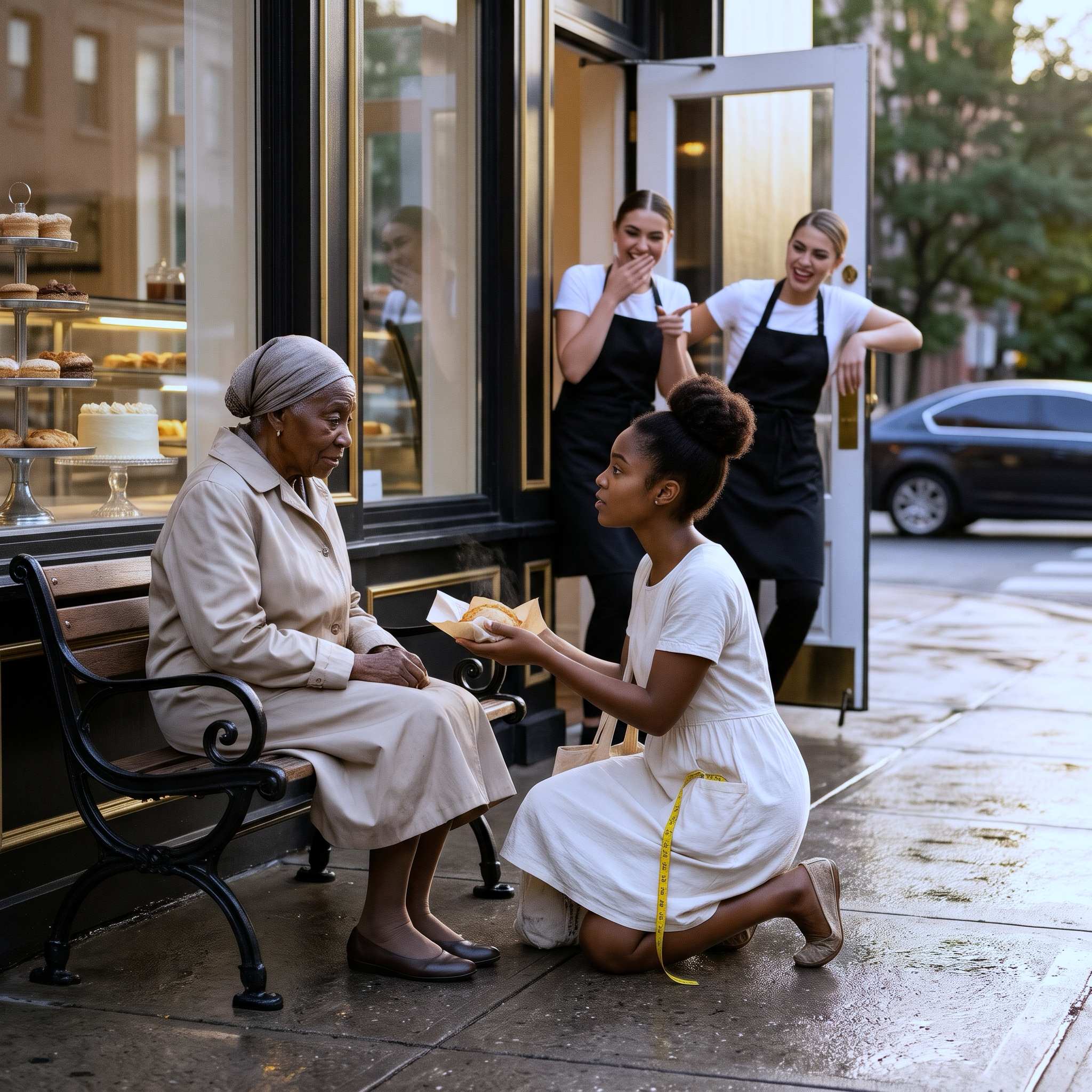
The young woman supporting her had a dressmaker’s measuring tape hanging from one pocket. A loose bundle of clothing had spilled from her bag onto the sidewalk.
“Did she hurt you?”
“Only my opinion of this establishment.”
The young woman kept a hand beneath Beatrice’s arm until she was steady. Then she faced the doorway.
“You pushed her.”
“This doesn’t involve you,” Joyce said.
“I was standing right here. She asked to use her phone.”
Della’s gaze traveled over the young woman’s worn flats and mended tote.
“You shopping, or just giving speeches?”
“What does the cake cost?”
“Thirty-eight. Can you manage that?”
The young woman opened the small purse tucked inside her bag. Beatrice saw folded bills, a few coins, and a bus card with its corner peeling.
“No,” she said, closing it. “But that doesn’t make either of us yours to shove around.”
“You two should go together,” Joyce said. “Save us another argument.”
The young woman collected her clothes without answering. A blouse had fallen near the curb; she shook off a maple seed and folded it with practiced care.
“Come sit down,” she told Beatrice.
There was a narrow bench beside the bakery window. Beatrice sat while the young woman settled the bag at her feet and took out a paper-wrapped hand pie.
“Here. It’s chicken. Still warm, I think.”
“You haven’t eaten it.”
“I can wait.”
Beatrice looked at the slight hollows beneath her cheekbones.
“And what will you eat?”
“I’ve got customers coming this afternoon. I’ll figure something out.” She opened the wrapping so Beatrice wouldn’t have to struggle with it. “Please. You were shaking.”
Beatrice accepted the pie. Through the glass, Della and Joyce were straightening a display that needed no straightening.
“What’s your name, sweetheart?”
“Emmeline Holt. Emmy’s easier.”
“I’m Beatrice Vale.” She waited, but the young woman only smiled. “You can call me Miss Bea.”
“All right, Miss Bea.”
Beatrice held out her phone. “Put your number in here. And send me where you sell those clothes.”
Emmy hesitated before taking it. Her fingernails were short, one thumbnail marked by a faint blue tailor’s chalk stain.
“Do you make them?” Beatrice asked.
“All of them.”
“Then I want to come look.”
“I’d like that. I really do have to go, though.”
She checked the time, lifted the heavy bag, and hurried toward the crosswalk.
Beatrice finished the first bite slowly. Plenty of women had brought her flowers after learning who she was. This one had walked away hungry without learning a thing.
A dark sedan pulled to the curb a few minutes later. Inside the bakery, Joyce grabbed Della’s wrist.
Nathan Vale got out before Curtis could reach his door. At twenty-seven, he had acquired the habit of looking composed even when he was annoyed. Beatrice recognized the tightness around his mouth.
“I left a meeting,” he said. “Are you all right? Why are you eating out here?”
Beatrice held out her hand. “I’ve found you a wife.”
Nathan stopped beside the bench. “You called me about a wife?”
“And now she’s gone. You took your time.”
“I came as soon as you called.”
“Then help me up.”
“Grandma.”
“She sews beautifully, she has manners, and she isn’t frightened of unpleasant people. We’re going to her stall.”
He looked toward Curtis, who suddenly found the sedan’s door handle fascinating.
“You met her today?” Nathan asked.
“Yes. And you’ve had twenty-seven years to arrange this yourself.”
Beatrice handed him her phone with Emmy’s address on the screen.
“Curtis knows where that market is. Let’s not keep her waiting.”
Emmy had barely hung the first row of dresses when Roland Pike called.
She let the phone vibrate twice before answering. Across the market lane, a man was unloading sweet potatoes from a pickup. If she concentrated on the thud of the crates, perhaps her own voice would remain steady.
“Mr. Pike.”
“Don’t waste my afternoon being polite. What have you got for me?”
“I’m working on it.”
“You’ve been working on it for years.”
There was no answer she hadn’t already given him. Her parents had trusted a family friend who offered them an investment with regular returns. At first, payments arrived. Then they put in their savings and borrowed more. By the time the accounts stopped making sense, the friend was gone.
Her father had become ill while creditors were still coming to the house. Her mother had outlived him by less than two years. Emmy had turned eighteen in time to put her own signature beside her mother’s on one desperate refinancing agreement.
She had sold the house after the funeral. Furniture, her father’s tools, her mother’s good dishes, almost everything followed. The remaining debt, the part bearing her signature, still stood at $140,000.
“I need a little longer,” she said.
“Friday. Then I come down there.”
“Please don’t make a scene at my stall.”
“I’ll wreck every garment on those rails. Then I’ll tell the whole market what your parents left unpaid.”
“They were cheated. They weren’t dishonest.”
“Then pay what they owed.”
He ended the call.
Friday was three days away. She counted the jackets on the rail, though she already knew their number. Even at full price, every garment together would barely dent the balance.
She pressed a clean scrap of lining beneath her eyes. A customer wouldn’t buy a blouse from someone crying over it.
An expensive sedan stopped beyond the market’s loading spaces.
Miss Bea emerged first.
“I told you I was coming.”
“So soon?” Emmy slipped the lining scrap into her pocket. “I haven’t even set everything out.”
The man beside Beatrice glanced at her face, then away, giving her a moment to compose herself.
“This is Nathan,” Beatrice said. “My grandson.”
He was tall, neatly dressed, and more handsome than Emmy was prepared to deal with that afternoon.
“Hello,” she said.
He nodded toward a jacket. “You did the tailoring?”
“Yes.”
Beatrice ran two fingers along a finished seam inside a sleeve.
“Where did you learn?”
“College. Fashion design.”
“And nobody’s employed you?”
“I’ve had interviews. Usually they want somebody who’s already worked for a label. Or somebody who knows somebody.” Emmy straightened a hanger. “This keeps me sewing.”
“Good work doesn’t become bad work because it’s sold beside a parking lot,” Beatrice said.
“Thank you.”
“My grandson needs someone sensible around him.”
Nathan closed his eyes briefly.
“Grandma, don’t.”
“He’s unmarried,” Beatrice continued. “No girlfriend, either. He owns—”
“I work for a company,” Nathan interrupted. “An ordinary job. That’s my employer’s car.”
Emmy glanced at the sedan.
“Your grandmother made it sound as though—”
“She likes improving my circumstances when she introduces me.”
Beatrice stared at him. He returned the look without blinking.
“Fine,” she said. “He’s employed. He’s healthy. You could do much worse.”
“I just met him,” Emmy said.
“And you’re getting along already.”
Nathan put his hands in his pockets. “We’re standing near each other. That’s different.”
Beatrice ignored him.
“What would it take for you to marry him?”
Emmy gave an exhausted little laugh.
“About a hundred and forty thousand dollars.”
Nathan’s expression shut.
She regretted saying it immediately.
“I’m sorry. That wasn’t funny. I’ve had a difficult phone call.”
Beatrice waited.
“My parents left debts. I’ve paid everything I could. That’s what’s left. I’m not asking either of you for it.”
“I’ll pay it,” Beatrice said.
Emmy gripped the empty hanger in her hand.
“No. You can’t.”
“I can. You and Nathan marry legally. The debt goes away.”
“We can’t marry for money,” Emmy said.
“No,” Nathan said. For the first time, she thought he agreed with her.
Beatrice looked between them. “You can treat each other decently. There are marriages that start with less.”
Emmy set the hanger down before she snapped it.
“I don’t even know where he lives.”
“A rented place,” Nathan said. “Nothing impressive.”
“And I’m not looking for somebody to rescue me.”
“You’d still do your work,” Beatrice said. “You’d simply stop paying for somebody else’s crime.”
Nathan looked at Emmy’s packed rails, her battered cash box, the phone she kept turning facedown.
“All right,” he said.
Emmy stared at him.
“You’re agreeing?”
“Yes.”
She couldn’t tell whether that made the offer easier or worse.
“I need to think.”
Beatrice took a card from her coat and wrote an address on the back.
“Come here tomorrow morning if your answer is yes.”
“Tomorrow?”
She laid the card on the cash box.
“I’ll arrange the appointment. You decide whether to use it…”
To read the rest of the story – CLICK the NEXT button 👇👇👇