


Tessa had both arms raised when the first motorcycle reached her. She could see the rider’s fingers tighten on the brake. Behind him, engines changed pitch, tires scraped grit, and somebody shouted from deep in the line.
She stayed in the lane.
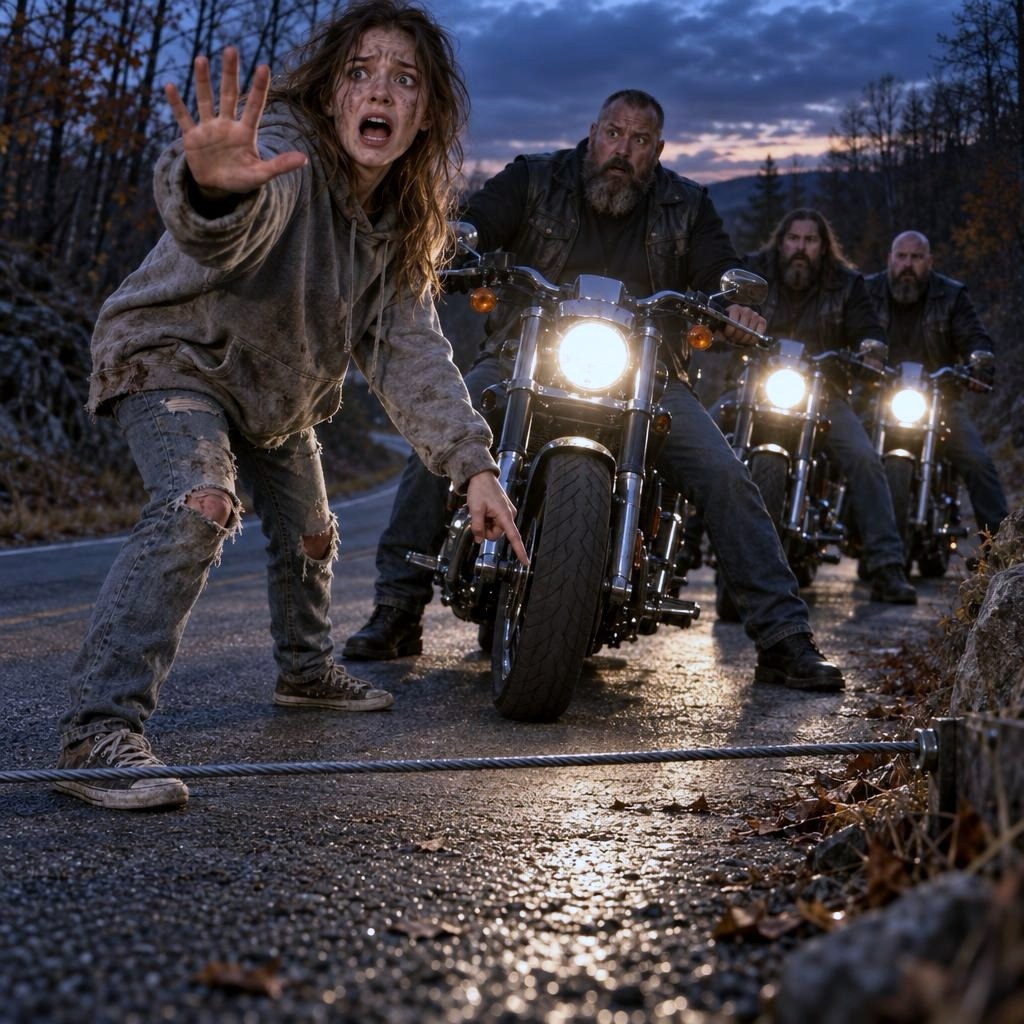
The lead rider stopped close enough for her to feel heat coming off his engine. A spare helmet was fastened behind his seat. He looked past her toward the downhill bend, then back at her shoes.
“Get out of the road!” a broad man yelled, pulling up beside him. “I nearly put my bike in the ditch.”
“There’s oil at the bridge,” Tessa said. “Two men are waiting across it. One has a rifle.”
The broad man killed his engine. “And we’re supposed to believe that?”
“The rail’s been loosened. Right after the turn.” She had to swallow before she could finish. “There’s somebody underneath, too.”
The leader raised one hand. Engines shut down along the line until Tessa could hear insects in the roadside grass.
A gray-bearded rider dismounted and looked at the black stains around her soles.
“Could be a way to get us stopped,” the broad man said. “Could be she wants paying.”
Tessa stepped back from him. “Keep your money. Just don’t go down there.”
The leader took off his gloves slowly.
“Off the pavement,” he told the others. “Leave room between the bikes.” Then, to her: “Give me something besides oil.”
“There’s a boy in a boat by the second support. I fish farther up the bank. His radio was loud enough I heard somebody say a man at the church would tell them when you left.”
Nobody interrupted her now.
“They said the older rider would be leading. With an extra helmet.”
The leader’s eyes went to the helmet behind him.
“I put that on in the church parking lot.”
“So she saw you,” the broad man said.
“The church is eleven miles behind us, Brute. We left fifteen minutes ago.” The gray-bearded rider studied Tessa’s cracked sneakers. “She didn’t beat us here on those.”
Tessa rubbed her palms against her shorts. “The radio said you’d come fast because you were grieving.”
The leader’s glove stopped halfway into his pocket.
“Did you call anybody?”
“I don’t own a phone.”
“Police car been through?”
“One was here around six. The deputy passed coffee out his window to a man by the truck.”
The leader turned to his companions. “Stitch. Brute. Come look.”
Brute’s jaw worked. “Parson, I’m not taking everybody downhill on her say-so.”
“Neither am I. I’m going to look.”
“If she’s walking us into something, she can walk first.”
Tessa was already moving toward the trees. “That’s where I was headed.”
The leader caught up beside her without touching her.
“Raymond Sutter,” he said. “Usually Parson.”
“He’s a church deacon,” Stitch added. “We weren’t particular about titles.”
“Tessa Quinn.”
Her path left the shoulder through a gap in the brush. Below it sat a little fishing camper, one tire sunk to the rim. A blue tarp covered part of the roof.
“You staying there?” Raymond asked.
“Yes. Except when the floor gets wet.”
“How long?”
“Fourteen months. Since foster care ended.”
“You’re nineteen?”
She nodded.
Stitch pushed a branch aside for her. “What do you live on?”
“Whatever I catch. Sometimes the church has food.”
Raymond noticed the writing along her forearm: crowded numbers, letters, times.
“License plates,” she told him. “People come creeping down here, I remember them better if I write them.”
“You could’ve stayed out of this.”
Tessa ducked beneath a limb. “Last winter I got sick. Passed out beside state route nine. I counted eleven cars before somebody stopped.”
She waited for him to clear the branch.
“I’m car twelve today.”
At the next opening, she dropped to a crouch. The men followed her gaze across the water.
A gray flatbed stood in the turnout beyond the bridge. One man leaned against its bed. Another, wearing an orange work vest, held a long gun against his leg. The bridge railing leaned outward by barely an inch.
“Truck. Men. Bad railing,” Brute muttered. “Still don’t see oil.”
“You won’t from here.”
They worked down through the trees. At the pavement’s edge, Raymond knelt and laid his bare palm against the curve. When he lifted it, a dark film covered his skin.
Stitch said nothing. He took a picture.
Tessa pointed beneath the bridge. The boat sat almost motionless against a piling, its bow rope disappearing around the concrete.
“He’s been there since before daylight. Never put a hook in.”
Raymond watched the boy lift a radio.
“The rail gives,” he said quietly, “and the river gets whoever comes through that turn.”
“Some could swim,” Brute said.
Tessa kept looking at the boat. “That’s why he’s there.”
Back above the bend, Stitch opened a saddlebag. He handed her a wrapped sandwich while Raymond made a call.
“When’d you last eat?” Stitch asked.
“Yesterday. At the fellowship hall.”
“Ham all right?”
She nodded, taking care not to tear the bread as she unwrapped it.
Raymond gave the dispatcher the road number and the old ferry bridge, then stopped her when she mentioned county deputies.
“State patrol. Please. Is Sergeant Keene working? Tell her Raymond Sutter called.”
He listened, his eyes on the descending road.
“Forty minutes,” he told the others.
“They expected us twenty minutes ago,” Brute said. “We wait, they leave.”
“And next time they know where I sleep,” Raymond said.
“There’s a gravel crossing,” Tessa told him. “Past my camper, around the bend. The water’s been low since August.”
He asked her to show him from the ridge. She pointed out the old landing, the pale strip of gravel, the dark patch where a foot would sink.
“Stitch, take eight down her trail. Get the boy and that radio. Two men stay with Tessa. Everybody else comes across with me.”
Brute looked toward the rifleman.
Raymond met his eyes. “No charging in. No throwing punches. We let them look around and count.”
“And if he starts shooting?”
“We’re not starting it.”
Tessa followed him toward his motorcycle. “I can take you down.”
He unfastened the spare helmet and put it in her hands.
“Keep this here for me.”
“I know the soft places.”
“You’ve shown me. You stay with these bikes, whatever you hear.”
She tightened her fingers around the chin strap as the men disappeared into the trees.
Below the bridge, Stitch reached the boat before its occupant understood the sounds behind him. The boy scrambled backward, rocking the narrow hull.
“Hands where we can see them,” Stitch said. “Then come ashore. You can stand there.”
Across the river, the man in the orange vest kept calling into his radio.
“Jesse? Answer. They should’ve come through already.”
Raymond stepped out of the timber. Men appeared behind the flatbed and along the turnout’s other edge.
“You can keep calling,” he told the rifleman. “We’re not leaving.”
The rifle came up. A shot cracked over the river.
Tessa was running before either guard could stop her.
“He told you to stay!” one called.
She kept to the dry edge of the road, the helmet knocking against her leg. At the turnout, men were lowering the rifleman to the ground. His companion was already sitting beside the truck, wrists secured behind him.
“Who got hit?” she demanded.
Raymond turned sharply. “Nobody. He fired overhead.”
“How many came back?”
“Every one.”
Stitch came up from the river with the boy, who couldn’t seem to stop shaking.
Beyond them, a small cross stood in the weeds beside the bridge approach. Tessa had passed it hundreds of times.
Raymond followed her glance.
“My nephew. Micah. Twenty years old.”
She looked at the helmet she was carrying.
“Eight months ago, Owen Harlan hit him with a pickup and drove on. I was riding behind Micah. Saw the whole thing. Read the plate before that truck disappeared.”
“Was he arrested?”
“He said somebody stole his truck. His trial starts tomorrow at nine.”
“And you’re the witness.”
“The only one who saw that plate.” Raymond looked down the curve. “His father’s Victor Harlan.”
Tessa looked from the oil to the cross.
Raymond’s mouth tightened. “One dead witness brings questions. A memorial ride wrecks on a bad turn, people say we rode too hard.”
The boy in Stitch’s grip began talking.
“They told me nobody was doing anything. Just an accident. I only sat in the boat.”
“I saw you,” Tessa said. “You were there before the sun came up.”
Raymond crouched in front of him. “And if somebody climbed out of the water?”
The boy stared at the dirt.
“When they found all those bodies, Jesse, who would’ve been closest?”
“Keep quiet,” the rifleman snapped.
A county cruiser came down the hill. Its tires crossed the center line before the bend, then returned to the right beyond it.
The deputy parked beside the flatbed and got out, one hand resting on his belt.
“Somebody want to explain why you’ve got three men tied up on my road?”
To read the rest of the story – CLICK the NEXT button 👇👇👇