


The breadbasket had been placed behind the lectern so it wouldn’t show in photographs. Tessa Navarro knew because she’d moved it twice at the event coordinator’s request.
Now a woman in a frayed coat stood beside it, one hand resting on the white tablecloth.
“Would anyone mind if I took a roll?” she asked. “I haven’t had a proper meal since the day before yesterday.”
Onstage, Dahlia Mercer paused beneath a photograph of herself distributing grocery bags. She had just told the donors about seeing a hungry man outside her father’s shop when she was little, and how that encounter had inspired her charity work.
“Gordon,” she said, lowering her microphone. “Deal with this.”
The banquet manager hurried over. His polished shoes stopped inches from the woman’s worn sneakers.
Tessa was gathering empty glasses nearby. She watched the woman pick up a roll, then set it down when Gordon Pike caught her wrist.
“For the invited guests,” he said.
The woman looked toward the stage. “But I thought feeding people was the reason everybody came.”
Several donors turned. Dahlia handed off her microphone and approached with the smile she used when a photographer needed one more picture.
“Our work involves fundraising and public awareness. You can’t simply wander into a private function.”
“What happens after you raise the money?”
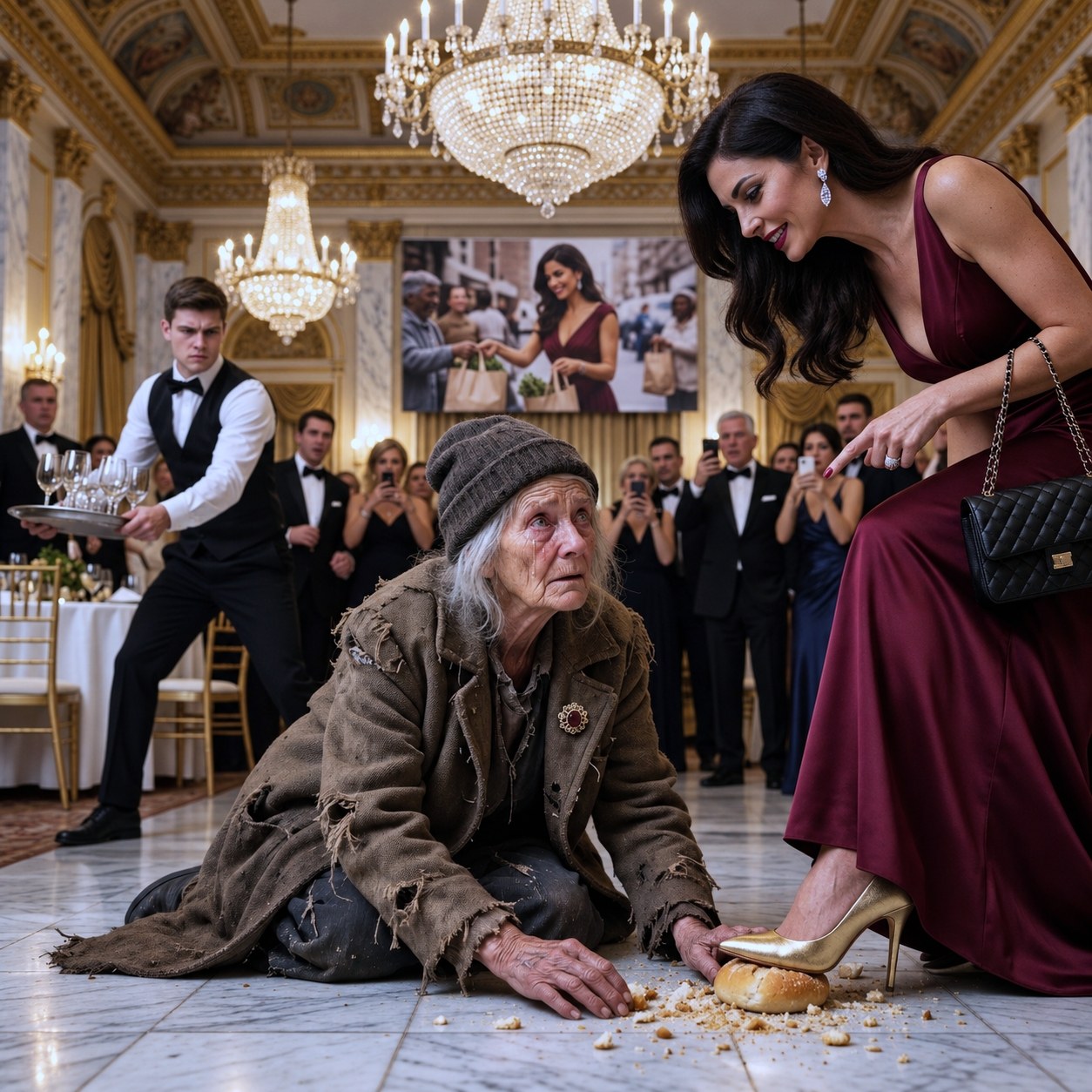
“That’s enough.” Dahlia knocked the roll from the woman’s hand. It landed near her shoe. “There. Help yourself.”
As the woman bent, Dahlia stepped on it.
Tessa set her tray down hard enough to rattle the glasses.
“Move your foot.”
Dahlia looked at the server’s apron before looking at her face. “Excuse me?”
“You’ve got a ballroom full of people paying to hear how much you care. Try caring.”
Gordon seized Tessa’s elbow. “Apologize. On your knees.”
She pulled free.
He glanced at the watching donors. “Do it, or clear out your locker.”
Tessa untied her apron and laid it across the tray.
Dahlia gave a small, satisfied laugh. “Some people need consequences before they understand their place.”
Tessa raised her phone. She’d started recording when Gordon demanded that she kneel. On its screen, Dahlia’s shoe rested on the bread.
“Shall we show your donors?”
Phones were already rising around them.
“Put those away,” Dahlia snapped. “Gordon, remove them. Both of them.”
A guard reached for the older woman.
“She’s leaving with me,” Tessa said. “Keep your hands off her.”
Outside, the service alley smelled of wet cardboard and fryer oil. Tessa waited until the woman had steadied herself against the brick, then led her to a little sandwich counter still open across the street.
She bought soup and a sandwich with the bills folded inside her phone case. While the woman ate, Tessa divided the remaining coins into bus fare and nothing else.
“What should I call you?” she asked.
“Rosalind.”
“Tessa.”
“Your manager cost you a job tonight.”
“He saved me from spending another evening working for him.”
Rosalind paused with the spoon halfway to her mouth. Then she laughed, softly and without trying to make it pretty.
“You ought to keep some of this,” she said, pushing half the sandwich back.
“I’ve got food where I’m going.” Tessa wrapped it again for her. “There’s a meal kitchen near the bus depot. Navarro’s. My mother started it. If you need supper or somewhere warm, tell whoever’s there that I sent you.”
A gold pin slipped from the lining of Rosalind’s coat when she stood. Tessa caught it before it reached the pavement.
The center stone was dark red, surrounded by little white stones that caught the sandwich shop’s fluorescent light.
“Your clasp’s broken.” Tessa placed it in Rosalind’s palm. “Keep that somewhere safer.”
“Suppose it’s worth two million dollars.”
“Then get the clasp fixed first thing.”
“You could pay quite a few kitchen bills with it.”
Tessa studied her for a moment. “You dropped something. That doesn’t make it mine.”
At the bus stop, she checked the empty street for headlights. A dark sedan pulled up instead, and a tall man in a good coat got out.
“Twelve minutes,” Rosalind told him.
“You asked me to collect you from the hotel. Then I find you out here, wearing that disguise again.”
Tessa turned.
“So you aren’t homeless?”
The bus hissed to a stop between them. She needed that bus; the kitchen’s evening volunteers were waiting for her keys. She climbed aboard before Rosalind could answer.
The man watched her disappear down the aisle.
“Who was that?”
Rosalind tucked the brooch into her pocket. “The woman you ought to marry.”
Bennett Voss shut his eyes briefly.
“I’m proposing to Dahlia tonight.”
“Do that, and my thirty-six billion goes to a cat.”
“You don’t own a cat.”
“I can correct that before the shops close.”
Inside the car, Bennett listened while his grandmother described the bread, the firing, and the returned jewel. When she finished, he loosened his tie.
“You can’t arrange my life around a woman who was decent to you for a few minutes.”
“And you shouldn’t arrange it around one who ground someone’s supper beneath her heel.”
“I love Dahlia.”
“You like how little inconvenience she causes your calendar.”
He looked out at the lights passing across the windows.
Rosalind took a slim folder from the seat beside her. While she’d eaten, her lawyer had answered the questions she’d sent him.
“Tessa’s mother ran that kitchen for twenty years. Now Tessa has the work, the arrears, and seven days to make the final payment under a settlement with the landlord.”
“How much?”
“Fifty-eight thousand.”
“I’ll cover it.”
“You haven’t asked a single question about her.”
“Would you prefer I let her lose the place?”
“I’d prefer you meet somebody without a checkbook between you.”
Bennett turned back toward her.
“Thirty days,” she said. “No company car, no cards, no assistant cleaning up after you. Work there. Learn her name before you try to buy her problems away.”
“And lie about mine?”
“Dahlia has been showing you a false face for nearly a year.”
“That doesn’t excuse you.”
Rosalind’s phone chimed. His followed a moment later.
He read the bank notifications, then stared at her.
“You froze my accounts?”
“Fourteen of them. The others will take another minute.”
“You can’t make an adult penniless with a phone.”
“You can when you control the bank.”
The next morning, Tessa stood beside the kitchen’s scarred preparation table while the landlord’s representative placed a notice under her hand.
“My mother paid you people for twenty years.”
“Her death didn’t cancel your debt.” He tapped the notice beneath her hand. “Seven days to clear it. Then we change the locks.”
When he left, she folded the notice into quarters rather than leave it where the lunch volunteers would see it.
Outside, an engine coughed, stopped, and coughed again.
Bennett sat behind the wheel of the battered sedan his grandmother had supplied. He called her from the curb.
“You couldn’t find one that runs?”
“It ran when I bought it.”
“When was that?”
“Don’t become distracted by history.”
Rosalind appeared a few minutes later, carrying her ragged coat over one arm. Tessa met them at the kitchen door.
“You came,” she said to Rosalind. Then she looked at Bennett. “You were outside the hotel.”
“I used to drive for people there. Lost the job.”
“And now?”
“I’m looking for work. Bennett Lane.”
“I can’t pay wages.”
“A meal and a place to sleep would do.”
Her eyes dropped to his watch.
“That’s an ambitious watch for an unemployed driver.”
“Imitation.”
“Expensive imitation?”
“Bad purchase.”
Behind him, Rosalind developed a sudden interest in the doorframe.
Tessa stepped aside and pointed toward the sinks.
“Let’s see how you do with dishes.”
Foam traveled across the drainboard and dripped onto Bennett’s shoes.
Tessa reached past him, shut off the tap, and picked up the bottle beside the sink.
“How much did you use?”
“The label said a drop.”
She looked at the nearly empty bottle.
“A generous drop.”
By lunchtime he had learned which pans needed soaking, which cupboard held the chipped mugs nobody would throw away, and that laundry detergent did not belong anywhere near the vegetables. Tessa intercepted that experiment before the potatoes reached a cooking pot and made him start over.
Rosalind watched from a chair near the pantry, her phone tilted discreetly toward the sink.
“What are you photographing?” Bennett asked.
“Something for an invitation.”
“What invitation?”
“A holiday card. Must you interrogate an old woman?”
Tessa gave Rosalind a bowl of stew and went to help a regular lower himself into a chair. She offered her forearm instead of pulling him by the wrist, waited while he found his balance, then brought his tea without asking what he wanted.
Bennett put down the pan he’d been drying.
“Do you know everybody who comes in?”
“Not yet.”
By evening, he knew that one woman needed her bread softened in broth and that a quiet man near the window saved half his meal for his wife. Tessa wrapped a second portion for him and wrote reheating instructions across the lid.
After they closed, Bennett found the folded debt notice beneath a stack of delivery slips.
“I know someone who could help with this.”
Tessa took the notice from him.
“Before you say no—”
“I’ve stood beside enough donors while they decide where the camera should go.”
“They aren’t all Dahlia Mercer.”
“You know her?”
To read the rest of the story – CLICK the NEXT button 👇👇👇