


The horse kept trying to spare one front foot, and the man selling him kept talking about everything else.
Ellen Pritchard stood against the sale-ring rail with her bidder’s card folded in her palm. The gray Percheron was enormous, broad enough through the chest to make the handler look undersized. Yet whenever he settled, his left foreleg eased forward and the other three took his weight.
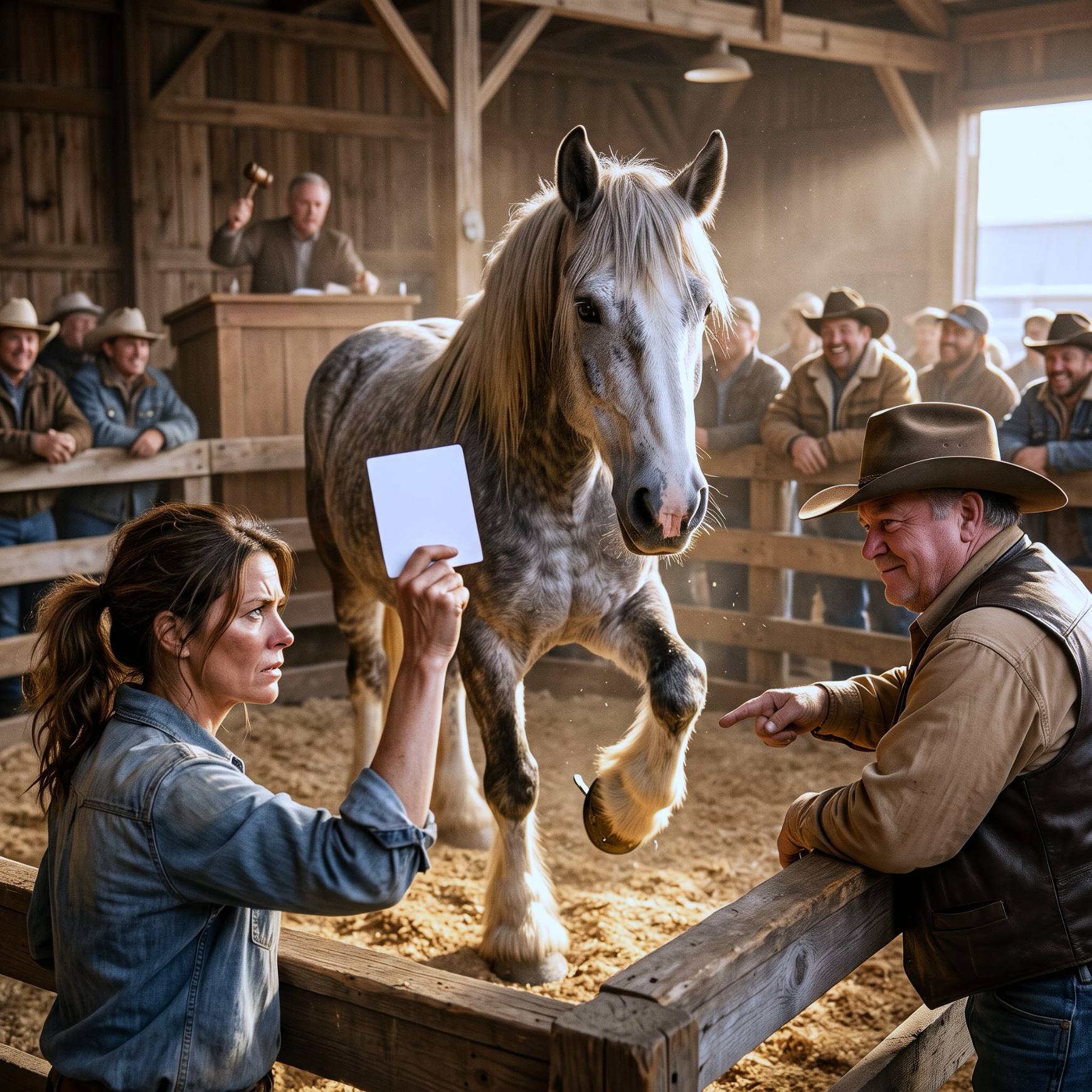
Russell Kincaid noticed where she was looking.
“Don’t let the size fool you. He couldn’t move a wagon with nobody in it.”
“He’s being decent with that handler.”
“Wait till somebody asks him to do something. Trailer, harness, you name it. Bad front end and a worse opinion about working.”
A man farther along the rail wanted the veterinarian’s name. Russell answered him with a smile.
“Forty years of carriage horses taught me to recognize one that’s done. I don’t need a vet for that.”
Ellen leaned out over the rail for a better view of the hooves. “Good. I’ll check his feet, then.”
“Look twice if you like. Feeding him won’t get any cheaper.”
The bidding had stalled. Russell signaled to the auctioneer to let the reserve go. Two hundred dollars would take him, with no promises attached.
Ellen raised her card.
The auctioneer looked around once, found no other hand, and brought the hammer down.
Russell caught her at the paperwork counter. “Well, Mrs. Pritchard. That’s one way to waste two hundred.”
She signed beneath the words as is.
“You haven’t produced an examination report,” she said. “You can quit describing him to me.”
His smile disappeared. “When he’s down in your barn come January, remember this conversation.”
“You won’t be hearing from me.”
The name on the sale sheet was Benson. Twelve years old. Ellen folded her copy and went to him.
At close range, his coat showed almost white around the muzzle and darker dapples beneath the dust on his shoulders. She put her hand against his neck. He stood without moving away, his skin warm beneath the coarse mane.
The trouble came at the exit. The handler led him toward a steel plate covering the gate threshold, and Benson stopped so abruptly the rope swung. He stretched his nose toward the opening, then lifted his left front foot clear of the metal.
Ellen watched that foot all the way to the loading area.
Her trailer was old, but Victor had chosen it for its height and width. She lowered the ramp, checked the fastening, and brought Benson around.
He reached the bottom and stayed there.
A yard worker appeared with a rope and a whip. Ellen shook her head before he could explain how he intended to help.
“We’ve got time.”
He shrugged and carried them away.
She stood beside Benson rather than in front of him. Now and then she asked him forward, accepting a shift of his shoulder or a few inches gained. Other trailers left. Someone swept the passage behind her. It took nearly three-quarters of an hour before Benson climbed aboard, lowering the troubled foot with painful care.
On the drive home, cut hay lay in pale strips along the Indiana hills. Farm stands had begun setting out their first apples, and the corn leaves along the road were turning dry at the edges.
Vellara, her sixteen-acre orchard, lay beyond Elvett, up a gravel lane where the last bend hid the house until you were almost there. The land sloped toward a narrow creek. Above it stood the barn, its doors open to the afternoon.
She had bedded the large stall before leaving that morning.
Benson went straight to the hay. Ellen watched him eat, then hung the water bucket a little lower. He managed the turn into the stall awkwardly, unwilling to step around toward his left. Once inside, he kept easing away from that same foot.
For eleven years, two horses had lived in this barn. Victor had driven orchard visitors in the fall, taking the wagon down between the trees while Ellen weighed apples and made change. Children used to wait at the lane for the sound of the harness bells.
Victor’s illness had emptied the wagon first and, by the following spring, the last stall. He had been gone three years now; he was fifty-two when Ellen lost him.
Ellen was forty-four now. The apple crop generally covered the mortgage. Repairs waited their turn.
Before going inside, she crossed to the equipment shed. A faded green cover lay over the wagon. She lifted one corner and found the driver’s seat beneath it, the edge polished by years of Victor climbing up and sliding into place.
She let the cover fall and tucked it around the wheel.
At the kitchen table, the shed-roof estimate waited inside her account book. She moved its paper clip aside, found the winter-feed page, and entered Benson’s purchase price. On the next line she wrote care, leaving the amount blank except for a small question mark.
Wade Tully answered his phone on the fourth ring. He had been shoeing heavy horses around Bramley County for close to thirty years. Thursday morning was the soonest he could come.
That night Ellen left her bedroom window open. Across the yard, a hoof scraped bedding. Then another. Long after she had turned out the light, the shuffling continued.
Wade arrived with a dented metal box and coffee he had forgotten to drink. Ellen was leading Benson out when he stepped into the barn.
His eyes stopped on the horse’s face.
For a moment he stayed beside the door. Then he put down the coffee.
“Let me watch him travel.”
Ellen walked Benson along the aisle and brought him back. Wade followed the left foreleg, crouched beside it, and felt the hoof. His fingers moved to the back of the pastern.
“Heat here. Strong pulse, too.”
He lifted the foot. With the sole turned upward, Ellen could see that the shoe looked much fresher than the worn horn above it. Along the outside branch, the nail heads wandered out of line.
Wade touched one with his thumb and reached for his testers.
Benson tolerated the first several squeezes. Wade shifted the jaws along the edge of the sole, making small, methodical changes. Near the outside nail, the horse snatched his leg free.
The hoof stand scraped across the aisle. Benson flung his head up and backed hard enough to strike the partition.
Ellen went with him, keeping the rope from tightening against his face. She spoke until he lowered his head. When she looked back, Wade had put the testers down.
“What did you find?”
“One place that hurts badly.”
“Can you fix it?”
“I need to know what’s underneath first.”
He raised the foot again without testing that spot. He studied the nail placement, ran a finger around the wall, and lowered the hoof carefully into the shavings Ellen had scattered over the concrete.
“Who shod him?”
“He came this way. I bought him Tuesday. Russell Kincaid’s horse.”
Wade rubbed his palms on his trousers.
“You recognized him,” Ellen said.
“I’ve worked over there.”
“And?”
“I’m not giving you somebody else’s business on the strength of a look.”
There was enough discomfort in his voice that she knew pressing him wouldn’t help. She turned back to Benson and loosened the rope where it had twisted around the halter ring.
Wade began closing his box.
“You’re leaving the shoe?”
“Until there’s a vet here. If this runs deeper than it looks, opening it carelessly could leave us worse off…”
To read the rest of the story – CLICK the NEXT button 👇👇👇