


The dog in the end kennel was trying to make himself smaller.
Miles Barrett watched him draw his hind legs beneath his belly, then tuck his nose against the floor. A man in a leather vest leaned toward the wire door, studying the animal’s teeth. Beside him, another buyer tapped something into a phone.
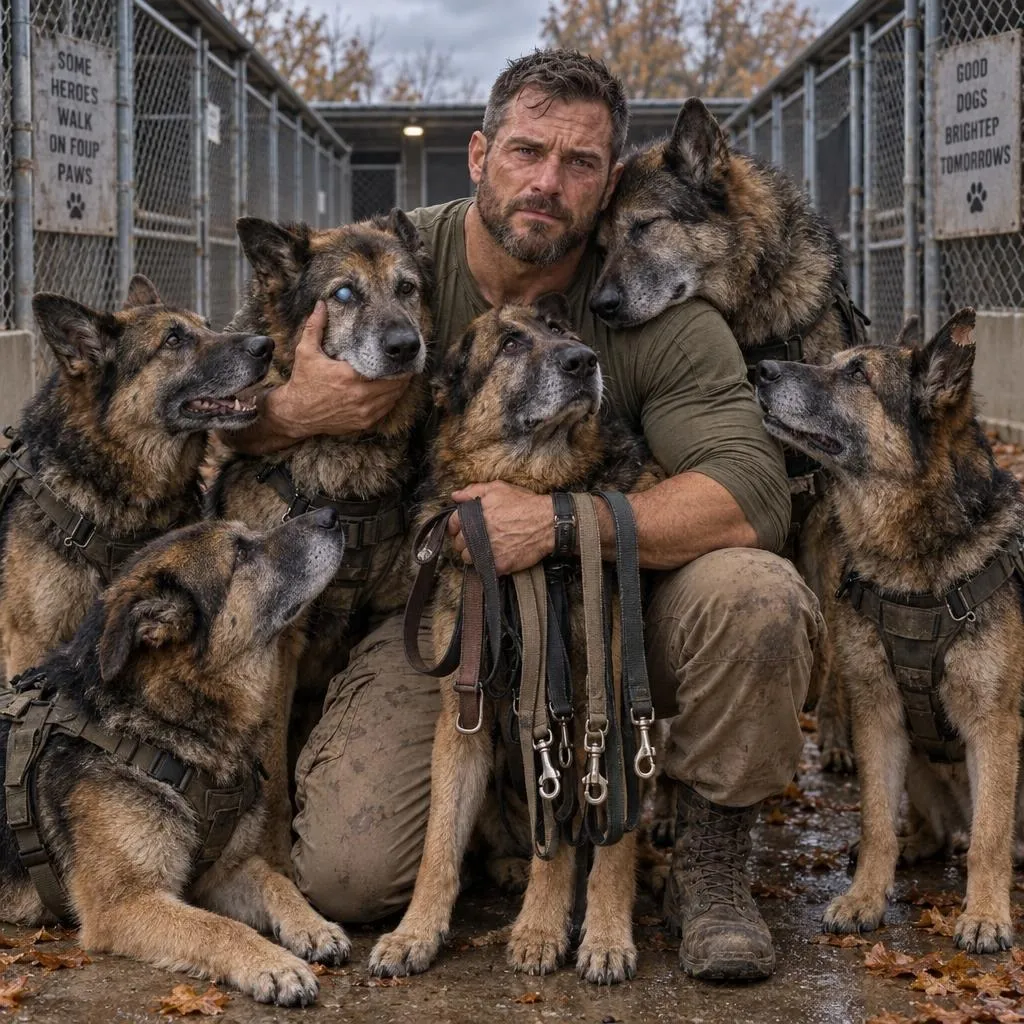
Nobody noticed Miles at the gate until Rook growled.
Miles shortened the leash. His German shepherd stood against his left knee, ears forward, the fur above his shoulders lifting. Somewhere beyond the two rows of kennels, a dog gave a thin, sustained cry.
Six years earlier, Miles had heard almost that same sound outside a compound in Somalia. A shepherd had been tied to a post while the Americans searched the buildings. His handler lay dead inside. Even after they brought the body out, the dog kept looking toward the doorway.
“Stay with me,” Miles murmured.
Rook’s leash tightened once, then slackened.
The message had arrived at four-thirty that morning, while Miles was still awake from another bad night.
They’re disposing of the working dogs today. All of them. The center outside Dunmere. Please come. Bring Rook.
No name. No explanation.
He had driven three hours through the Oregon darkness, stopping only to let Rook stretch his injured hip. Now the sun was up, and the naval support station’s disposition yard smelled of disinfectant, wet concrete, and an overdue cleaning.
Twelve transport kennels stood under a sheet-metal roof. Several dogs paced. Two lay with their eyes open and their bodies still. One kept licking the same spot on his front leg.
A folding table blocked the entrance to the bidding area. Behind it sat a lieutenant commander whose khaki sleeves were pressed sharp enough to cut paper.
“Registration’s here,” the officer said. “You’ll need identification and proof of payment.”
Miles looked at the cash box, then at the printed list beside it.
Lieutenant Commander Graham Pruitt.
“Who are these people?” Miles asked.
“Prospective civilian owners.” Pruitt glanced at Rook. “You already have one, apparently.”
“He worked with me.”
“Then you understand the program. These animals have been retired and approved for transfer.”
Rook had worked beside Miles through four deployments. Shrapnel had torn into his left hip during a breach in southern Somalia. The surgery saved his leg, but not his place on an operational team.
Getting him home had taken Miles half a year. Every week brought another missing form, another office claiming the decision belonged elsewhere. Miles had called old commanders, a congressional liaison, anyone willing to put a name beneath a request.
When the adoption finally cleared, Rook had stepped out of his kennel and put his forehead against Miles’s sternum. Miles had stood there with his arms around the dog until a kennel attendant quietly turned away.
That had been two years ago.
Now Pruitt was sliding a registration sheet across a table as though Miles were shopping for a surplus desk.
“What assessments?” Miles asked.
“Behavioral and medical. The animals no longer meet service requirements. Aggression, anxiety, physical decline. The usual causes.”
“Let me see the reports.”
“Bidder information comes after registration.”
Rook pulled toward the kennels again. Miles left the paper untouched.
At the first row, a broad-headed shepherd rose so abruptly that his water bowl tipped. Miles stopped.
“Gage?”
The scar beside the dog’s left ear had faded white. Miles remembered that scar crusted with dust on a deployment three years earlier. Gage had found seventeen improvised explosives in one week and once stopped an entire convoy from approaching a vehicle packed with enough explosives to destroy the checkpoint.
His handler had trusted that nose more than any piece of equipment they carried.
Miles crouched. Gage pushed his muzzle against the wire, breathing hard.
“Well, look at you.” Miles offered the back of his hand. “How’d you end up in this place?”
Rook approached from the side, and the two dogs investigated each other through the mesh. Gage’s tail moved low against the kennel floor.
A dog farther down stood. Then another. The familiar working-dog scent, Rook’s quiet presence, Miles’s low voice—whatever reached them, heads began turning toward the aisle.
The next card read Flint.
Miles knew him, too. Explosives detection. Six years in service. At a checkpoint overseas, Flint had alerted on a man wearing a concealed explosive vest before the man reached a group of Marines.
Now he lay with his chin flat, making no effort to approach.
Miles waited a moment, then moved on.
Dash was circling so tightly that his shoulder brushed the kennel wall each time around. Miles remembered a lean, astonishingly fast patrol dog who could cross open ground before a fleeing suspect understood he had been released. This animal’s sides fluttered with shallow breaths. His coat had lost its shine.
“Easy,” Miles said.
Dash kept circling.
At the last kennel, Miles bent to read the card.
Haven.
For a moment, he could hear only the scrape of Rook’s nails on concrete.
Julian’s dog.
The shepherd lay on his side, hipbone prominent beneath a dirty coat. One ear rested sideways. His eyes were partly closed, but he wasn’t asleep.
Miles lowered himself until both knees touched the ground.
“Haven. Hey, pal.”
The ear lifted.
“It’s Miles.” He brought his fingers to the door. “I’m here for you. Julian would’ve sent me.”
The dog opened his eyes. He stared without moving, then pulled himself upright in stages, front legs first, hindquarters dragging after them.
Miles had last seen him eighteen months earlier, in the confused hours after Julian Shaw died in Libya. He had asked for the dog afterward. An officer told him Haven had gone to another team. Someone else told him to concentrate on his own recovery.
He had believed them.
Haven reached the door and pressed his nose against Miles’s fingers. The cry that came from him made a nearby buyer stop talking.
Miles gripped the mesh. He bowed his head until the metal touched his forehead.
“God, buddy. I looked in the wrong places.”
Rook leaned against his thigh. Miles put an arm around him without looking away from Haven.
A young petty officer approached carrying bidder forms.
“Sir, if you’re interested in that animal—”
“Who ordered him retired?”
The young man looked toward Pruitt’s table.
“I’d need to ask.”
“Then ask. And ask who notified his handler’s family.”
The petty officer left quickly.
Miles stood, wiped his face with the heel of his hand, and returned to the table.
Pruitt was arranging signed forms into a neat stack.
“Haven was cleared for duty after Julian Shaw’s death,” Miles said. “I saw that evaluation. Gage and Flint were two of the steadiest dogs I ever worked around. You’re telling me all three suddenly became unsuitable?”
“I’m telling you qualified personnel made those determinations.”
“Show me their names.”
“Petty officer, your concern is noted.”
“You’ve got people out there discussing breeding rights. One of them’s checking mouths like he’s buying fighting stock. Where are the former handlers? Where are the retirement organizations?”
Pruitt laid his pen down.
“You don’t get to walk into my facility and make accusations.”
“Then open the records.”
“The event starts in ten minutes. Register or leave.”
A buyer behind Miles cleared his throat. Someone else moved nearer to hear.
Miles could still see Haven through the gap between two kennels. The dog had remained at the door, his nose resting against the wire.
Julian’s last words had come through a torn, breathless effort on the evacuation flight. Miles had leaned close to hear him over the aircraft.
Bring Haven home. You hear me?
Miles had said yes.
He picked up the registration form.
The contractor running the auction wore a headset microphone and a clean jacket. He climbed onto a low platform, tested the microphone with a tap, and welcomed the bidders.
“Twelve retired working animals today. Individual lots. Transfers are final. Health files remain restricted, and responsibility passes to the buyer upon completion.”
Miles raised his hand.
The contractor nodded toward the registration table. “Staff can help with paperwork.”
“I’m asking about those restricted files.”
“We’ve been instructed—”
“By whom?”
The contractor glanced at Pruitt.
Miles turned so the buyers could see him.
“Some of these dogs have old blast injuries. Some can’t hear well. Some watched a handler die. Their history matters to whoever takes them home. It also matters that nobody seems to have tried to get them home before bringing you here.”
A woman lowered the phone she had been using to photograph identification tattoos.
Pruitt stepped into the aisle. “That will do.”
“No. You haven’t answered.”
“You’re interfering with an authorized transfer. I can have security remove you.”
The contractor tried to speak over them. “We’ll begin with lot one—”
“Don’t.”
Miles hadn’t shouted. The contractor stopped anyway.
Rook stood beside him, watching the approaching officer.
Miles looked down the two rows, making himself see every occupied kennel.
“Put all twelve under my name…”
To read the rest of the story – CLICK the NEXT button 👇👇👇