


The repairman left his estimate on my kitchen counter, held down by a saltshaker. Twenty-one hundred dollars, and that was if the pump quit before a freeze split anything else.
I read it while my daughter sat on the floor trying to pull a sock through the heel of her boot. The lining had folded under her foot again. She didn’t complain. At nine, Tessa had already learned to make an inconvenience look smaller when she knew I couldn’t fix it.
“Leave those by the stove,” I told her. “I’ll work on them tonight.”
The dentist’s reminder was under the pump estimate. I put both papers in a drawer before she saw me looking at them.
I was thirty-four that fall, living on thirteen acres outside Dunlow, Colorado, in a house my aunt had left me along with a barn that leaned toward the sunrise. The land wasn’t free of obligations, but it was ours. I could look from the kitchen window and see the whole place: the old well shed, the pasture fence, the corner where my aunt had planted currants that never amounted to much.
My name is Mara Bennett. Most of the people who hired me didn’t need reminding. They called when a calf wouldn’t nurse, when a heifer was in trouble at midnight, when frost had shoved a stretch of fence out of line and their regular crew was somewhere else. During calving, I sometimes earned forty-five dollars for staying awake until morning. Coffee usually came with it. Breakfast depended on the rancher.
There was always work. What there wasn’t, very often, was money left after doing it.
In Dunlow, the people with money generally had some connection to Russell Kincaid. His family’s name hung over the livestock arena every fall. It traveled past my driveway on stock trucks, appeared on the feed buildings beyond town, and occupied a polished little plaque at the bank where I made my payments.
I’d managed to work around him for years without working for him.
That October, with cold weather settling in the bottoms, I drove to his ranch and parked beside the office.
Russell let me wait while he finished a conversation inside. When he came out, he studied the repair I’d sewn into my jacket cuff, then my boots, then the pickup. There was baling twine caught around a toolbox in the bed. I noticed him notice it.
A man at the corral behind him stopped talking.
“You’ve handled much breeding stock?” Russell asked.
“Enough to know when to give it room.”
He was forty-eight, neatly gray at the sides, with the kind of coat a person didn’t wear to crawl under a sick cow. He looked at my hands as if I’d offered him the wrong references.
“I need somebody who can hold up physically.”
“If muscle settled everything, none of us would last long around a bull.”
The man at the fence made a small sound through his nose. Russell glanced back, and the sound stopped.
His herd manager was short two hands. Winter was coming whether Russell approved of me or not, so I got the job. He explained my limits before we discussed my pay: water, feed, fence repairs. I wasn’t to handle breeding animals or enter a working pen without permission.
“Dean will tell you what needs doing.”
Dean Pruitt, the herd manager, gave me a pair of cracked work gloves and pointed toward the tank line. He didn’t ask whether I already owned gloves.
On my fourth afternoon, I was pulling slack out of a wire beside the isolation pens when the pliers jumped in my hand. The impact had traveled through the fence before I heard the metal ring.
Another blow followed.
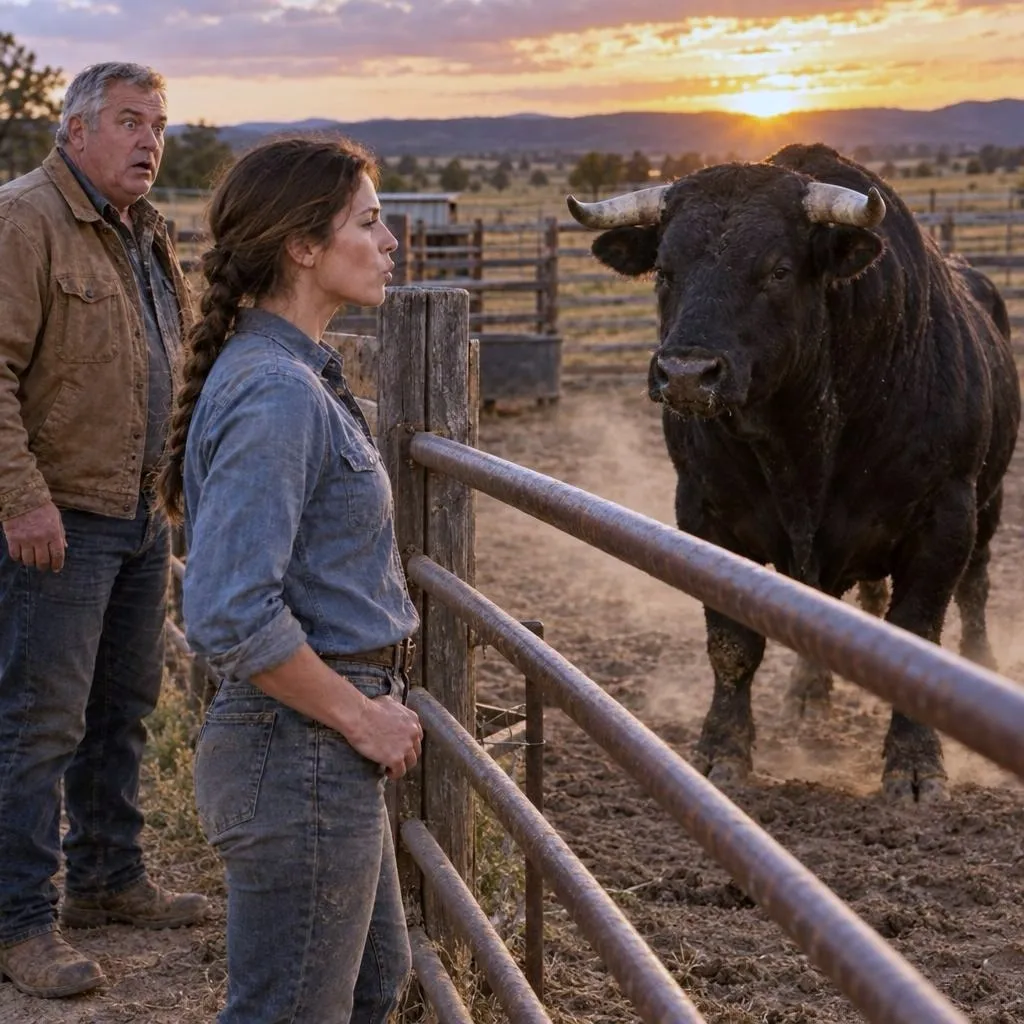
I set my tools down and walked far enough along the alley to see between the uprights. A bull stood in the last pen, his dark back nearly level with the top rail. Rust-colored hair showed under the black along his ribs. He carried close to nineteen hundred pounds, most of it gathered through his neck and shoulders.
A hand on the catwalk reached over him with a red sorting stick.
The bull struck the gate so hard the man snatched the stick back.
“Monarch,” Dean said behind me. “Don’t get interested.”
Over the next few days, everybody supplied a story. Monarch had flattened a veterinarian. Monarch had wrecked a headgate. Monarch had come from a summer production sale outside Talven, Kansas, and somebody there had known exactly what they were unloading.
The stories all arrived at the same conclusion: the bull was crazy, and I should leave him to people who knew what they were doing.
My work kept bringing me past his pen. I carried feed, repaired a leaking float, spliced wire. Between those jobs I watched.
When the feed truck stopped, he waited. A hand in a blue jacket could lean over the fence without moving him. Left alone, he crossed his pen at an ordinary walk, nosed his hay, and settled.
Then the sorting stick would appear, and he’d batter whatever stood between him and it.
I knew cattle didn’t see red the way we do. It wasn’t some storybook fury at a color. He recognized that particular implement, its outline and the way it came down at him. The men could change places and get the same response. Put the stick away, and his breathing eventually slowed.
There was a shake in his hindquarters after those episodes. I’d seen a horse shake like that after hearing the rattle of a rope that had once trapped him. Monarch wasn’t looking for a fight while he ate his breakfast. Something kept convincing him a fight was already coming.
By my second week, I’d learned what Russell had paid: a hundred and eighty thousand dollars.
That figure explained the visitors, the telephone calls, and the way Dean’s jaw worked when anyone mentioned the bull. Monarch’s pedigree ran through four generations of proven production and maternal performance. His carcass figures were the sort buyers passed around without joking. A breeding syndicate in Oklahoma wanted semen from him, but their agreement required a veterinarian’s signed breeding soundness evaluation before a November deadline.
They had no signature.
Two attempts at putting him through the hydraulic chute had failed. On the first, he had damaged a side panel and torn loose part of the headgate. On the second, he’d gone down in the alley and stayed there for forty minutes while men shouted from above him. The veterinarian had finally refused to make another attempt under those conditions.
Russell hired a consultant.
The consultant’s trailer held portable panels that still had paint on them. He spent an hour around the pens, then took his coffee to the shop doorway. I was sorting fence staples nearby when he gave Russell and Dean his answer.
They needed six men, he said. Pressure everywhere. No release, no pause, no opportunity for the bull to make them retreat.
“He gets a win, you start over from worse,” he told them.
Dean listened with his arms folded and his chin tipped up. I kept my eyes on the staples. I’d been there less than two weeks; nobody had paid me for an opinion.
Two days later, Monarch hit another panel while they tried to bring him toward the working alley. A young hand named Ben scrambled off the catwalk, landing badly enough to catch himself on both palms. Russell came out of the office.
I hadn’t intended to speak.
“Put that stick away,” I said. “Watch what happens when he can’t see it.”
Russell turned toward me. For a second he looked less angry than inconvenienced.
Then he laughed.
“Nine workdays,” he said to the men around him. “That’s all the training she needed.”
Two of them smiled. Ben didn’t.
I held the bucket of staples against my leg.
“You can test it without me standing here,” I said.
“Go mend something, Mara. I’m paying for fences, not a bull’s emotional development.”
They went back to work. I carried the staples away.
At quitting time, the pens were quiet. Monarch paced along the far fence, turned, and followed the same worn track back. I rested my forearms on the rail outside his pen and waited until he reached the turn.
I whistled the little call I used for calves: three brief notes, each a little higher than the last.
His next hoof never came down where he’d meant to put it. He stopped with it suspended, then set it carefully beneath him. One ear turned toward me.
I waited long enough to hear water dripping into a trough farther down the row.
The second time I whistled, he faced me.
He didn’t brace himself. He didn’t lower his forehead. He stood listening, with his muzzle tilted toward the sound.
My fingers tightened around the rail. I’d used that call for years, but the last animal that had answered it quite that way had lived on a small ranch in northern New Mexico, eleven years earlier…
To read the rest of the story – CLICK the NEXT button 👇👇👇