


The front caster caught in the rubber entrance mat, and Vivian Mercer backed up before anybody could hurry over and help. On the second try, she cleared it cleanly.
Behind the reception desk, a printer chattered. Rain ticked against the glass doors. Somebody had left a paper cup on the only stretch of counter low enough for her to reach, so she moved it, signed herself in, and tucked the pen back into its holder.
Seven months at this place. She knew which elevator button needed a second push, which restroom door swung too hard, and which section of the corridor narrowed whenever a staff member parked a cart there. By now, she could have drawn the floor plan from memory, including everything the people who walked through it never noticed.
Her driver was still outside, checking the van’s lift. Warren had delivered her at twenty minutes to nine, with country music loud enough to follow her through the doors. He wouldn’t become conversational for another twenty minutes. She respected a man who kept regular hours even for speaking.
Vivian took the east corridor toward physical therapy.
The rehabilitation center had once been Marden’s county hospital. You could tell by the widths of the old doorways and the little windows in doors that no longer opened into patient rooms. The building stood near the northern edge of town, where Idaho’s wooded slopes crowded the last houses. After two straight days of November rain, water had collected in the broken pavement beside the employee entrance.
Inside, the radiators smelled hot and dusty. A custodian was working at a coffee stain that had survived at least three administrations.
“Morning, Viv.”
Linda Pruitt had a folded towel over one shoulder and a measuring tape around her neck. She was in her fifties, with short hair she cut herself between appointments and a manner that made unnecessary reassurance difficult.
“Morning.” Vivian parked beside the treatment mat. “What’s the damage today?”
“Depends how much you argue.”
“I save that for upstairs.”
Linda took her coffee and put it on the counter while Vivian transferred. She offered a steadying hand without putting it on Vivian until asked.
That was one reason Vivian had stayed.
At twenty-five, she had become painfully familiar with people who meant well and moved too quickly. They pushed her chair without permission, answered questions directed at her, and used the same softened voice for every subject, from the weather to whether she needed the bathroom.
Others simply looked past her.
She had dark blond hair she wore in a braid, eyes her mother used to insist changed color with the weather, and calluses along the base of both palms. Most days she wore jeans, a thermal shirt, and a canvas coat. Her running shoes were still in good condition. It was possible they would remain that way for years.
Eighteen months earlier, she had been a passenger in a friend’s car in Pocatello when a drunk driver came through a red light and struck her side. The other driver had been going close to sixty miles an hour. He left the hospital with an injured shoulder. Vivian spent ten days in intensive care, then three months in acute rehabilitation, learning the practical meaning of a T6 incomplete spinal cord injury.
Incomplete sounded encouraging until someone explained how little it promised.
Some feeling remained below the injury. Some messages traveled. Others did not. Her left leg had begun responding more reliably than her right, though reliably was a generous word.
Linda had never promised she would walk again.
“We find what’s available and make it useful,” she had told Vivian at their first appointment. “That’s the work.”
Now Vivian lay on her stomach and planted her hands beneath her shoulders. Linda checked the position of her hips.
“Up as far as you can control. Don’t chase height.”
Vivian pressed into the mat. Her arms began to tremble. She concentrated on keeping the movement even, listening for Linda’s count over the clank of a cable machine across the room.
The room grew quiet before she heard the door.
Linda’s counting stopped.
Vivian turned her head, cheek nearly brushing the paper covering the mat.
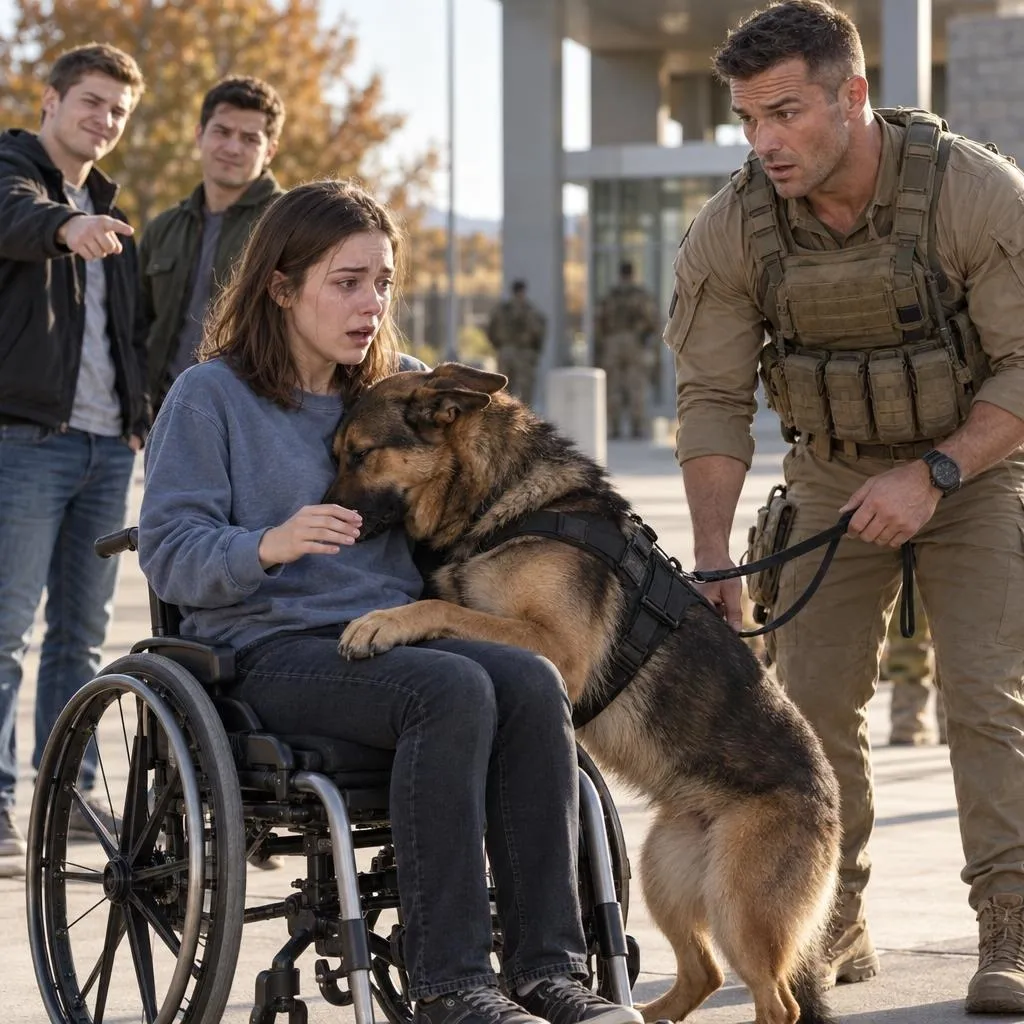
A German shepherd stood just inside the therapy wing. Big, though not clumsy, with a deep chest and a black saddle of fur over tan legs. He wore a sand-colored working harness fitted with a handle and flat side pouches. One shoulder showed a narrow break in the coat where old scar tissue had changed the way the hair grew.
The leash ran to a man who was studying the room rather than the people looking at him.
He was tall, late thirties, short dark hair, unshaven jaw. His clothes were ordinary enough: work pants, boots, a plain pullover. He kept his injured arm close to his side. With his other hand, he held the leash loosely, leaving no slack near the floor.
“Commander Danner?” Linda said.
“Owen’s fine. I’m down for nine-fifteen.”
Evan, the therapy coordinator, looked from his screen to Linda.
“I had nine-thirty,” she said. “Let me check.”
Owen waited. He didn’t repeat himself or fill the pause.
Vivian lowered her chest, caught her breath, then pushed upright. Her chair was where she had left it, brakes locked. She moved across in one practiced transfer and reached for her thermos.
The dog followed the whole operation with his eyes.
She unscrewed the lid. His nose lifted slightly.
“What’s he called?” she asked.
“Flint.”
“Can I say hello?”
“Not yet.”
There was nothing unfriendly in the answer. Nothing negotiable, either.
“All right.” She took a drink.
Flint shifted his front feet, and she saw the other scar.
It lay just above the joint on his left foreleg, partly concealed under the fur. Small. Older than the shoulder wound. An uneven little crescent where skin had pulled tight during healing.
Vivian set the cup down too hard.
Coffee splashed onto her thumb.
“Everything okay?” Linda asked.
“Hot.”
She wiped her hand on the towel and looked toward the window.
Five years earlier, her headlights had found a puppy in a ditch.
At twenty, she worked at the grocery store on county road eighteen; that night, two shifts had kept her there late. The April rain had turned the gravel shoulder soft. She slowed for a bend, and two points of reflected light appeared below the guardrail.
By the time she stopped, she could no longer see them.
She left the car running and worked her way down through the wet weeds, one hand gripping a fence post until the ground leveled out. He was smaller than she had thought. Eight weeks old, perhaps, soaked through, his black-and-tan fur flattened to the shape of his ribs.
He tried to lift his head when she crouched beside him.
“Oh, honey.”
His left front leg was cut above the joint. Mud had worked into the wound. She couldn’t tell whether a vehicle had clipped him or he had caught himself on something sharp. She could tell he wasn’t getting out of that ditch on his own.
Vivian pulled off her coat, tucked it around him, and climbed back toward the headlights with him held against her chest.
Her parents were asleep when she got home. She went through the utility room, avoided the squeaking board outside their bedroom, and closed her own door with her heel.
Her father disliked spending money on animals. Her mother disliked fur on furniture. Neither objection would improve after midnight.
She laid the puppy on an old beach towel and fetched warm water, clean cloths, and the first-aid book from the hall cupboard.
He made a thin sound when she began cleaning the leg. She stopped until he settled, then tried again.
“Just a little more, Pip.”
The name came out because he was such a little thing beneath the towel. Once she said it, she kept saying it.
She spent her spare cash on food, gauze, and cleaning supplies. With the book beside her and careful instructions pulled up on her phone, she changed the dressing before dawn each morning. When he was hungry enough to eat, she sat on the floor and held the bowl so he wouldn’t have to struggle toward it.
By the second week, he would crawl into her lap after breakfast. By the third, he could follow her from the bed to the door, hitching a little on the injured leg but determined not to miss anything.
The cut closed. A pale crescent remained.
Vivian had known the position of every edge of it.
She had been making arrangements to move to Pocatello for a new job when Pip disappeared. She came home from work, opened her bedroom door, and found the towel empty. She searched the yard, the road, every place a puppy might have crawled. Her father said he hadn’t seen him.
She never found out whether Pip had slipped away or somebody had made a decision for her.
For a long time, she had kept looking whenever she drove past that ditch.
“Vivian?”
Linda stood beside her chair.
“Sorry.”
“Owen’s meeting with the director before we get started on his shoulder. Flint’s staying down here with us. He’s retired from operational work, but they’re still working through the transition. Separation isn’t helpful right now.”
Vivian glanced across the room. Owen was speaking quietly to Evan. Flint remained at his leg, looking straight at her.
“Every day?” Evan asked Linda.
“For now.”
Linda went to settle the arrangements. Vivian capped her thermos.
A German shepherd with an old leg injury. There had to be thousands.
When Owen left with the director, Flint lay on a designated mat near the window. Linda kept an eye on him while she worked, as agreed. He did not bother the patients who gave him a wide berth. Arthur, there after a knee replacement, chose a chair at the other end of the room and studied the radiator with great interest.
By late morning, Flint had moved closer to Vivian’s chair.
She hadn’t called him. In fact, she rolled a few inches away to give him room.
Brent noticed anyway.
He was in his forties, a contractor recovering from a back injury, and had spent much of the past seven months finding fault with the building, the staff, the temperature, and anybody whose appointment ran longer than his.
“What’s she supposed to do with a military dog?” he asked, pitching his voice toward the room.
Linda turned. “Brent.”
“I’m asking about safety. You want somebody in a wheelchair getting him worked up?”
“He isn’t worked up,” Vivian said.
“How would you know?”
“He picked this spot. There’s a whole room available.”
Flint raised his head and looked at Brent.
Brent tugged his resistance band once, then turned back to the wall.
By twelve-forty, Vivian was in the lobby waiting for Warren. Her book lay open in her lap, though she had read the same paragraph three times.
Brent came out with two men she recognized from previous visits. They gathered beside the entrance, blocking half the doorway, and began talking about the clinic.
Then they began talking about the people in it.
“You can tell who’s here to work,” one of them said. “Some folks just want an audience.”
Vivian lowered her eyes to the page.
Brent’s shoes turned toward her.
“If you’re never going to get up, what are they accomplishing?” the other man asked. “Can’t earn a living sitting there.”
The receptionist stopped typing.
An older woman across the room folded her magazine. “That young woman has ears.”
Brent shrugged. “Then she heard.”
Vivian closed her book and watched the van entrance. She would not give him her face to examine.
He came closer. His next remark was about the chair. The one after that was about what a woman like her could possibly expect from life.
The corridor door opened.
Flint entered ahead of Owen, who was putting away his phone. The leash straightened as the dog crossed the lobby.
He stopped directly in front of Vivian’s wheelchair, broadside to her, facing the three men…
To read the rest of the story – CLICK the NEXT button 👇👇👇