


The part number had rubbed off on Walter Dempsey’s thumb by the time he reached the livestock pens. He stopped beside a gate and unfolded the paper again, squinting at the two versions he’d written at breakfast. One was shaky. The other was darker, pressed hard enough to score the paper.
An alternator. That was the whole errand.
His tractor had been stranded in the bottom field for three days, with weeds brushing its axle and a mower it couldn’t pull. Another county warning about the field would be along soon. He’d already set the bank’s latest envelope beneath the salt shaker, where he could see it without having to open it again.
Walt folded the paper carefully. At sixty-nine, he could still mend a fence or rebuild a gate. Keeping a farm solvent had become a different kind of work, done with a pencil that never seemed to reach the right answer.
He had $240 in his wallet. Before leaving the house, he’d counted it beside the sink, then stood looking into the open cupboard. Evelyn’s cup sat behind the everyday glasses, its handle turned outward so she could reach it.
Fourteen months, and he still put it back that way after dusting.
A truck passed close enough to scatter grit over his boots. Walt stepped aside. Somewhere inside the auction barn, the auctioneer paused for breath and a buyer shouted a number. Chains dragged across a loading ramp; chickens battered their wings against a crate. The air carried exhaust and damp grain, with the sharp ammonia smell that rose when too many animals stood too long in one place.
He ought to have been in the equipment lot.
Instead, he’d gone around the end of the barn to avoid a man he recognized from church. The man would have asked how he was managing. Walt would have said he was getting along. Then they’d both have had to stand there a moment with the lie.
Once, stopping to talk had been easy. People wanted to know whether Evelyn’s preserves were ready, whether she’d finished the baby quilt, whether she’d let anybody help weed her garden. After the funeral, every conversation required him to report on himself.
He followed the trailers until the gravel gave way to packed dirt. The auction sounded farther off here. Weeds grew through the bottom of the pipe fencing, and the shade roofs had been patched with whatever sheet metal somebody had found.
Walt knew these pens.
A cow stood with one hip dropped, switching weakly at flies. In the next enclosure, a lame sheep kept circling back to the same wet patch of ground. Three horses crowded beneath a roof too small for them.
Beyond them stood a mare by herself.
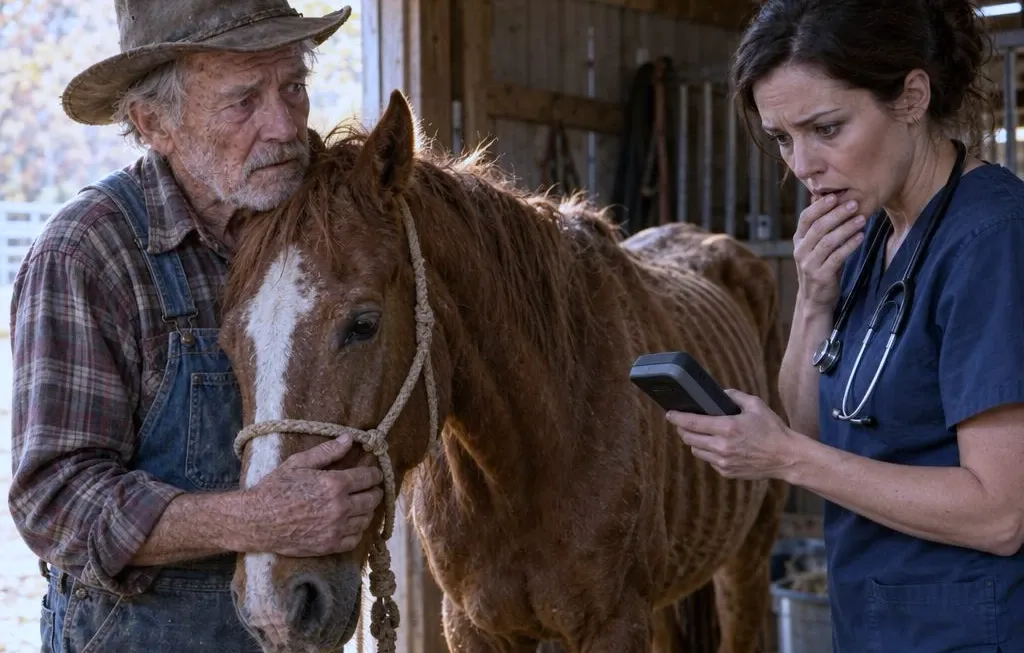
He noticed the leg before he understood the rest of her. Her left front knee was so enlarged that the limb below it appeared too narrow. She held the hoof forward, barely brushing the dirt, and the muscles above the joint quivered as she tried to keep her weight elsewhere.
Then he saw how thin she was. Her mane had twisted into dirty cords. Burrs and old bedding hung from her tail. Under the filth, her coat was nearly white, stretched across a body that had used up everything it had.
Walt put the part number in his pocket.
“Wouldn’t waste your afternoon,” a voice said.
A man beside a livestock truck dropped his cigarette and ground it beneath his heel. His beard grew unevenly along his jaw, and he watched Walt with the bored alertness of a salesman who already knew the objection.
“Who’s handling her?” Walt asked.
“I am. Until the hauler comes.”
The man pushed away from the truck. He gave the mare a look that took less than a second.
“Picked her up behind another sale. There’s a buyer for the weight if she can get up the ramp.”
“Somebody should’ve tended that knee.”
“Somebody should’ve done a lot of things.” The broker reached for another cigarette. “Leg’s finished. Could be infection clear into the joint. You buy her, you’ll be digging a hole before you get any use out of her.”
Walt studied the mare’s foot. She lowered it, tried a little weight, then snatched it away again. The movement traveled through her whole body.
“I didn’t ask about using her.”
“Then I’m telling you free. Leave her where she is.”
The broker struck his lighter. The mare’s ears moved at the click, but her head stayed down.
Walt had held animals while a veterinarian ended their suffering. He’d buried dogs and lost calves despite sitting up all night. He didn’t believe kindness required keeping every creature breathing at any cost.
He stepped nearer to the fence to look at her eyes.
She raised her head with visible effort. There was no toss of the neck, no angry warning. She looked at him across the rail, too exhausted even to turn away.
Walt’s hand closed around the fence.
During Evelyn’s illness, she’d kept a notebook with colored tabs for appointments and medicines. Even when she couldn’t get outside, she’d reminded him which plants needed water and which ones he was drowning. Once, she’d told the hospice chaplain he was welcome to pray, provided he stopped practicing his burial voice.
Walt had laughed because she wanted him to.
In the final week, she’d quit reaching for the notebook. She would sit with his hand in hers and look toward the bedroom window, listening to something he couldn’t hear. He’d rubbed his thumb over her knuckles, trying not to make her stay awake for his sake.
Those hands of his had always been useful. At her bedside, he’d watched them lie idle on the blanket.
The mare’s eyelids lowered.
“Mind your fingers,” the broker said as Walt reached through the rails. “I don’t guarantee manners.”
Her skin tightened when she noticed the hand. She drew back just enough to show that she’d seen it, then stood waiting.
Walt let his arm rest against the pipe. He kept his palm open.
A gate slammed somewhere behind him. The mare startled, caught herself on her good legs, and stood breathing through widened nostrils. Walt waited until her breathing slowed.
“You don’t have to,” he told her.
She stretched her neck. His hand was still too far away, so she made one short, awkward movement forward. The bad leg shook beneath her.
Her nose touched the edge of his palm.
He could feel each breath along the inside of his wrist. There was dust on her whiskers and a small damp place above her lip. He rested two fingers against her muzzle, lightly enough that she could leave whenever she wished.
For a moment, he imagined her in his old foaling shed, with clean water and no truck coming for her.
Then he thought about the money.
The tractor couldn’t wait. Neither could the taxes. Feed cost money, and a mare in this condition might need more veterinary care than the farm had earned all summer. He knew every sensible argument before he took his hand away.
The broker watched him reach inside his coat.
“You fixing to make an offer?”
Walt opened the wallet Evelyn had given him fifteen Christmases earlier. One seam had split. Behind the folded bills was a picture of her in the garden, laughing at him for taking too long to press the button.
He pulled out the cash.
The broker’s cigarette stopped halfway to his mouth.
“She’s for sale?” Walt asked.
“Everything out here’s for sale.”
“Then name it.”
The man glanced at the bills. “Two hundred. As she stands. No complaints afterward.”
Walt separated forty dollars and put it back. He held the rest over the rail.
“You understand she might not get home?” the broker asked.
“Write me a receipt.”
The man took the money quickly. He found a pad in the truck, scratched on it with a pen that needed shaking, and tore off the top sheet. Walt tucked it into his coat without reading it.
“Trailer?”
“Equipment lot.”
The broker jerked his chin toward the barn. “Go fetch it. If she falls getting in, she’s already yours…”
To read the rest of the story – CLICK the NEXT button 👇👇👇