


Eli Serrano had stopped telling me about the feeding schedule. His eyes were on the observation window, where a man in a faded work shirt stood enclosed by a gorilla’s arms.
“Should we wait?” I asked.
“We’ve been waiting a lot lately.”
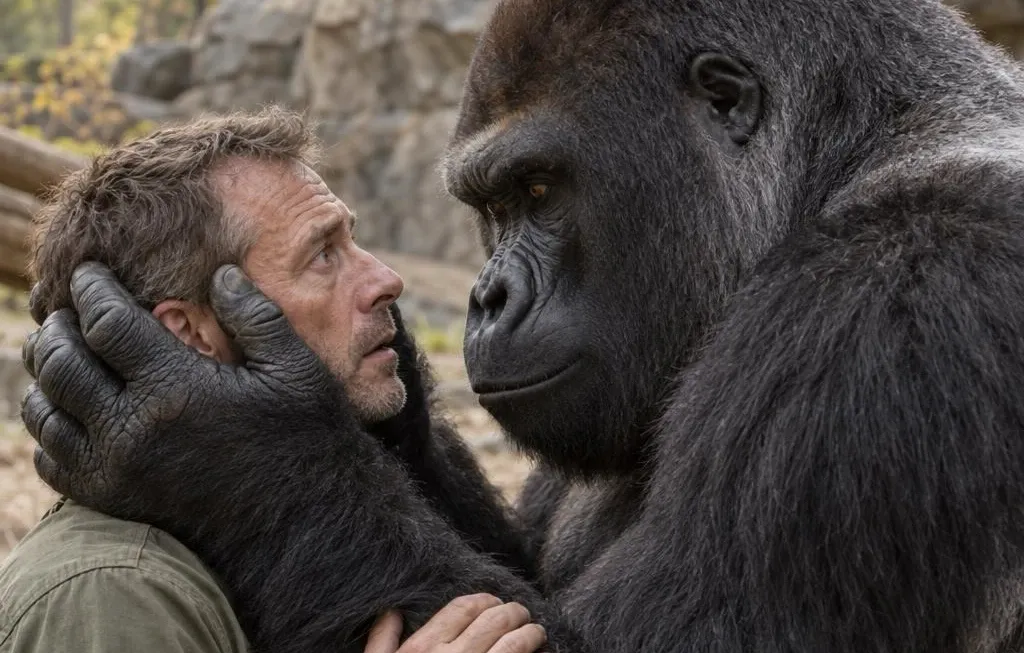
I set my bag beside the wall and took out my phone. By the time I started timing, the contact was already well underway. The keeper wasn’t restraining the animal or trying to free himself. His palms lay open against the gorilla’s back.
Nearly five more minutes passed before the arms relaxed. Even then, one enormous hand remained on the man’s shoulder. The gorilla leaned forward to examine his face.
That was my introduction to Kito’s new behavior.
I’d come to Talvern wildlife park, in the wooded foothills of North Carolina, expecting to investigate an environmental problem. My work involved great-ape behavior, and the request from the park’s primate center had mentioned increasingly persistent contact. Noise, discomfort, an altered routine: those were the possibilities I’d brought with me.
The man inside was Russell Bennett, fifty-five years old, Kito’s keeper for a quarter of a century. Kito was twenty-eight and weighed a little over four hundred pounds. Usually he distributed his attention sparingly. He could tolerate other keepers nearby without wanting anything from them. Russell had earned something different, but until recently, even with him, Kito had never demanded much physical reassurance.
“Since breakfast,” Eli said, “that makes three.”
I looked away from my timer. “Three like that?”
He opened his tablet. “Yesterday there were fifteen. Not a hand on the arm. The whole thing. Sometimes Russell barely gets started again before Kito comes back.”
The old records made the change plain. Three months earlier, staff had noted two such contacts in a week. The next month there were five; after that, ten. Now a single day could contain more than a previous week.
In my first entry, I enclosed the word “hug” in quotation marks. By the end of my second week there, nobody was using the term lightly.
The park still permitted a closely supervised direct-contact arrangement between Russell and the animal he had raised. It was an old practice, an exception rather than a model for new keepers, and Russell never worked alone. Eli controlled the service access that morning. Other staff watched from the corridor and observation room.
Kito’s attention did not extend to them. When Eli moved through the supervised work area, the gorilla acknowledged him and returned to pulling apart a bundle of straw. A veterinary technician received a longer inspection, but no approach. Russell couldn’t walk halfway across the enclosure without a touch at his elbow or a palm laid briefly against his back.
I asked Eli to walk me through everything they had ruled out. He brought up diet sheets, veterinary notes, maintenance work orders. The food hadn’t changed. There were no new medications, no nearby construction, no unfamiliar disinfectant. Russell’s hours were the same.
“And before these holds? Any trouble between them?”
Eli shook his head. “You’d expect some warning if he was upset with Russell. There isn’t any. Watch how gentle he is.”
Inside, Russell reached for a bucket. His fingers closed around the handle, but he didn’t lift it. He stared beyond the bucket toward the service passage, his lips parted as though he’d been about to speak.
Kito left the straw immediately.
Russell looked up when the gorilla arrived beside him. He gave us a rueful glance through the window.
“You’re going to put me behind on chores, pal.”
The gorilla reached around him. Russell let the bucket settle back onto the floor.
This time I kept my attention on the man. His smile required effort. There was a strain around his mouth that remained after he’d stopped speaking, and his hand rested on Kito’s back without moving for several seconds.
I lowered my voice. “How long has Russell been having difficulties?”
Eli locked the tablet and held it against his chest.
“We noticed little things in the spring. About six months ago. Keys in the wrong place. He’d come into a room and ask which way he’d come. Then he’d ask something we’d just answered.”
He glanced toward Russell before continuing.
“We made excuses. Everybody forgets things. Everybody gets tired.”
“What changed?”
“He used the wrong name for one of the females last week. Then he got a feeding procedure mixed up. He taught me that procedure.” Eli swallowed. “His wife got him to a neurologist.”
Kito had eased away enough to look at Russell again. The bucket remained between Russell’s boots.
“It’s Alzheimer’s,” Eli said. “Early-onset. They caught it fairly early, but the doctor says it’s progressing unusually fast.”
For a while, I heard the ventilation fan and the scrape of Russell’s shoe against the concrete. I had come to examine the gorilla. Now I watched the keeper lift the bucket with both hands, taking care over a task his body had performed thousands of times.
“Do you think Kito can tell?” Eli asked.
“I think he’s noticing changes we’ve been explaining away. I want a specialist to look at this with us.”
Kito caught the loose edge of Russell’s sleeve between his fingers. Russell stopped again, this time willingly.
“We may have the direction wrong,” I told Eli. “Kito may be offering comfort.”
Long before I met either of them, Russell had been the one who waited.
Kito had arrived at the park at three years old in a transport crate, with sore knuckles and no inclination to accept a human being’s good intentions. Russell was thirty. The young gorilla’s charges could frighten him, but they never made him rush.
For months, Kito slapped the floor when he approached. Branches came flying. Fruit went untouched while Kito watched from the farthest available corner.
Russell kept his voice level. He finished a little cleaning, left food within reach, and withdrew. He didn’t use hunger to demand an approach or reach out because he thought a day had gone particularly well. The next morning he returned and did the same ordinary work.
Almost a year passed before Kito chose to touch him.
Russell was down on one knee, arranging enrichment materials beside a log, when two small fingers rested against his cheek. He didn’t turn his head. He waited until Kito took his hand away.
The staff remembered that moment because Russell had hardly spoken about it afterward. He’d gone back to finishing the logs, though someone later noticed that he’d left one of his tools in the straw.
Over twenty-five years, he came to know the old injuries beneath Kito’s hair, the foods worth searching for, the set of his shoulders before discomfort became obvious. Kito, in turn, recognized the sound of Russell approaching before he reached the building. A certain whistle belonged to him. So did the small exertion noise he made when he lifted a heavy feed tub.
Much of their working day passed without words. Russell would pause; Kito would move. A glance could settle a question that would have required another keeper to back away and start again.
After Eli told me about the diagnosis, we changed the records. Counting contact alone wasn’t enough. We needed what had happened immediately before it: a missed word, an unfinished action, a tired morning, a clear one. We compared current observations with archived security footage, careful not to turn every ordinary movement into evidence.
On my sixth day, Russell stopped at the inner service gate.
Eli stood close enough to handle the locks. Russell wasn’t responsible for opening anything, but his hand went automatically toward the familiar sequence. Then it hovered there. He stared at the fittings as if he had never seen them arranged that way.
Across the room, Kito dropped the straw he was sorting.
Russell recovered before anyone needed to intervene. “Had a blank there,” he said, smiling toward the glass. “I’ve got it.”
Kito was already moving. He settled in front of Russell, between him and the gate, and lifted his arms.
For a moment Russell didn’t respond. I saw him look toward us, toward the people he had trained and the woman taking notes about him. Then he stepped closer.
The gorilla folded him in.
A patch of Russell’s shirt darkened where Kito’s mouth rested against his shoulder. A low call came through the enclosure microphone, uneven enough that Eli reached toward the speaker before realizing the sound wasn’t a fault in the equipment.
Russell’s fingers stopped stroking Kito’s back.
“What is it, pal?”
The call came again.
Later, Russell told me where he had heard it before: after the death of an older female who had helped Kito settle into the group, after a painful medical treatment, during a storm that had battered the building for hours. It was a distress vocalization, not human weeping. We had no reason to make it into something else.
But there was no storm that morning, no procedure, no animal missing from the group.
Russell moved his hand up to the gray hair over Kito’s head.
“You’ve got me,” he murmured. “I’m here, pal.”
Two weeks after that episode, Dr. Judith Feld arrived with a small case, a laptop, and a habit of listening through the end of an answer. She was a neurologist whose research concerned primate cognition and social attachment. She had little patience for claims that grew larger with each telling.
For several days, she worked through the material. With Russell’s permission, she reviewed his medical information alongside the observations. She read Kito’s veterinary history, questioned the keepers separately, and watched hours of footage, including stretches where nothing happened.
On her fourth morning, I found her in the office beside the observation deck. She pulled another chair to the desk rather than greeting me across it.
“Come look at the dates,” she said.
She brought our separate records onto one screen. Wherever Russell’s documented lapses clustered, Kito’s repeated efforts to hold him clustered too…
To read the rest of the story – CLICK the NEXT button 👇👇👇