


Clara Mercer kept the flour on the upper shelf now, where she couldn’t see how far the sack had sagged. Moving it hadn’t changed the amount. Twelve pounds, a little less after yesterday’s bread. Beside it stood a jar of beans and a crock containing the last of her dried apples.
She knew the rest without looking: thirty-eight pounds of cornmeal, potatoes enough for perhaps three weeks, and six dollars and fifteen cents folded inside a handkerchief under her mattress. There was nothing wrong with her arithmetic. That was the trouble.
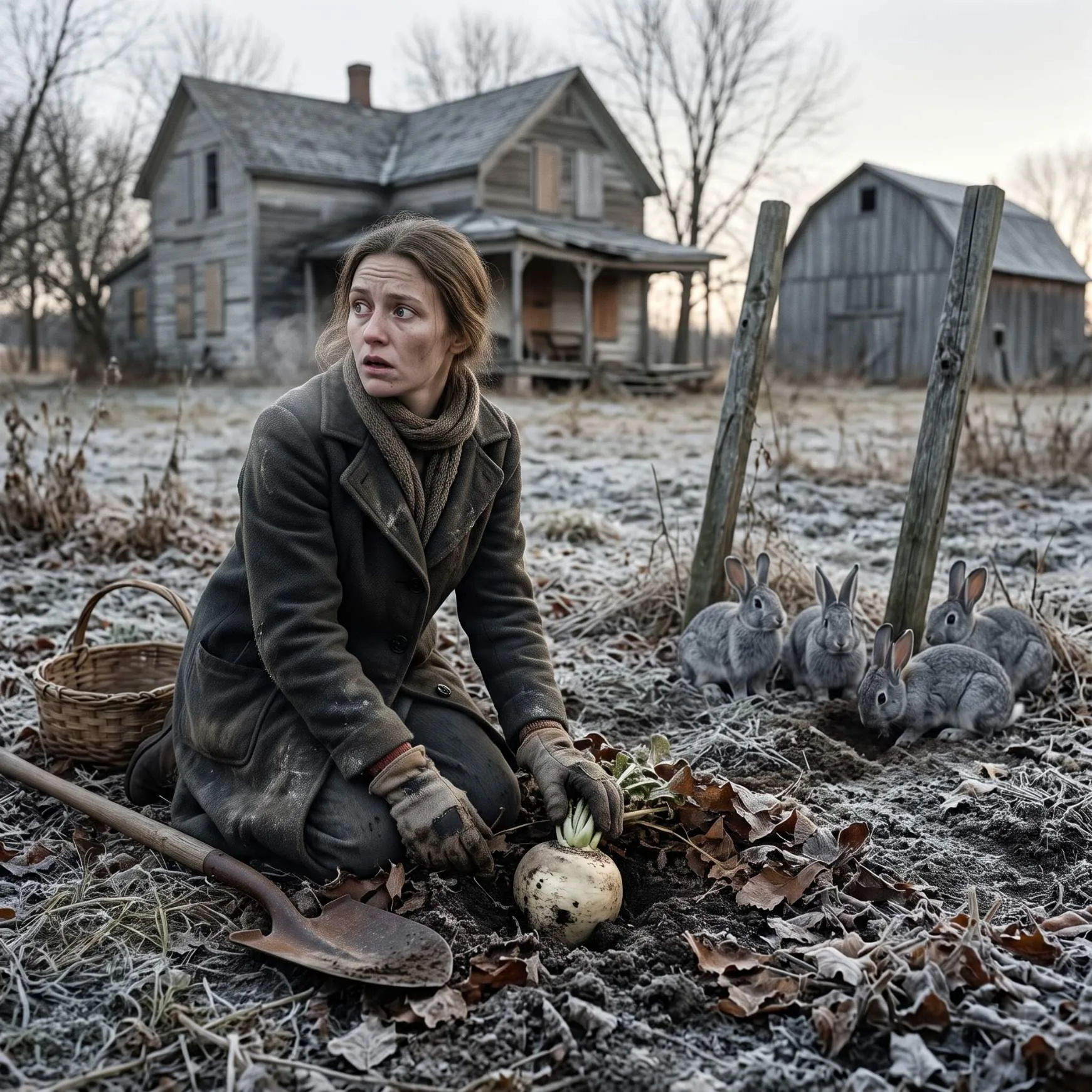
Coffee warmed her fingers as she stood in the doorway. Overnight, the first snow of the season had settled on the farms outside Delswick, Wisconsin. It was November 4, 1932. A scant covering showed where the yard needed leveling and collected along the lower fence rails. Across the field, it had lodged in the weeds around the empty Voss place.
At twenty-two, Clara was preparing for her second winter alone. People in town called her the young widow, as though the words explained everything anyone needed to know about her. They didn’t explain how to make flour last, or where a woman found money when everyone who might hire her was trying to keep his own place out of the bank’s hands.
One bank had already shut its doors. Farms were changing hands for less than the buildings had cost. Grown men took work that paid scarcely enough to feed them through the day. Clara could see a long way from her kitchen window, but nowhere in that view was there a dependable wage.
She drank the coffee before it cooled, fetched her water pail, and stepped into the yard.
Movement near the Voss fence caught her eye. Something dark passed behind a fallen rail, followed by another shape. Clara stopped with the empty pail against her leg.
Five rabbits were gathered near two crooked posts.
They were too heavy-bodied for cottontails. Even at that distance, she could make out upright ears, broad hindquarters, and gray coats that looked different whenever an animal turned. Her father had kept American chinchilla rabbits when she was a girl. These had the same dense, banded fur, dark beneath the paler tips.
She hadn’t seen one in years.
Clara set the pail down. One rabbit scratched rapidly with its forefeet, paused with its nose against the ground, then backed away. Another moved into the opening and resumed the work. A third waited nearby, chewing.
There was plenty of ground around them. All five wanted that particular place.
The breed had become fashionable during the previous decade, when people talked about fur prices and the useful size of the animals. Her father had liked their steadiness. He could reach into a hutch without starting a panic. But he had been particular about their shelter, too. A good coat didn’t make a wet rabbit safe in a northern winter.
These animals had no keeper that she knew of.
She watched until the handle of the pail began hurting her bare fingers. As she picked it up again, the largest rabbit raised its head. For a moment, its ears faced her. Then it lowered its nose and went back to the shallow hole.
Clara continued to the creek.
During the morning, she found reasons to stand at the kitchen window. The rabbits left and returned. At midday she could see only three; later, two more came from the direction of the barn. None stopped anywhere else for long.
By supper, she had given more thought to that scrap of ground than to the meal on her plate.
The next day, she counted six.
Two had darker coats than the others, with less of the pale tipping she remembered. They emerged from beneath the barn, crossed a short stretch of open yard, and made for the leaning posts. Sometimes they scratched. Sometimes they sat with their noses moving close to the soil. Eventually they went back under the building.
Her father used to notice where his animals spent their effort. A rabbit in cold weather had to eat enough to pay for every unnecessary journey. Clara remembered him resting a hand on a hutch door while he watched an animal that had stopped behaving as expected.
He never began by assuming it was foolish.
On the third morning, Clara waited until the last rabbit had disappeared under the barn. Then she left her pail by the door and crossed the field in her heavier coat.
The Voss farmhouse had been shut since early summer. Someone had boarded the downstairs windows, but one board had worked loose. The porch listed toward a corner where the support had sunk. Beyond it, a plow stood in the weeds, its handles dark with weather.
The family still owned the place. That much people agreed on. Where they had gone, and whether they meant to return, depended on whom Clara asked.
She approached the barn from the sheltered side. Under the eaves stood the remains of a row of hutches. Several wire doors hung loose, and a cracked water crock lay in the straw beneath one. A feeding tray had split along its bottom seam.
Clara crouched to look beneath the barn. The earth there was dry. Old timbers and the stone foundation left openings small enough for a rabbit, while the building itself broke the wind. These animals had stayed close to the housing they knew, or had been born to animals that had.
She straightened and turned toward the fence.
Tracks overlapped so thickly that individual trails were hard to follow. They led into a low stretch of ground perhaps a dozen feet across. Several small areas had been cleared of snow and leaves.
Clara knelt beside the nearest opening. The soil felt cold through her glove, but when she pressed, it yielded. Out in her yard, the frost had already made the surface resistant to a boot heel.
She scraped aside a few wet leaves.
A pale, rounded surface showed underneath. She rubbed it with her thumb, expecting grit. Instead, her glove slid over smooth skin. The thing didn’t move when she nudged it.
Clara pulled off one glove and brushed with her bare fingers until a shoulder and a little crown appeared.
A turnip.
She looked from it to the other places the rabbits had opened. There were more than she had first noticed, some no wider than her palm. Snow lay between them, and dead stems lay across the whole patch.
She stood so quickly that her knee protested, then walked home for the spade.
When she returned, the rabbits had come out. They stayed near the barn while she placed the blade well away from the exposed root. Her father’s garden lessons came back through her hands: loosen first, pull afterward, and don’t put the tool through what you mean to keep.
A shallow crust broke. Beneath it, the spade entered easily.
She worked around the turnip, reached down with both hands, and lifted it free. It was nearly the breadth of her palm, with firm skin and no sour smell. Clara laid it on a clean patch of snow.
The next one was smaller. The third took more digging.
A few feet farther along, she uncovered a long root that resisted her first careful tug. She loosened the earth deeper and brought up a parsnip. Another grew beside it. Beyond those, a heavy rutabaga showed a purple shoulder under the collapsed leaves.
Clara lowered the spade.
From where she stood, the dead stalks no longer looked scattered. She could follow a line of them, then another running beside it. The leaning fence enclosed far more ground than the rabbits had cleared.
She had uncovered the edge of a planted garden…
To read the rest of the story – CLICK the NEXT button 👇👇👇