


The auction clerk had to count Nolan Voss’s money twice. Eight dollars, mostly in ones, lay beside a receipt for eighty-five calves.
Behind him, somebody laughed. Nolan left his hand on the counter a moment after the clerk had gathered up the bills.
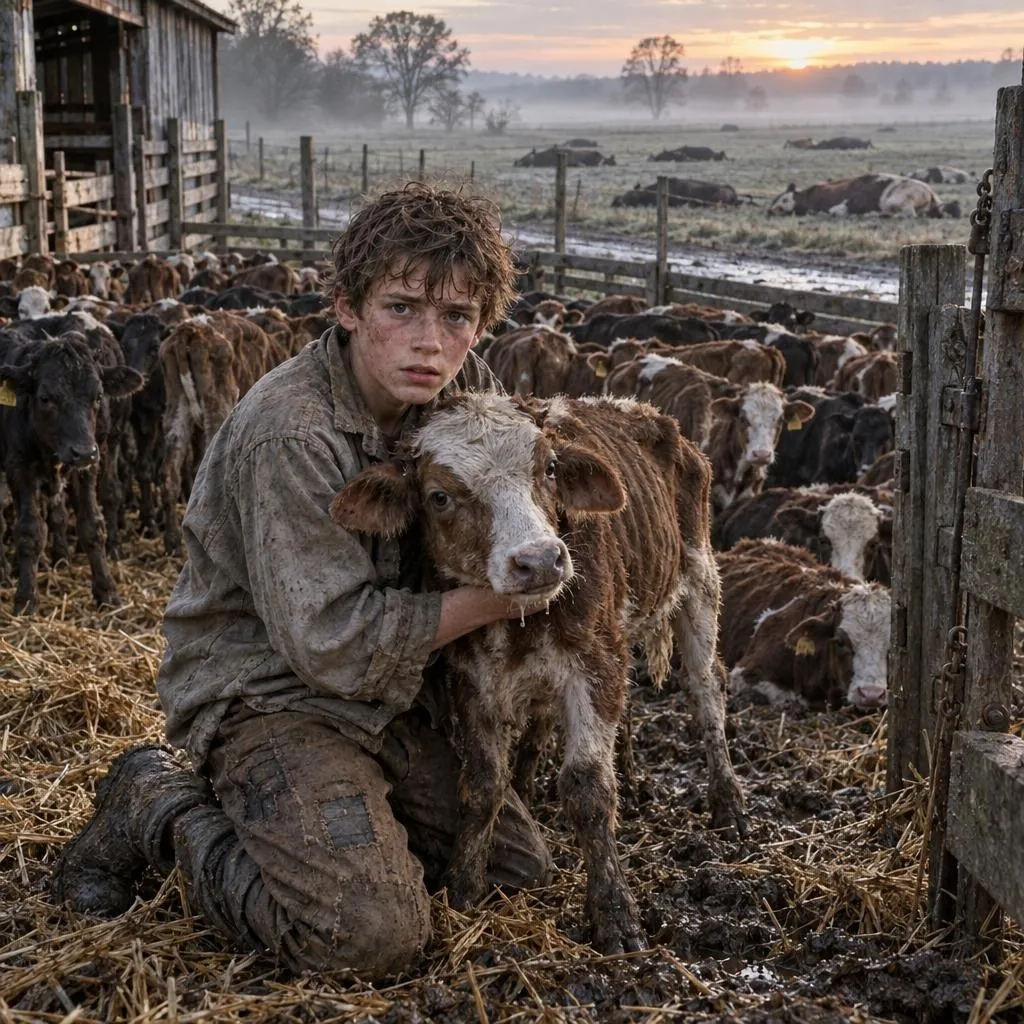
Gordon Pike leaned against the counter, his coat open over a clean work shirt. “You’ll spend more burying them.”
Nolan took the receipt. Through the doorway, he could see a calf nosing the rim of a water tub. Another had folded its legs beneath it, but its ears turned when a gate slammed.
“Likely lose half before spring,” Gordon added. “And you’re hauling them to that played-out farm?”
“I need to get them loaded.”
“Better find a shovel first.”
Nolan folded the paper into quarters and put it inside his coat.
He had come to the sale barn in Lanscott looking for things other people didn’t want: wire with some life left in it, gate hinges, perhaps a length of pipe. Talvera, his family’s farm, needed all of those. He hadn’t intended to buy a single animal.
Then the last pen had come up for sale.
Nobody had hidden the calves’ condition. Discharge crusted their nostrils. Their coats looked rough, their sides narrow. Coughing traveled through the bunch as they shifted away from the auctioneer’s platform. Men who had bid freely an hour earlier stood with their hands buried in their pockets.
Nolan watched the water tub instead of the bidding rail. Some calves were too dull to move toward it. Others drank, swallowed, and made room for the next animal. When a loose chain struck a post, several raised their heads at once. A little red calf stumbled, caught itself, and stayed standing.
At sixteen, Nolan had started working after school for Dr. Lydia Mercer, whose large-animal practice sat on the edge of the city he shared with his mother. He scrubbed buckets, washed instruments, and learned to keep his fingers clear of a closing gate. Lydia made him watch before she let him help.
Once, while they cleaned a pen after treating a group of coughing calves, she had pointed toward a clogged waterer.
“Fix that before you carry another bucket.”
He’d thought she meant saving labor. She made him look again: calves shoving one another away from the little water that trickled through, bedding soaked beneath their feet, stale air hanging under the low roof.
He learned that an illness could gain ground through all the ordinary things people stopped noticing. He also learned that good care didn’t guarantee a recovery.
Two years of chores hadn’t made him a veterinarian. Standing at the auction counter, he knew that much.
Now he needed a truck.
His great-aunt Esther listened to him from the farmhouse telephone without interrupting. Then she gave him the name of a neighbor who might lend a pickup and stock trailer. By afternoon, Nolan had the keys and a promise to keep: when money came in, he would return the rig with at least as much fuel as it had when he borrowed it.
He loaded lightly. The calves needed room to brace themselves, and some could barely manage the ramp. Saving a trip wasn’t worth having them piled against the trailer’s front wall.
The road out to Talvera had ruts that held their shape through every grading. Nolan crawled over them, watching the trailer in the mirror. He unloaded, drove back, and did it again. By the last trip, he had worked the skin raw beside one thumbnail opening stubborn latches.
Esther’s flashlight found the trailer as he backed toward the old chute. Its beam passed over peeling boards and stopped on the gate latch.
“Hold it there,” he called.
The final calves came down reluctantly. Nolan counted them into the enclosure, then checked the total against the loads he had already brought home.
Eighty-five.
Esther turned off the flashlight once he had fastened the gate. In the porch light, she looked small inside her heavy coat.
“You know they need room,” she said. “Tomorrow you’ll find out how much work room takes.”
By morning, he was carrying water uphill.
Talvera covered a hundred and fifty-six acres in the Missouri uplands, but only about fifty-four were readily usable. Brush had closed over stretches of old fence. Water pipes ended where somebody, years before, had stopped maintaining them. Near the house, rain ran off the packed clay before it could soak in.
The easiest choice would have been one large lot close to the barn. Nolan walked past it with a coil of wire over his shoulder.
He made smaller enclosures wherever he could secure them. The weakest calves went apart from the more alert ones. He patched gaps with salvaged wire, ran hose to the places it would reach, and hauled buckets to the rest. When a patch became muddy and trampled, he moved the animals and left it alone.
Every division created another latch to check, another container to scrub, another stretch of fence that might fail in the night. By supper, his arms shook when he lifted his fork.
One evening, Esther found him crouched beside a calf that wouldn’t drink. He had been there nearly an hour, waiting through a swallow, a pause, another small effort.
She set a fresh bucket within reach.
“You can keep a herd alive and still lose some,” she said.
He rubbed the calf’s neck without looking up.
The first death came before he had quite learned to expect it. Three days later, another calf was gone. During the first bitter spell, the losses reached seven.
Nolan wrote each one down. The auction receipt stayed tucked inside the same pocket notebook.
Eighty-five purchased. Seven dead. Seventy-eight left.
At night, a cough outside could bring Gordon’s voice back more clearly than Nolan wanted. He had watched Lydia work for two years. Gordon had been raising cattle longer than Nolan had been alive.
After the seventh loss, Nolan stood at the fence until the light had drained from the field. When he finally went inside, Esther had left a plate at the back of the stove. She was mending a shirt and didn’t ask what had kept him.
He ate beside the stove, with his coat still on.
The next morning, he measured what he could. More water was disappearing from the tubs. A calf that had waited behind the others now pushed toward feed. In the stronger groups, the coughing came less often.
He wrote those things down, too.
Winter reduced his days to chores performed with cold fingers. Break the ice. Check the water. Look along the wire. Move a group before the ground beneath it was worn bare. He came to recognize the calves by a nicked ear, an uneven patch of white, the angle of a tail.
Eventually, no new death went into the notebook.
One morning midway through winter, Nolan counted seventy-eight animals, then walked the enclosures and counted again. Their sides had filled out. A few still coughed, but he could hear them chewing from the other side of the fence.
Esther waited until he had finished writing the number before speaking.
“They’ll eat more now.”
He looked toward the feed.
“A good deal more,” she said.
The feed figures left him with a choice he disliked: sell in spring, or find a way to keep the herd eating. He had almost no cash, no established credit, little working equipment, and no means to buy the hay, grain, and prepared ration the animals would need in the coming months. A sale promised money; afterward, Talvera would stand empty again.
He began estimating what part of the herd might bring. Between chores, he looked toward the brush on the northern slope. Old pasture lay under it, according to Esther. From the house, he could see little worth feeding an animal.
The answer turned up while he was trying to stop rain from reaching an upstairs ceiling.
Nolan pulled loose boards away from a cramped space beneath the roof and struck wood with his knee. A small chest had been pushed against the wall. Its lid caught on a swollen corner before yielding.
Inside lay eleven notebooks.
His late great-grandfather’s name, Arthur Voss, appeared inside the first cover. Nolan expected bills or household accounts. Instead, he found a drawing of the farm, divided by slopes and soil rather than fence lines.
There were twenty-six years of entries. Arthur had marked the places that stayed damp after weeks without rain and the ground that greened earliest. He tracked grass through hot summers, hard freezes, dry years, and seasons when cattle had been left too long in one place. Beside several sections, he had written how long recovery took.
Nolan sat on the dusty floor until the light failed.
After that, he read at the kitchen table between chores. The books described native grasses he had scarcely recognized beneath the brush. Arthur had kept returning to them, testing what survived and what brought it back.
Near the back of one volume, Nolan found a short entry he read several times.
“Before condemning the ground, examine what you’ve required of it.”
He carried the open notebook to Esther.
She touched the handwriting with the side of a finger. “I wondered where these got to.”
“Did he ever make this work?”
“He understood it better than most.” She turned a page. “Folks wanted this place to produce like deep bottomland. More cattle, less waiting. Arthur kept telling them they’d wear it out trying.”
“Did anybody listen?”
“A few. Not enough.”
Nolan spread the farm drawing beside his feed calculations. Esther watched him move the paper with the sale estimates underneath the notebook.
“I’m keeping the herd,” he said…
To read the rest of the story – CLICK the NEXT button 👇👇👇