


Calvin Rusk left the envelope on the passenger seat and sat in the shelter parking lot with the engine running. On its back, beneath the address, he’d written three things: small, young, not a working dog.
His daughter had sent him a photograph of an eight-week-old beagle mix. One ear stood up; the other looked unfinished.
“Go meet him,” Natalie had said. “You don’t have to decide your whole life before you leave the driveway.”
She lived a state away and called more often than he called back. Lately, she’d stopped asking whether he was lonely. Instead, she sent pictures of dogs.
Calvin shut off the engine.
At fifty-three, he still had the shoulders of a man who’d spent twenty-two years in the Navy doing work that required him to get other men through narrow places. His knees made getting out of a pickup less graceful than it used to be. Most mornings, he waited until he was upright before deciding how much they hurt.
He’d been a SEAL. He could walk into an animal shelter.
The brick building stood on the edge of Lornell, Idaho, forty minutes from his farmhouse. Wind worried a loose section of chain-link fencing. Beyond the gravel lot, the mountains had disappeared beneath a low ceiling of cloud.
Inside, a woman was fitting a fresh liner into a wastebasket behind the counter. She finished before coming to meet him.
“Beagle mix?” she asked, glancing at the envelope in his hand.
“That obvious?”
“We don’t get many people bringing directions anymore.”
Her name tag read Ruth Hensley. Sixty-four, silver hair tucked behind her ears, sleeves rolled neatly above her wrists. She’d run the Veylan animal shelter for nineteen years. Nothing about her suggested she intended to hurry through the twentieth.
“The puppy’s doing well,” she said. “Before we bring him out, I’d appreciate a few minutes of your time.”
Calvin waited.
“There’s a dog in the back. I’d like you to see him.”
“What kind?”
“A Malinois.”
His fingers tightened on the envelope.
Ruth noticed. She didn’t pretend otherwise.
“You can walk away after you look.”
He should have said no at the counter. Instead, he followed her past a room full of puppy noise, through a heavy door, and into a corridor where the sound fell away.
Ruth stopped beside a narrow window.
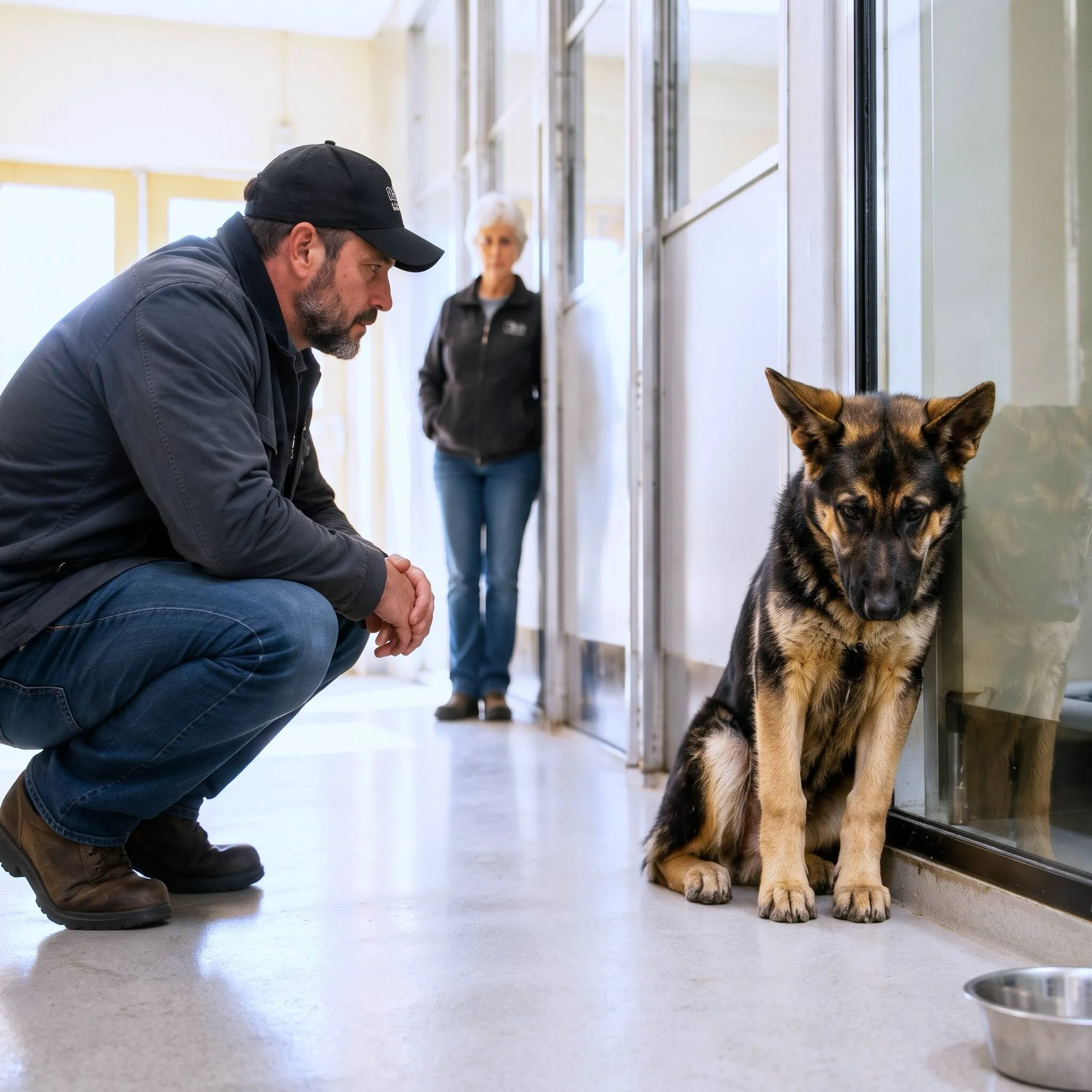
Calvin saw the untouched food first. Dry pieces had been scattered around a bowl, but none appeared to be missing. At the far end of the kennel, a dark-faced dog had folded himself against the wall, elbows tight to his chest.
“Flint,” Ruth said. “Four years old. He’s been here nine days.”
The dog’s coat lay flat over jutting ribs. He needed close to thirty pounds that he didn’t have. His eyes stayed on the door, though neither person was standing in front of it.
“He hasn’t eaten in four days. Before that, hardly anything.”
“Vet seen him?”
“We’ve had him evaluated. The behaviorist wrote down grief, then put a question mark beside it.” Ruth watched the dog through the glass. “His owner was Walter Dempsey. Seventy-one. Retired Army. He lived alone up the canyon after his wife died. Neighbors said he’d been keeping to himself for a couple of years.”
Calvin shifted away from the window, but Ruth hadn’t finished.
“Walter died in his chair. By the time someone checked the house, Flint had been beside him nearly three days.”
The dog’s ears moved at a distant latch. His body didn’t.
“He walked out with animal control,” Ruth said. “Since then, we’ve mostly been watching him wait.”
On the clipboard beside the door, someone had flagged a risk of aggression. Calvin tapped the edge of the sheet.
“One handler reached too quickly,” Ruth explained. “Flint snapped without making contact. That’s the incident.”
“And that’s the label.”
“Yes.”
Calvin looked again.
Nine years earlier, overseas, he’d worked with a Belgian Malinois named Bishop. There had been a doorway, a pressure plate Calvin hadn’t cleared, and a dog moving faster than a man could understand what he’d seen. Bishop had driven into him, knocking him out of the opening before the blast.
Calvin had held him for eleven minutes.
He could still remember where the harness strap had pressed into his palm. He had not said the dog’s name to anyone since.
Flint had the same close-set strength through the shoulders. Even wasted down like this, the resemblance was there. Calvin had spent years looking away from dogs built that way.
“My daughter found me a puppy,” he said.
“He’s still here.” Ruth stepped back, leaving him room to leave. “I haven’t heard this one answer a voice yet.”
Calvin’s house was twelve acres of meadow and an old farmhouse set so far off the road that headlights never reached his bedroom. He’d liked that when they bought it. He’d liked it more after Elaine died eighteen months ago.
Elaine had chosen the place eleven years earlier, on a raw March afternoon. Before they’d seen the kitchen, she’d walked to the back fence, looked toward the mountains, and told the agent they could stop searching. She’d had quick hands and a laugh that never arrived out of politeness.
Her illness had allowed them some conversations. It had not allowed them enough.
Beyond the glass, Flint adjusted one paw, then put it back exactly where it had been.
Calvin leaned close enough for his voice to carry through the door.
“Steady.”
One ear turned. The movement lasted less than a second.
Ruth lowered her clipboard.
“Open it,” Calvin said.
He entered without facing the dog directly. There was a fresh water bowl near the door; he moved it partway across the kennel, then lowered himself to the concrete. His right knee objected. He breathed through it and settled with one shoulder toward Flint, hands loose where the dog could see them.
For a while he said nothing.
Then he began talking about the stove at home. Elaine had insisted on it. He’d spent their first winter admitting, in installments, that she’d been right. There was snow coming, probably before the weekend. He still needed to cover the last stack of wood.
The dog didn’t move.
Calvin kept his voice where he’d learned to keep it on long, difficult nights. No demand at the end of a sentence. No sudden change in pitch. He told Flint about a gate that sagged whenever the ground froze and the pair of magpies that stole anything he left outside.
Roughly twelve minutes passed before a claw scraped behind him.
Calvin kept his eyes on a chipped spot near the drain.
Water stirred in the bowl. A few small laps, a pause, then another.
He spread his hand on the cold concrete and let his breath out slowly.
When he returned to the corridor, Ruth had the beagle’s folder tucked beneath her arm. Calvin looked at it, then at the door he’d just closed.
“What would it take to bring Flint home for a couple of days?”
To read the rest of the story – CLICK the NEXT button 👇👇👇