


The coupling on the grease gun wouldn’t catch. Ned Mercer wiped it with his thumb, tried again, then set the tool on the barn workbench before he damaged something out of pure stubbornness.
Above the bench, four roofing nails held his chore list against the inside of the door. Fresh paper covered most of the old sheets. Each January he copied forward whatever remained undone, but he always left the bottom of one yellowed page showing.
Ruth’s handwriting was there.
Take care of that well, Ned. A child could fall in.
She’d added it eleven years earlier, during the last spring she could still make the walk from the house. He could remember her standing in this doorway, pushing the pencil hard because the paper had no solid backing. The letters dipped where the wood beneath them was rough.
He’d never copied that line. Each year, he arranged the new page so he could still see hers.
The hay rake needed grease. There was wire to stretch along the creek and a gate in the upper pasture dragging its bottom hinge. He was sixty-nine, and the work on his hundred and twenty-eight acres had begun accumulating faster than he could finish it.
He reached for the grease gun again, then glanced toward the house.
Mabel wasn’t on the porch.
Warmth lingered over the southeastern Ohio hills that last week of October. By noon a man working outdoors wanted his jacket off, though the hollows stayed damp until late morning. Beech leaves collected beneath the fence wire, and the smell of drying corn drifted from the next farm.
Mabel ordinarily spent this part of the day stretched across the porch steps, making Ned step over her. At thirteen, she considered moving aside an unreasonable request.
For three mornings, though, her bed had been empty when he came out. She returned with a muddy underside and seeds caught in the long hair of her tail. Breakfast went untouched. After drinking, she lowered herself onto the boards with a sound that made him look away.
Then, later, she disappeared again.
Ned had watched old dogs do that. A place under a shed, a thicket beyond the pasture, somewhere a person didn’t think to look until too late. That morning he’d written the veterinarian’s number across the back of his hand. He meant to call Monday.
Now he put the grease gun down and listened.
The sound came from beyond the far pasture: Mabel’s voice, but without the full, rolling bark she’d once used on rabbits. She kept worrying at one low note.
Ned crossed the field, his boots darkening as he entered the shade. The first farmhouse had stood a quarter mile behind the present one, before a fire left only a collapsed chimney and a cellar depression. A lilac still grew there. Around it, young sassafras and blackberry stems crowded the old fence.
He saw Mabel’s white back through the brush. Her red ears hung forward, except for the one that always showed its pink lining, no matter how often he turned it right side out.
“Mabel. Come on out of there.”
She didn’t even look at him.
He pushed a cane away from his face. “You’ve found yourself something you can’t catch, haven’t you?”
Then a cry rose through the leaves at his feet.
For three seconds, he was certain a child was underground.
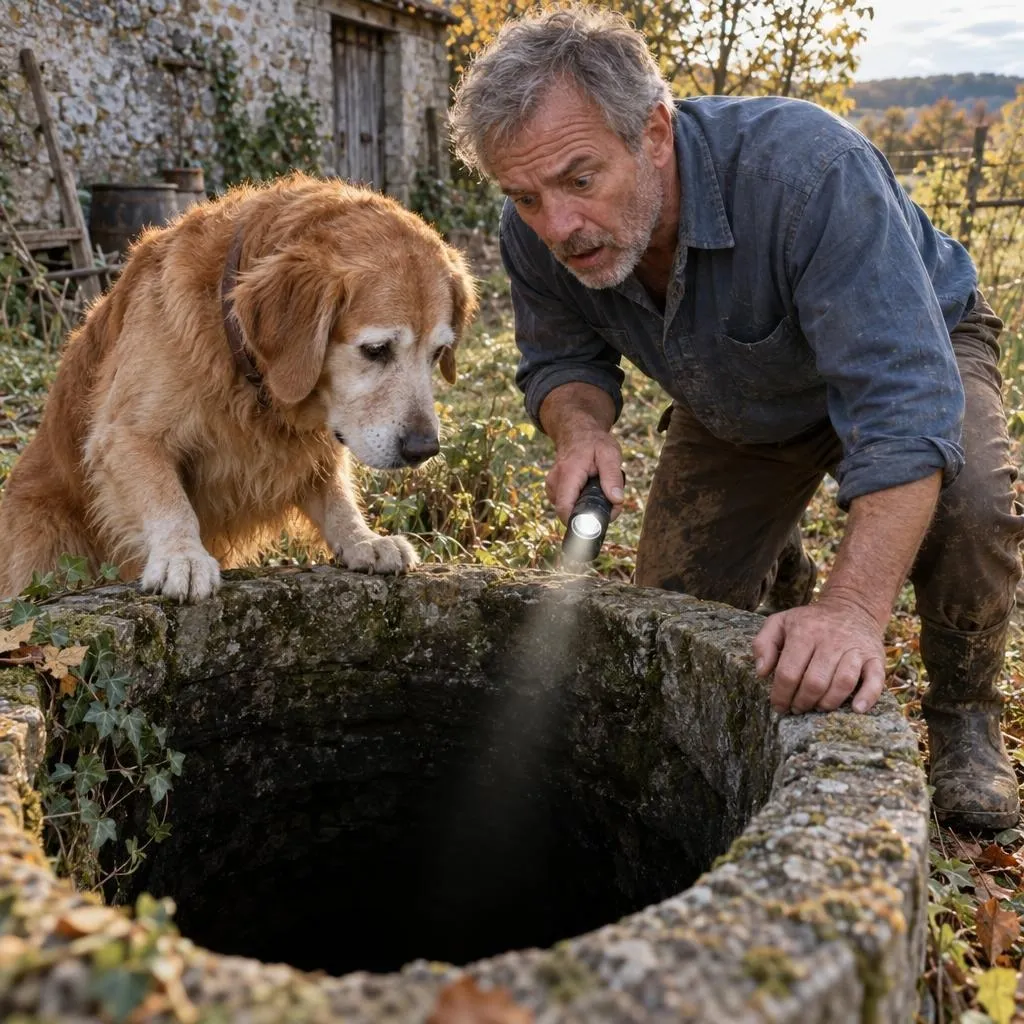
He dropped so abruptly that a stone struck his knee. Both hands went to work, dragging away leaf litter. His fingers found the rounded edge of the well collar. Beside it, a rotten panel sagged into an opening barely visible through the brush.
His father had boarded over this shaft in 1965, when piped water reached the farm. Ned had been nine. Before that, his grandfather had drawn water here from a well he’d dug by hand in the 1920s.
Twenty-eight feet. Ned remembered the knots in his grandfather’s measuring rope.
He pulled the little flashlight from his key ring. It was scarcely brighter than a match down there, but he held it steady until he could separate the damp stonework from the darkness below.
Something moved beyond the light.
Two eyes caught the beam. They vanished when the animal turned its head, and the next cry ended in a rough, defensive sound no child could make.
Ned sat back. One hand shook badly enough that he closed it around the flashlight to hide it.
Mabel pressed against him. He caught her around the ribs and felt how thin she’d become.
“Since I was nine,” he said. “I’ve known it was here since I was nine.”
He took his phone from his shirt pocket.
The emergency dispatcher let him give his location before she interrupted. Her voice was young and carefully level.
“I need to establish whether someone has fallen. Did you see a person?”
“No. I thought I heard one, but I was wrong. It’s an animal. Looks like a wild cat.”
“A domestic cat?”
“A bobcat, I think. In an old well.”
Keys clicked at her end. She told him she would connect him with the appropriate office.
For nearly an hour, Ned explained the same hole to people in different buildings. The county desk sent him to the sheriff’s office; there he was given the state wildlife number. That call put him on hold long enough for the screen to leave a warm patch against his cheek.
He paced between the ruined chimney and the fence. Each time the animal cried, he stopped. Mabel followed him a few steps, then returned to the opening.
Three mornings.
He looked at her muddy belly, then at the full outline of the veterinarian’s number on his hand. He rubbed the ink with his thumb until it smeared across his skin.
Officer Cal Voss arrived shortly before two. His green pickup stopped in the pasture, and he came through the brush carrying a light large enough to fill his hand. He was broad across the chest, somewhere in his forties, and moved without wasting effort.
Ned started explaining before the officer reached him.
Voss held up one finger. “Let me see her first.”
He stretched out beside the opening and stayed there for several minutes. When he rose, there was damp earth across the front of his uniform.
“Young female. About eighteen months. She’s standing.”
“She’s been there three days.”
Voss studied him.
“My dog’s been coming out here that long. I thought she was sick.” Ned looked down at Mabel. “I didn’t follow her.”
The officer put his light away without commenting.
“What can we do?” Ned asked.
“First, nobody tries to catch her. State law puts wild animals under our authority, so any handling or removal has to be authorized. I can arrange that part.”
“And the rest?”
“I’m not a rope team. I’m also not a veterinarian. Sedation would have to be a vet’s decision.”
Ned glanced into the opening. “Somebody still has to get down there.”
Voss pulled out his phone. “That’s the part I’m working on.”
Two county rescue trucks crossed the pasture around three. Ned knew their volunteer squad chiefly from the annual fish supper, where he bought a ticket and put extra money in the donation jar. Until that afternoon, the equipment behind their open truck doors might as well have belonged to another trade entirely.
Beth Pike came through the fence first. She was forty-two, lean and quick, with a cap pulled down over her tied-back hair. On school mornings she drove a bus past his mailbox and raised two fingers from the steering wheel. He’d never seen her without the bus until now.
She acknowledged him with a nod, then knelt at the well. After looking down, she turned toward the oak near the chimney and followed its trunk upward with her eyes. Next she looked at the trucks and the ground between them and the hole.
Raymond Fenn, whom everyone called Ray, arrived carrying a gear bag. At fifty-seven, he had a gray beard and shoulders that filled his rescue jacket. He’d been doing rope work for thirty-two years.
He looked into the shaft. Unlike Beth, he didn’t stay long.
“No descent,” he said.
Beth waited beside the rim.
Ray looked toward the clouds gathering beyond the western ridge, then back at her.
“Our coverage is for rescuing people. None of us is qualified to handle an angry wild animal.” He pointed with two fingers. “That lining’s old. We haven’t checked the atmosphere. Put a volunteer down there and we may need a second rescue.”
“We can assess—”
“Assess it, yes. But hear me first.” His voice stayed quiet. “I’ve spent too many years bringing people home to gamble one of ours on a cat. Nobody goes down…”
To read the rest of the story – CLICK the NEXT button 👇👇👇