


The truck’s ventilation fan had begun to squeak again. Glenn Mercer turned it off and lowered his window, letting the June evening come in warm against his forearm.
Beside him, his sixteen-year-old granddaughter slept with one socked foot tucked under her. Tessa’s phone lay dark in her lap. She had arrived from Greenville with enough clothes for the summer and a careful explanation about wanting to spend time in the mountains. Glenn suspected his daughter had supplied the explanation.
He was sixty-two, retired after thirty-five years of hauling freight, and apparently no longer trusted to spend a summer by himself.
The road into Avenell, North Carolina, narrowed above the Tawley River. Glenn knew the patched pavement, the places where gravel washed down after rain, the bend that tightened just when a stranger might think it was finished.
Evelyn’s reading glasses rested beneath the windshield. Fine gold frames, one earpiece slightly crooked. She had been gone two springs, and he still carried them there.
They always slid a little on this curve.
A shape appeared in the headlights.
His arms acted before he could name it. Firm grip, hard braking, hold the lane. He had spent too many hours in safety classes to put the truck into a ditch on instinct.
The impact came before the truck stopped.
Tessa jerked upright. Something small struck the floor near his boots. For several seconds Glenn listened to the engine idling and could not make his hand turn the key.
“What happened?” she asked.
“Stay put.”
He found the flashlight in the door pocket.
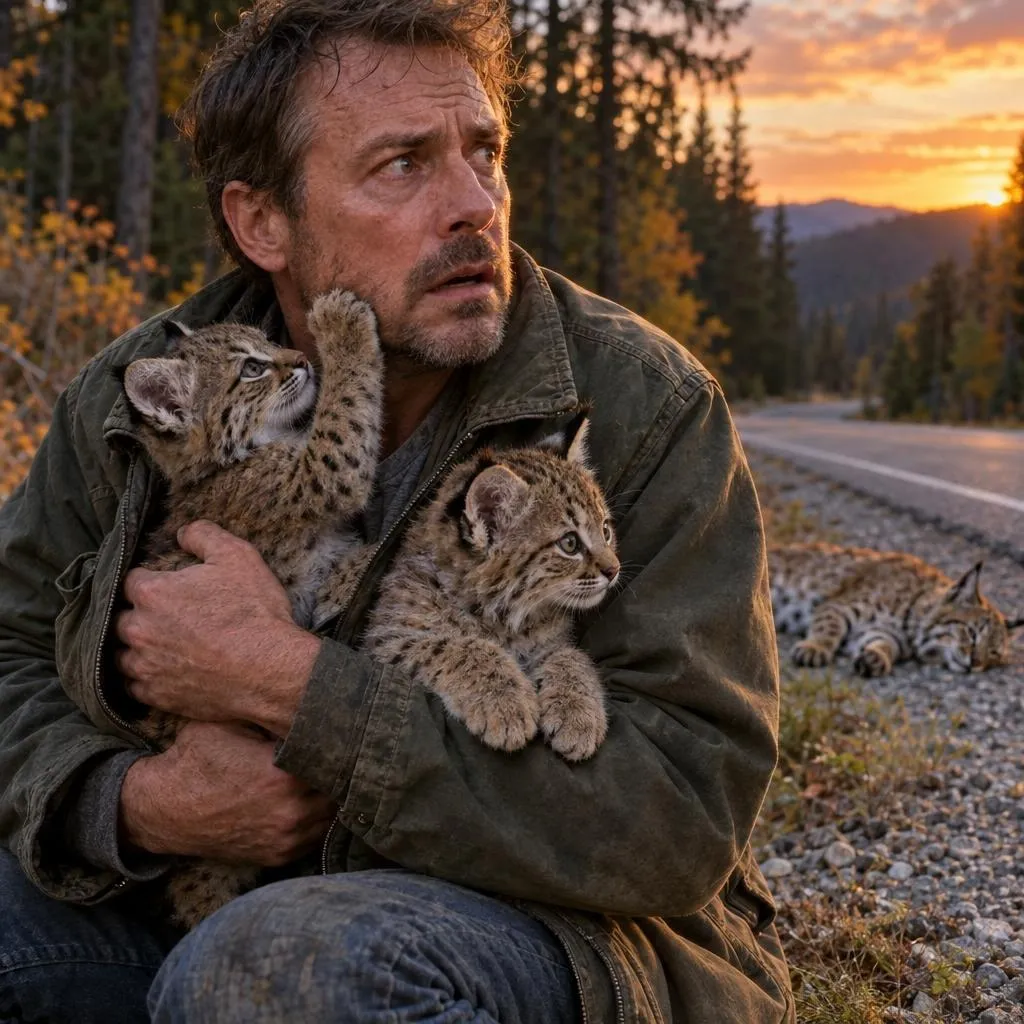
Beyond the white line lay a female bobcat. Her hind legs were stretched into the gravel, and the beam picked out the dark markings on her forelegs. Glenn crouched without touching her. There was no movement beneath the spotted fur.
He lowered the light.
At last he went back for the flannel jacket behind his seat. He spread it over her, working carefully around the ears, though there was no reason left to be careful.
A sound came from the weeds.
He turned. Two little faces shone in the flashlight beam, close together at the bottom of the ditch. Both kittens had their ears laid flat. The noise they made was a dry, fierce rasp, scarcely enough to carry over the idling engine.
Neither backed away. The grass trembled around their small bodies, but they held their ground beside the place where their mother lay.
Gravel shifted behind him.
Tessa had climbed out without her shoes. Before he could stop her, she was kneeling, hands extended toward the kittens.
“Leave your hands where I can see them.”
She froze.
“You don’t reach for an animal just because it’s little,” he said. “Not when you don’t know what you’re doing.”
For once she swallowed her answer.
His phone had a signal, but he had no idea whom to call. Tessa took it, found the state wildlife office, and handed it back while the line rang.
The recording gave him weekday hours. Someone would be available Monday morning.
Glenn looked up the road. It was Friday.
A pickup swept into the bend, and he stepped out with the flashlight raised. The driver moved over late. Its tires passed close enough to stir dust against Glenn’s trousers.
“We could keep trying numbers,” Tessa said.
He aimed the beam into the ditch again.
The smaller kitten had moved. Her nose was buried against a loose fold of his jacket, and she kept pressing forward, withdrawing, pressing again. The other kitten stayed beside her, silent now.
Glenn watched until Tessa said his name.
“Find that grocery box behind your seat.”
She looked at him, then hurried to the cab.
He emptied the box onto the floor. Tessa pulled off her sweatshirt and spread it inside. Wearing his work gloves, he gathered the kittens one at a time while they spat and struck at the leather. Their feet were hardly larger than the ends of his thumbs.
When he folded the flaps loosely over them, Tessa said, “I thought we weren’t supposed to touch things we didn’t understand.”
“Help me hold this closed.”
He retrieved Evelyn’s glasses from the floor before they left.
The drive home took twice as long as usual. Tessa kept a hand across the box, lifting one corner occasionally to check on its occupants. Glenn never took the truck above twenty.
In the kitchen, he brought down Evelyn’s baking scale. Tessa made a wall with a dish towel while he weighed each kitten in the shallow pan.
The smaller one weighed 480 grams. The other weighed 495.
He wrote both figures on the yellow pad beside the telephone. His handwriting looked too large for the numbers.
By dawn, the kittens were asleep on the sweatshirt, their box tucked beside his chair. Glenn sat at the table with Evelyn’s glasses open across his palm. When the refrigerator motor stopped, he could hear the tiny movements they made in their sleep.
At breakfast on Monday, Tessa watched him pour coffee.
“The office is open now.”
He set the pot down.
“I’m aware.”
She waited with her spoon suspended over her cereal. He could feel her looking from him to the box beneath the table.
He had spent most of Sunday night remembering hospital chairs in Caldren. The washable cushions. The vending machine that accepted his dollar only if he smoothed it first. People who spoke kindly and carried Evelyn through doors he could not follow.
He had driven home alone from the last hospital.
These two had lost their mother beneath his truck. He could not picture putting their box into a stranger’s hands and watching another door close.
Tessa lowered her spoon. She did not mention the telephone again.
That afternoon Glenn bought kitten formula and small nursing bottles from Vernon Keene’s feed store. Vernon, seventy-two and suspicious of anything that couldn’t earn its keep, held up one bottle before ringing it through.
“Since when do you keep a cat?”
“Since recently.”
“One?”
“Two.”
Vernon made a dissatisfied noise. He disliked ordinary cats and had a particular grievance against bobcats. One had taken nine of his laying hens during a hard winter, and nobody who bought feed from him had escaped the account.
Glenn paid before he could begin it again.
Tessa found feeding instructions on her phone. She checked the formula temperature, showed Glenn how to keep a kitten belly-down, and wrote a schedule beneath the weights on the yellow pad.
Every four hours.
Glenn set alarms on his old flip phone. Through the rest of June he rose at midnight and four, warmed bottles in a mug of water, and sat with a towel across his knees while each kitten fed. He had done something much like it when Tessa’s mother was a baby. His hands remembered how to support a small body without squeezing.
They lived in a deep plastic tub in Evelyn’s sewing room, with gentle heat beneath one end so they could move away from it. For the first week, every lifted lid brought a furious reception.
During the second week, the hissing stopped.
In the third, he heard a new sound as he came down the hall: quick, high notes, answered by another set from inside the tub. He stood outside the door, listening, until Tessa came to see why he hadn’t gone in.
“They’re calling you,” she said.
He named the smaller one Tawley, after the river. She climbed toward his hands whenever he reached into the tub, and once she could follow him, she did.
The larger kitten became Russet for the reddish tips that showed around her ears in sunlight. She was first over the tub’s rim, first to try meat from a spoon, first to fasten her teeth on Glenn’s thumb and convince him to put the spoon down.
He wrote both names beside their weights.
Then, halfway through July, Tawley stopped eating.
She stayed tucked against the side of the tub while Russet scrambled over the bedding. When Glenn lifted her, she offered neither protest nor the little calls he had begun waiting for.
On the second day, Tessa sat on the sewing-room floor, wiping her cheeks with her sleeve.
“We can’t fix this here.”
He drove forty minutes to a clinic in Orsett, where nobody knew his truck. He arrived near closing with a towel-lined shoebox held against his chest.
Dr. Mehta lifted the towel. Her hand paused above the kitten’s head.
“Tell me where she came from.”
Glenn told her about the road. Not everything, but enough.
The veterinarian treated Tawley for an intestinal infection. Only after the kitten had been examined and Glenn had been shown how to measure the medicine did she take him aside.
“I’ll treat an animal that needs me,” she said. “That doesn’t make keeping her all right.”
He looked down at the little bottle in his hand.
“You need to call wildlife services.”
“I’ve been meaning to.”
“Each week with you makes going back harder. She can lose that chance. Call them…”
To read the rest of the story – CLICK the NEXT button 👇👇👇