


The fence gave a dry crack, and Nora Bellamy felt it in her teeth.
The black mare had thrown herself against the rails. A rope lay in the dust beneath her head, the end still twitching where Gideon Rusk had flung it. One of the men slapped his thigh. Another applauded, two slow claps that sounded terribly loud in the yard.
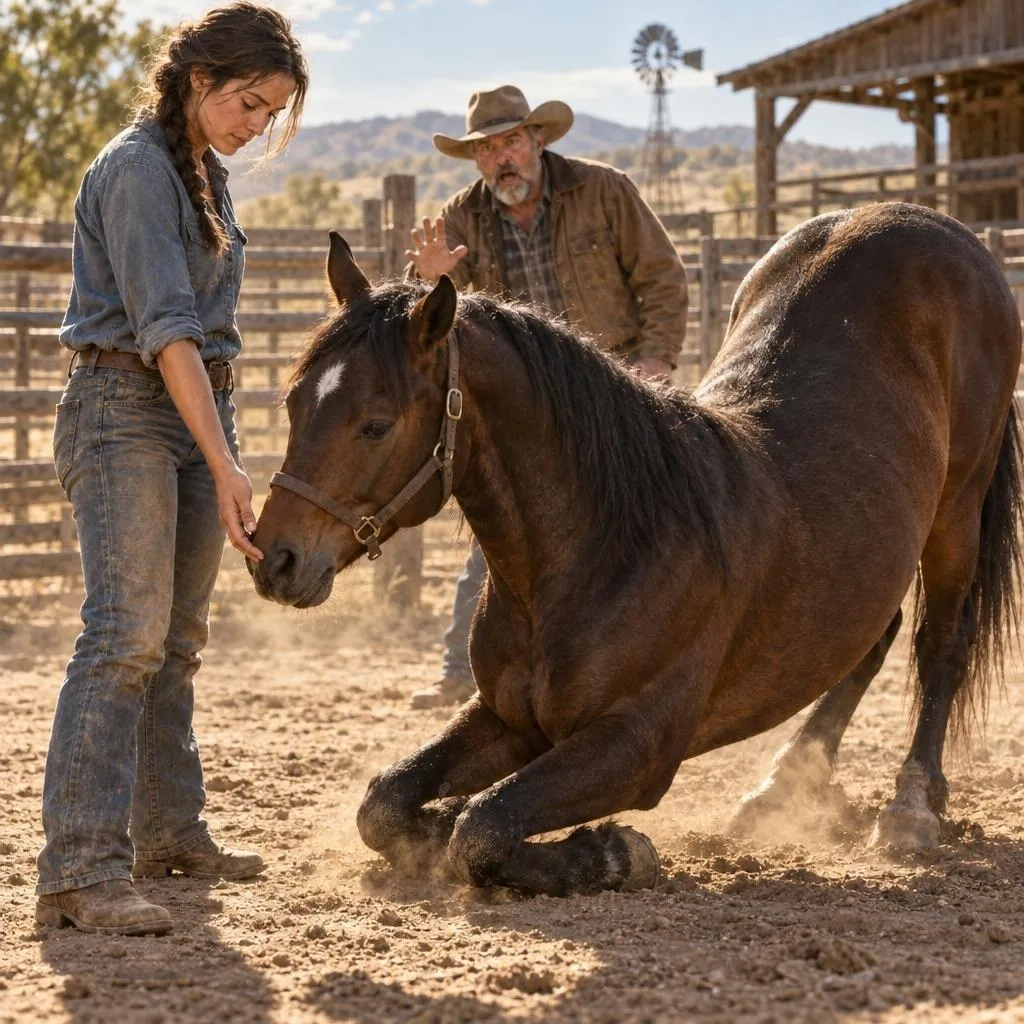
Nora kept her hands against the seams of her skirt. She wouldn’t give them the sight of her fingers trembling.
“Now she remembers whose place this is,” Rusk said.
He had taken the rope from a hand who hadn’t been doing anything with it. There had been no loose horse, no emergency, no reason to send it flying at the mare’s eyes. Now he stood admiring the result while the animal fought for room that the corral couldn’t give her.
Across the yard, a dark-haired man leaned against another stretch of fence. His gaze traveled from the damaged rail to Rusk. He said nothing. Nora, watching the mare’s flared nostrils, never saw him straighten.
She had first walked into the yard on April 7, 1888, with grit inside both boots and thirteen cents sewn into her coat pocket.
Her right sole had come loose several miles back. While she stopped to fasten it with a crooked nail, the supply wagon went on without her. The remaining walk gave her time to study the country: open grazing land, distant mountains, water running cold in the shallow cuts. By the time she reached Avenra ranch, the sun had dropped low enough to show every sag in the fences.
There were more buildings than she’d expected. Better buildings, too. But a gelding stood beside a trough with his hind legs tucked too far beneath him, and the horses beyond the nearest gate watched the yard instead of grazing.
She adjusted the strap of her canvas bag. Inside were a spare blouse, her few other belongings, and a recommendation from a livery keeper in Talven. He had died before she could find a use for the letter. She had kept it anyway.
Two young hands stepped aside when a broad man came out of the barn. Nora knew who he was before he spoke.
“Bellamy?”
“Yes. I wrote about the stable position.”
Rusk studied her bag, her boots, and finally her face. He was in his middle forties, with a sun-narrowed gaze and shoulders that seemed to require more room than other men’s.
“The letter made you sound bigger.”
“It said I could work.”
“We’ll find out.”
He started toward the barn. Nora followed, putting her loose sole down carefully so it wouldn’t flap.
The building itself pleased her. Air moved through the upper openings; the stalls had been framed by someone who understood horses. Some were kept beautifully. Others showed hasty work. She noticed a frayed strap hanging from a peg and a bucket placed where a horse could strike it with a knee.
At the far end, an extra timber had been bolted across a stall door. A chain secured the latch.
The mare inside stood nearly against the rear wall. Her black coat had a dull sheen in the dimness, and the fine bones of her face made the tightness around her eyes more apparent. Nora stopped before Rusk did.
“That’s Vesper,” he said. “Taken from a wild herd seven months ago. Three years old when they caught her. We meant to breed her.”
Vesper turned one ear toward his voice, then flattened it again.
“Five riders have tried her,” he continued. “Good men. She’s never kept one aboard ten seconds. Two went into a fence. Another couldn’t put his boot on properly for weeks.”
Nora looked at the floor of the stall, at the chain, at the mare’s closely planted feet.
“A contractor’s interested,” Rusk said. “He’ll pay slaughter value. I’ve put him off until the twenty-first. Somebody proves she’s useful before then, she stays. Otherwise, I’m through feeding her.”
“Which side did they get on?”
He frowned. “What?”
“The riders. Did any of them try her from the right?”
“You get on a horse from the left.”
“Usually.”
Rusk turned fully toward her.
Nora had intended to keep quiet. She needed a bed, meals, wages. At twenty-two, she knew exactly how expensive a poorly timed opinion could be. But the mare had raised her head at Nora’s voice, and one ear was no longer pinned quite so tightly.
“She looks frightened,” Nora said. “That isn’t the same trouble as being mean.”
“What she looks like won’t mend a man’s ribs.”
“Pain could account for—”
“You’re here to clean stalls. Water, feed, tack when it needs doing. That end belongs to you.” He pointed back toward the occupied stalls. “This end doesn’t. You start at five.”
He showed her a small room over the feed storage, private and barely tall enough beneath the eaves. She put her bag on the cot and waited until he had gone before taking off the damaged boot.
For three days, she gave him nothing to complain about.
She scrubbed water buckets until their rims no longer felt slick. She stitched leather, hauled bedding, and learned which horses needed a word before a hand. An old bay would snap if a person hurried past his shoulder. A roan filly stiffened at an unexpected touch but settled if Nora spoke while approaching.
There were able horsemen among the crew. She watched them when she could, borrowing small economies of movement without making a show of it. There were boys who laughed too readily, older hands who had learned to disappear when Rusk was displeased, and men who did good work but wanted no part of another person’s difficulty.
Every answer about Vesper came to the same thing: leave her alone.
Nora noticed the dark-haired hand during those first days. He worked by himself more often than not. One morning he was fitting a rail along the eastern pasture; the next she saw him crouched beside a watercourse, lifting a clump of sod to examine the seep beneath it. He was tall, spare in his movements, and had the browned skin of a man who did his own work.
She assumed he was an experienced hand. She had other matters to consider.
Before the fourth morning’s chores, Nora carried a milking stool down the barn aisle.
The scrape of its legs brought Vesper’s head around. Nora stopped well short of the stall, set the stool down, and sat with her palms loose on her knees. She chose a knot in the floorboards to look at.
The mare remained rigid long enough for Nora’s legs to grow cold. A swallow made two attempts to enter through the high opening and finally found its way. Somewhere outside, someone dropped a pail.
Nora didn’t move.
After nearly three quarters of an hour, a hoof scuffed the bedding. Then another. She could hear Vesper breathing closer to the door.
When she finally lifted her eyes, the mare was watching through the rails.
“You’ve had reason,” Nora said softly. “I expect you’ve had plenty.”
Vesper’s ear turned.
Nora left before the mare had to ask her to.
The next morning, Rusk found the stool.
His boots came down the aisle fast enough that Vesper retreated before he reached them. Nora rose and moved clear of the door.
“I gave you work,” he said. “Wasn’t sitting down part of it.”
“My chores will be finished.”
“I told you to stay away.”
“I haven’t gone inside.”
His glance went to the mare. “That animal’s wasted months of labor. Don’t add yours to the tally.”
“She came to the gate yesterday.”
“I don’t care if she served you breakfast.”
Two hands had appeared near the entrance. One was a nineteen-year-old named Benitez, still wearing a hat stiff from the store. The other, Doss, leaned where he could see without being obliged to help.
Rusk noticed them. His mouth settled into a small, unpleasant smile.
“Benitez. Bring a saddle.”
The boy hesitated only a moment. Nora could hear leather shifting in the tack room, then the awkward sound of his approach.
Rusk took the saddle and thrust it toward her.
“Here’s your chance to show us what all this waiting buys. Put this on her. Stay aboard ten seconds.”
“That’s too much for her now.”
“Or too much for you?” Doss said.
A few more men drifted in. Nora could feel them arranging themselves behind her, out of Rusk’s way but close enough to enjoy what followed.
“She’s beginning to let a person near,” she said. “Force her today, and we lose that.”
Rusk brought the saddle closer until a stirrup brushed her skirt.
“You’ve been employed here five days. My riders have spent seven months on her.” He looked over her shoulder at the men. “Ten seconds, Miss Bellamy. Earn the right to tell them their business…”
To read the rest of the story – CLICK the NEXT button 👇👇👇