


Owen had shifted onto his other knee twice before I asked him to stop. The bottle was cooling in his hands. Against the padded wall, the calf held his trunk tight beneath his chin, listening to us breathe.
“Set it down for a minute,” I said.
“I’m all right, Dr. Voss. I can stay.”
We watched Amos uncurl his trunk toward the formula. He investigated the air above the nipple, then pushed backward so hard that the rubber lining creaked.
I touched Owen’s shoulder. He needed the rail to get upright after twenty minutes on the floor. When he carried the bottle out, Nora caught my sleeve.
“Don’t ask us to tube him again today.”
“I won’t.”
I’d already abandoned two attempts. Amos had fought until his breathing frightened me, and neither attempt had accomplished enough to justify repeating it. We could maintain fluids and some nutrition for a while. That wasn’t the same as getting him to eat.
At three weeks old, he had spent five days with us at Veyra, an elephant sanctuary outside Troy, in Pike County, Alabama. Federal wildlife officers had brought him from a roadside animal park near the coast. His mother had gone down while they were removing the animals. Starvation and neglected joint disease were in her records; she died before the officers finished their work that evening.
Her calf arrived with an infection that should have been treated much sooner. We controlled it, but his sight was gone.
A motor started beyond the treatment building. One small ear tilted toward it. Then Owen’s shoe scraped the floor, and Amos stiffened again.
From the pasture came a call I recognized as Hester’s. At fifty, she had settled more frightened arrivals than any of us. Nora had tried bringing her close enough for Amos to hear and smell her. She’d also tried Lila, our two-year-old. He retreated from them both.
I left him with the afternoon team and went to Ruth Hensley’s office. She had cleared everything from her desk except his chart and the staff schedule. Nora took the chair nearest the door.
Ruth turned the weight sheet toward me without offering me a seat.
“Before we discuss another night shift, tell me whether there’s anything here I’m reading wrong.”
There wasn’t. I sat down and gave her the kidney results, which were worse than the previous set.
She laid her pen across the page. “We have to consider euthanasia, Daniel. Keeping him alive can’t be our only measure.”
At fifty-two, I’d had that conversation from both sides of a desk. Ruth had found people to sit with him around the clock. She knew what their care was costing him as well as what it cost the sanctuary.
“When that motor came on, he listened,” I said. “He still wants to know what’s around him. But every time we come close, we do something he’s afraid of.”
Nora rubbed the edge of the clipboard against her palm. “We’ve tried bottles, different formulas, other elephants. What haven’t we asked him to do?”
“I want a different kind of contact. Fourteen days to try.”
Ruth’s eyes stayed on the chart.
“Not a commitment to keep him going for fourteen days,” I added. “We reassess each morning. If he keeps declining, or we can’t control his distress, we stop sooner.”
Nora looked at me, then nodded. Ruth drew a line beneath that morning’s weight and wrote the next date below it.
On my way home, I stopped at the county shelter. We shared veterinary work with them, and Lena Maddox had learned to recognize the evenings when I was checking on a patient because I couldn’t face going home yet.
She shut off the hose when she saw me.
“Tell me you’ve had supper.”
“Tell me you don’t need anything stitched.”
“No stitches. Come here.”
She led me away from the loudest runs to a black Labrador mix lying on a cot. He watched her open the gate but didn’t get up. His dinner sat near the cot, the surface undisturbed.
“Boone,” she said, crouching beside him. “Somebody else to worry about you.”
I settled on the concrete outside the gate. He was a substantial dog, close to eighty pounds, with an old injury showing through the hair over his left shoulder. Lena ran her fingers down his neck rather than over the scar.
“He’s only about two,” she said. “The paperwork makes him sound older.”
His owner had been an outfitter in Montana. Wade Sutton took people into the mountains with pack animals, and Boone went along. When a mule disappeared, Wade took the dog out to find it. They came upon a grizzly feeding on a carcass.
“His sister told me Boone went at the bear,” Lena said. “Tried to get it away from him.”
She adjusted the collar though it didn’t need adjusting.
“Wade didn’t survive.”
Rangers found them the following morning. The injured dog was stretched across Wade’s chest. He couldn’t stand, but he still resisted anyone coming near the body. They had to sedate him before they could treat him.
Wade’s sister brought him home to Birmingham after his wounds healed. She lived in an apartment and worked hours that left him alone too much. Eventually she arrived at Lena’s door with his records, his bowl, and no dry tissues left in her purse.
“He’d eat if she held the food,” Lena said. “He’ll take a few bites from me. Then he just turns his head.”
I watched Boone’s eyes move from her hand to the gate. After a while, I asked her to have his leash ready the next morning.
Ruth said no before I’d finished explaining. Nora waited until I had finished, then described a startled calf crashing into a wall and a dog caught beneath him.
I had no answer that made either risk disappear.
“One meeting,” I said. “Both of them free to move away. You each have the authority to end it.”
“And if he barks?” Nora asked.
“We separate them.”
“You don’t know that he won’t.”
“No.”
We went through the shelter records and the requirements for bringing him over. The observation room had two ways out, padded walls, and space to keep the animals apart. We assigned the doors, arranged veterinary backup, and agreed that increasing distress in either animal would end the visit.
By the time the handlers brought Amos on a padded cart, Owen had removed the trough and covered the remaining hard edges. They eased the calf onto clean hay. He immediately felt backward until he reached the wall.
I waited with Boone while Owen made a final circuit of the room. Through the glass, Ruth and Nora watched me release the leash.
The dog stood beside my leg for a moment. Amos breathed faster. Boone sniffed a seam in the rubber, looked away from the calf, and opened his mouth in a long yawn.
I kept watching. A yawn could mean he was uncomfortable; quiet wasn’t a guarantee of anything.
He chose a place several feet away and lay down on his side. His head rested on the floor. For most of the next hour, the only changes were in the light on the glass and the angle of Amos’s ears.
Then Boone gave a small, breathy whine.
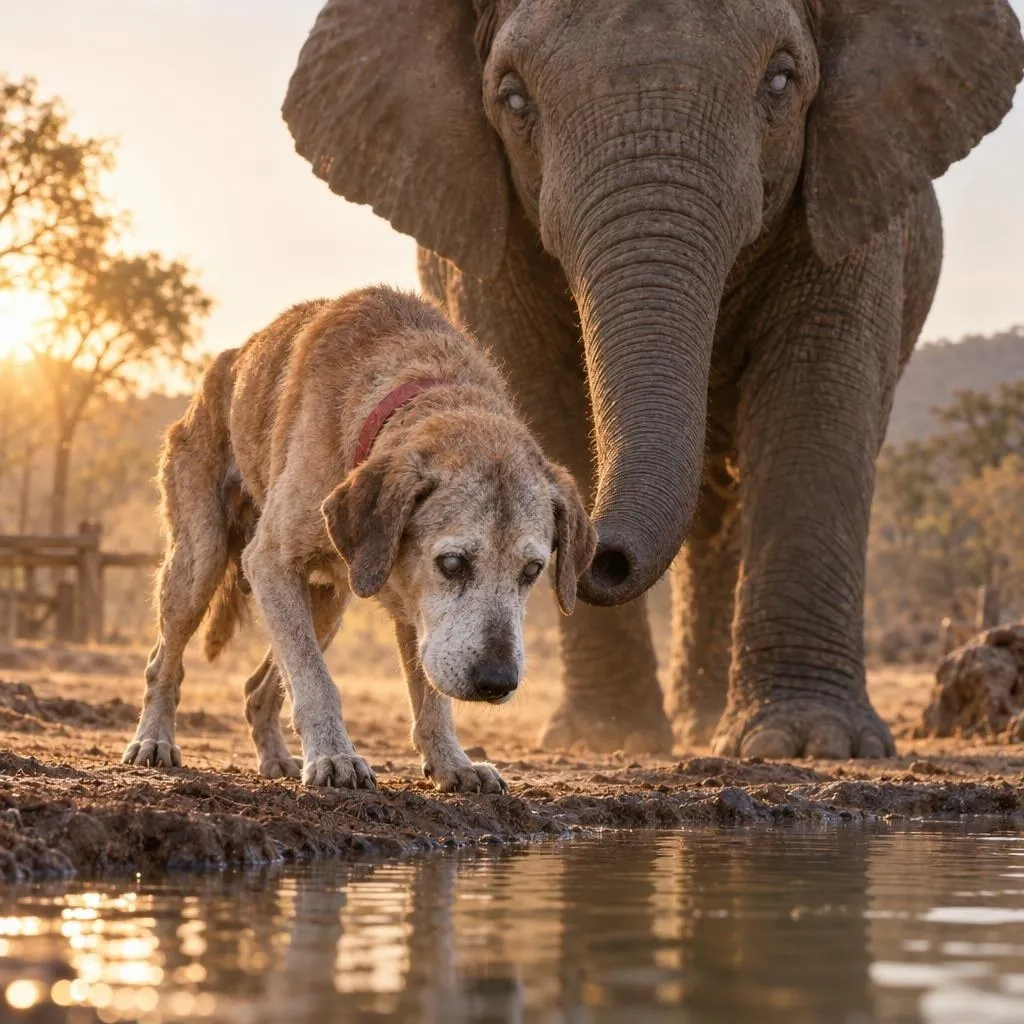
The calf’s trunk loosened. Its tip moved through the hay, stopping when the dog shifted forward on his elbows. Boone paused, moved a little closer, and extended his left front leg.
Amos found fur and recoiled.
The dog left his foot where it was. His tail brushed the floor, and Amos turned toward the sound. On the next reach, the tip of his trunk touched Boone’s toes and stayed there.
Boone flexed his paw once. The calf’s breathing slowed. Behind the glass, Nora lowered the hand she had been holding against her lips.
I remained by the door until my own feet began to ache. At eighty minutes, I changed my stance. Boone lifted his head, made a low sound in his throat, and stood, drawing his paw out from under Amos’s trunk…
To read the rest of the story – CLICK the NEXT button 👇👇👇