


The volunteer put out his hand before Leah Mercer reached the first row of chairs.
“Family seating,” he said, touching the ribbon stretched along the aisle. “You can watch from the bleachers. There’s room at the back.”
Leah stopped with the folded invitation still between her fingers. Beyond him, little children were climbing into grandparents’ laps, and a woman was straightening the collar of a soldier’s uniform. She could have explained that she had been invited. Instead, she put the paper into her coat pocket.
Someone behind the volunteer said, quietly enough to pretend otherwise, “She shouldn’t be down here.”
Leah nodded and turned toward the bleachers.
The gym at the Army post outside Lanton, Kentucky, had been dressed for a retirement ceremony. Flags stood along the wall, and rows of folding chairs faced a lectern. Every few steps, someone recognized someone else and called out a name. Leah passed through those greetings without interrupting any of them.
She chose the end of the highest bench, close to the door.
Her aunt had offered to press a blouse for her that morning. Leah had said the shirt she had on was fine, then pulled her oversized canvas jacket over it. The jacket had belonged to someone else before it belonged to her; the shoulders sat well down her arms, and the cuffs had gone pale from washing. With it buttoned, nobody would notice the little repair beneath the sleeve of her shirt.
At sixteen, she had learned which things could be hidden without much trouble.
Her backpack rested against her ankle. A safety pin held one compartment closed where the zipper no longer caught, and she checked it by touch before folding her hands in her lap.
A few seats below, two officers’ children looked up at her, then went on toward friends nearer the floor. Later, a lieutenant’s wife came along with three relatives and asked whether Leah could move over so they could sit together.
“Of course.”
Leah gathered her bag and shifted to the very end. The woman thanked her while already turning to help a child onto the bench.
From there, Leah could see the whole gym without anybody having to look past her.
She had nearly stayed home.
Mrs. Keene, who worked in one of the administrative offices, had invited her. Leah’s aunt cleaned those offices twice a week, fitting the work around shifts at the packing plant, and sometimes Leah came along afterward to help carry supplies to the car. During one of those visits, she had mentioned liking dogs.
Mrs. Keene had remembered.
“They’re bringing the working dogs in for the ceremony,” she had told her. “You ought to come. I’ll make sure you have an invitation.”
Leah hadn’t known how to refuse the kind expression that accompanied the offer. She had thanked her, taken the envelope home, and left it beside her schoolbooks for two days before deciding to go.
For three years, she and her aunt had lived in half of a rented duplex about twenty minutes from the post. Her aunt worked enough hours that they sometimes left notes for each other beside the kettle instead of having a conversation. There was always food, always a clean towel, always a light left on if Leah was coming home after dark. There wasn’t much left for replacing a jacket that still kept out the wind.
Leah never asked.
People in Lanton knew fragments about her family. Her father had been in the Army. He had come home having trouble. Then there had been an accident, and afterward the girl had moved in with her aunt.
Occasionally, someone remembered the Mercer name at a store counter or in the school office. Their voice would change, and Leah would find a reason to leave before the questions started. At school, she had learned to open a book when the seats beside her stayed empty at lunch.
Her father had been dead since she was thirteen. She had no practiced answer for people who wanted to know what had been wrong with him.
Down on the gym floor, a microphone gave a brief squeal. Leah lifted her head.
The man being honored was major general Victor Ellison, leaving the Army after thirty-two years. His family occupied the front row. There were speeches still to come, a presentation, photographs. About three hundred soldiers, veterans, and relatives had gathered to see him off.
The working-dog demonstration was meant to be one of the afternoon’s pleasures.
Leah sat a little straighter when the handlers appeared at the far end of the floor.
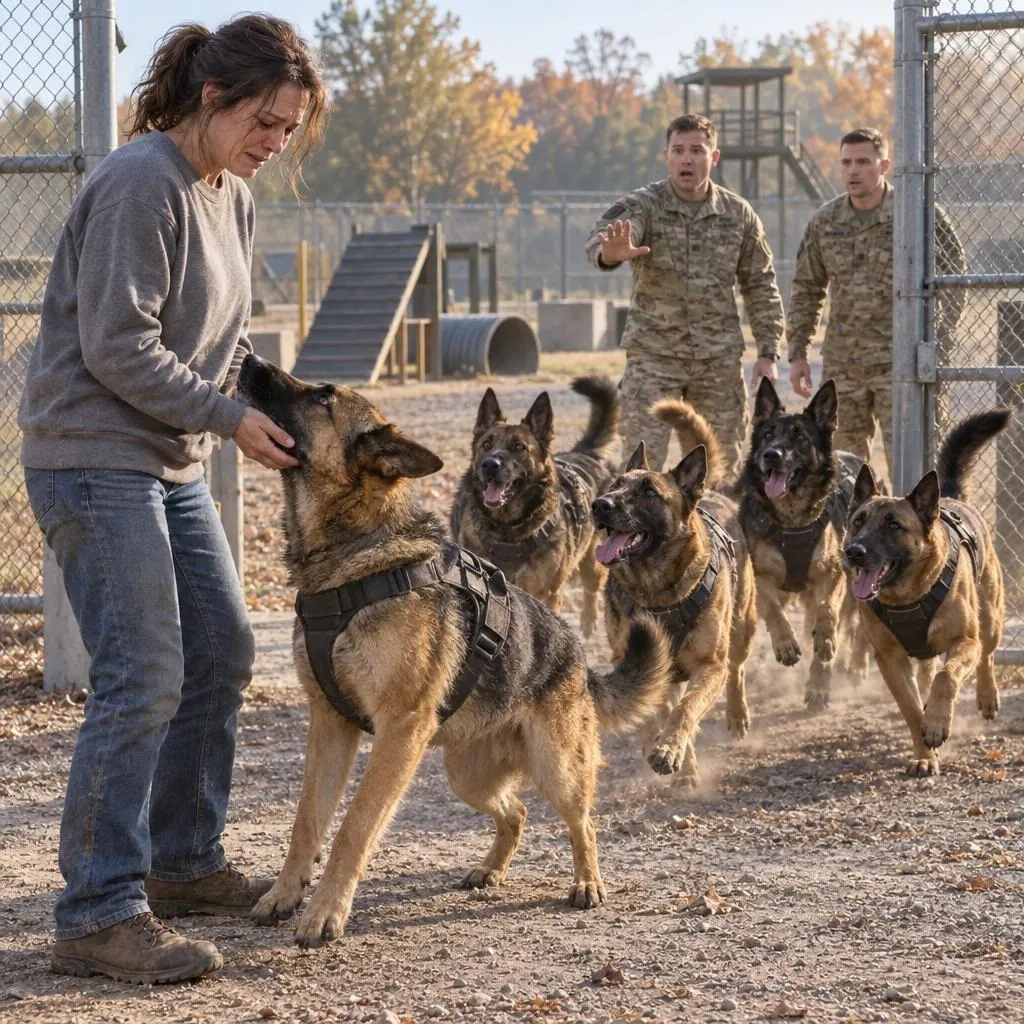
Seven dogs came in with them. Their nails made a light, irregular tapping beneath the applause, then fell quiet as the teams took their places. Several children leaned forward. Phones rose above shoulders.
At the head of the formation walked a German shepherd with a dark muzzle and an easy, economical stride.
His handler was a young corporal named Bennett. He had worked with Flint for almost two years, long enough to know how little the dog required from him. A slight adjustment of a hand, a change in pace, a word spoken without raising his voice: Flint answered them all.
The shepherd was ten, older than the others, with two deployments behind him. Crowd drills didn’t distract him. Simulated gunfire didn’t send him searching for reassurance. Bennett had never had to wonder whether he would hold his place.
Ellison was introducing the teams from the lectern when Flint’s stride shortened.
Bennett felt the change before he understood it. The dog’s head came up, his nostrils working. Instead of watching the handler ahead, he turned toward the high end of the bleachers.
Bennett gave the small correction that ordinarily brought Flint’s attention back.
The shepherd went past his hand.
“Flint. Heel.”
Leah saw him coming and lifted her fingers toward her mouth. For an instant, she thought he must be heading for someone below her.
Then the Belgian Malinois behind him turned. Cinder, usually attentive to the smallest movement of his handler’s wrist, broke away before the man could step across his path. Nell, the youngest dog, barked once and followed.
By the time Bennett called again, the remaining four were moving too. Barely four seconds separated Flint’s first turn from the whole formation coming apart.
“Flint, heel!”
The third command caught in Bennett’s throat.
A folding chair scraped backward. Someone stood too quickly and knocked another chair sideways. One of the dogs brushed a flag stand as he cut through the aisle; a handler caught the pole after the base hit the floor with a metallic crash.
The general stopped speaking.
For a moment, a few people laughed. They were waiting for the part that would make it clear this was planned.
Then they saw the handlers running.
Leah lowered her hand. Flint had reached the bleacher steps, and his eyes were on her. He took them quickly, without stopping at any of the outstretched hands or startled knees in his way.
She didn’t scream. She put her backpack behind her and slid from the bench to the broad step below, bringing herself closer to his height.
Flint stopped directly in front of her.
The other dogs crowded onto the steps and along the bench ends. Their handlers were still calling, but the barking had stopped. The gym had become quiet enough for Leah to hear the shepherd breathing.
She held out her palm.
He pushed his forehead beneath it and let out a wavering sound so low she felt it through her fingers. She swallowed, looking at the dark fur spreading between her knuckles.
Bennett came up the steps with his face flushed.
“Keep your hand there. Don’t pull away suddenly. I’m sorry, he’s never—” He reached toward Flint’s collar, then stopped. The dog wasn’t threatening her. He was pressing closer.
Leah looked at Bennett.
“He’s trying to find somebody.”
The corporal glanced at the six dogs settling around her. “Do you know these dogs?”
She shook her head. “No. But my dad used to talk about one.”
Flint lifted his muzzle at the sound of her voice. Leah rubbed the place between his ears, slowly, with a familiarity that surprised her as much as anyone watching.
“Dad?” she whispered. Then, as though a full name might help the dog understand, she said, “Evan Mercer.”
Flint gave a sudden bark. His ears folded back, and he pushed his shoulder against her knees so firmly that she steadied herself with her other hand on the bench.
Cinder lowered himself onto a step. Nell sat near Leah’s shoes. The others arranged themselves nearby, no longer rushing, while their handlers approached with open hands and lowered voices.
Across the gym, several older veterans had gone very still.
Bennett looked from the shepherd to the girl’s face.
“What was your dad to this dog?”
To read the rest of the story – CLICK the NEXT button 👇👇👇