


The toolbox slid across the cargo floor when Daniel Mercer turned into the rescue’s driveway. Beside him, his son braced one oversized boot against the seat rail and studied the blue plastic lifting from a corner of the roof.
Daniel had meant to fix a kitchen cupboard that morning. Instead, he’d already cleared branches from two streets, checked on an elderly resident whose power was out, and collected Eli for the next job. His uniform was still damp across the shoulders. Being off duty hadn’t amounted to much since the storm hit Brenwick.
“Will they have to move the animals?” Eli asked.
“Not if we can help it.”
Wet snow covered the hills behind the low building. It was late October, early for this much winter even in that part of Idaho, and the town had spent the morning listening to chain saws and utility trucks. A length of fence leaned over the gravel lot. Someone had propped a bucket beneath the gutter, where water fell with a hollow, irregular plunk.
Eli watched the tarp slap against its fastenings. He was eight, slight enough that the winter coat Daniel had bought him seemed mostly sleeves. His brown hair stuck out above one ear. He’d been quiet throughout the drive, but Daniel knew better than to mistake that for inattention.
The front door swung open before they reached it. Miriam Bell came sideways through the opening with a roll of plastic under her arm and a work glove clamped between her teeth.
She took out the glove. “Please tell me one of you knows something about roofing.”
“I know it’s supposed to keep the rain outside.” Daniel lifted the toolbox. “Brought an assistant, too.”
Miriam looked down at Eli. Fifty-five, sturdy, and tired enough that even her loosely tied hair seemed to have surrendered, she still found a smile for him.
“I pay helpers in cocoa.”
“With the little marshmallows?”
“That depends on the helper.”
“He’ll want that in writing,” Daniel said.
Eli gave him a brief grin and followed Miriam inside.
The rescue ran on donations, improvised repairs, and people who came after their regular jobs. Daniel had been there often enough to recognize the chair with the repaired arm and the front sign that needed repainting. Today a stack of food cartons occupied the lobby, well away from the wall where rain had come through.
Miriam set down the plastic and pointed with her glove as she explained. The roof over one storage area had leaked. Several fence panels needed bracing. The kennel wing was dry, and every animal was accounted for, but some had spent the night trembling through the crash of falling limbs.
Daniel began moving the heavy food bags. At forty-two, he was still built for carrying awkward things, though his lower back now offered an opinion afterward. He’d noticed more gray in his dark hair that fall, too. He ignored both developments and made another trip to the storage room.
Eli took folded towels from a damp cardboard box and arranged them in a clean bin. He checked with Miriam before moving anything he wasn’t sure about. After a while, Daniel caught him looking through the open doorway beyond the lobby.
“The dogs are down there,” Miriam told him. “You can walk along the aisle. Gates stay shut, hands stay on your side. A few of them are pretty wound up.”
“I won’t touch the latches.”
“Go ahead,” Daniel said. “We’ll be here.”
When Eli was out of sight, Miriam handed Daniel another bag. “Does he always listen that well?”
“Depends whether there’s an animal involved.”
“I can still hear you,” Eli called.
The first dog announced his arrival before he could read its card. A young hound bounced against the wire, then landed with its tail swinging against the wall. Farther along, a thick-necked brown dog gave three sharp barks and shoved its nose toward him.
Warm air carried the smells of cleaning solution, kibble, and wet coats. Eli walked slowly, pausing at the cards, speaking softly when a dog settled enough to hear him. He kept his hands in his coat pockets.
At the last gate, he almost went past.
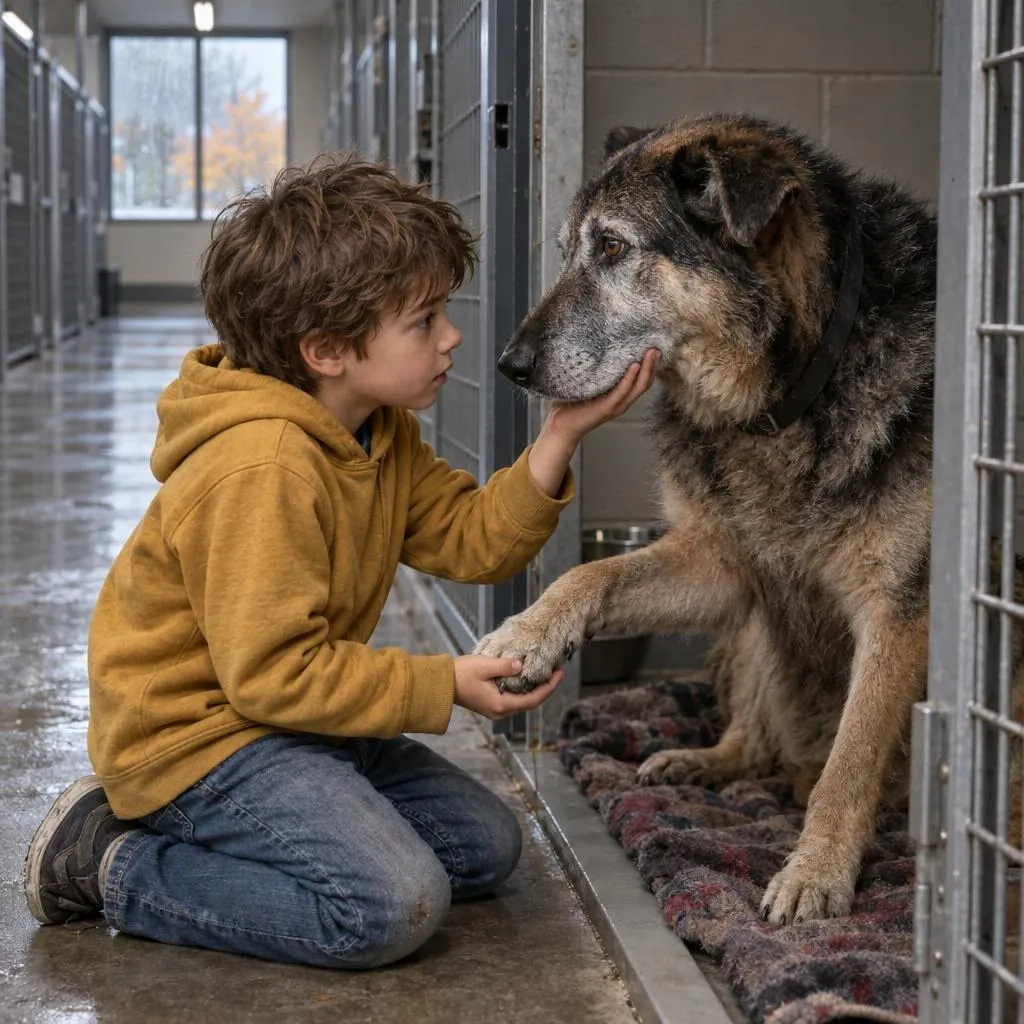
A German shepherd sat against the back wall, so still that the dark part of his coat blended with the shadows under a shelf. Gray covered his muzzle and had begun to lighten the fur beneath his eyes. One ear was straight; the other tipped a little to the side.
The dog looked at Eli. Then he looked beyond him.
Eli turned. The corridor behind him was empty.
He read the laminated card twice. Rook. Eleven years old. German shepherd. Retired police K-9. A smaller sheet underneath showed that he’d been at the rescue for six months.
Six months ago, Eli’s second-grade classroom had still had paper flowers taped to the windows. Summer had come and gone since then. He looked back through the gate.
Rook had a broad chest and sat carefully, with his hindquarters tucked in a way Eli hadn’t seen in the younger dogs. His eyes moved to the distant doorway again. He made no attempt to come closer.
Miriam found Eli there a few minutes later. She was carrying blankets against her chest, and she stopped when she saw which gate he stood beside.
“He used to work with police officers?” Eli asked.
“He did.”
“Why hasn’t somebody taken him?”
She slid the blankets onto a shelf. “People have come to meet him. A couple of families. A man who’d had dogs all his life.”
“But they didn’t.”
“No.”
Eli waited for more. Miriam rested her forearms against the shelf rather than turning away.
“People like to know a dog’s happy to see them. Rook doesn’t rush over. Doesn’t offer much of a tail wag. They leave thinking he doesn’t want them.”
“Do you think that?”
“I honestly don’t know.”
The answer held Eli’s attention. Adults usually seemed to have one ready.
“He lets us do everything we need to,” she continued. “Brush him, give him medicine, take him out. He’s never difficult. But I can be standing right beside him and feel as though he’s listening for something in another room.”
“He watches that door.”
“Yes. A lot.”
Daniel came down the corridor rubbing a patch of sawdust from his sleeve. He’d put a temporary brace beneath a wet section of wall and was looking for the next job.
“Found your supervisor?” he asked Eli.
His son didn’t smile this time. Daniel followed his gaze to the shepherd, then read the card.
“How long?” he asked Miriam.
“Half a year.”
Daniel glanced at her. “For a retired K-9?”
“Especially for a retired K-9. People worry about age. Or training they don’t understand. Then he doesn’t greet them the way they hoped, and that settles it.”
Daniel had worked near canine teams for years. He’d seen nervous dogs and exhausted dogs, dogs that wanted distance and dogs that had stopped expecting anything good. He couldn’t quite fit this one into any of those pictures.
He bent his knees a little, keeping his hands away from the wire.
“Hello, Rook.”
The dog’s gaze traveled from his face to his chest.
Eli saw the ears move. “Dad.”
Daniel lifted a finger without looking away.
The shepherd shifted forward. His rear legs took a moment to cooperate, but he got them beneath him and stood. He crossed the kennel in two deliberate strides and halted at the gate.
Miriam lowered her hands from the shelf.
Rook’s head was up now, his attention unwavering. He didn’t jump or wag. He stood as though he had been brought into position and knew exactly where his feet belonged.
Daniel became aware of the badge above his pocket, the radio clipped near his shoulder, the dark uniform he hadn’t bothered changing out of.
“Well,” Miriam said softly.
He straightened. Rook held his gaze.
Daniel had seen that posture beside patrol vehicles, before searches, in training yards while handlers waited for an exercise to begin. It carried an expectation he recognized more readily than he wanted to.
Eli moved close enough that his sleeve brushed Daniel’s.
“He’s not frightened.”
“No,” Daniel said.
“I think he’s waiting.”
Miriam looked from the dog to the boy. “For somebody?”
Eli didn’t answer immediately. Rook’s tail hung still. Behind them, another dog dragged a metal bowl across its kennel, but the shepherd didn’t glance toward the noise.
Daniel wondered how many visitors had stood here hoping for affection while the dog waited for direction. The difference was small enough to miss through a gate. He might have missed it himself if the uniform hadn’t brought Rook to his feet.
His son caught the edge of his sleeve.
“Don’t leave him doing this.”
Daniel looked down. Eli’s fingers had tightened in the fabric.
“We don’t know what he needs yet.”
Eli kept watching the dog. “What if the person who can tell him to stop never comes?”
To read the rest of the story – CLICK the NEXT button 👇👇👇