


The ten-dollar bill kept trying to escape from Wade Mercer’s pocket. He pushed it deeper with one cracked finger and watched the man who’d bought his tractor alternator carry it toward the parking lot.
That was flour, coffee, and perhaps enough left over to keep the lights on another week. Wade had driven to the livestock auction in Tresset with no intention of bringing anything home.
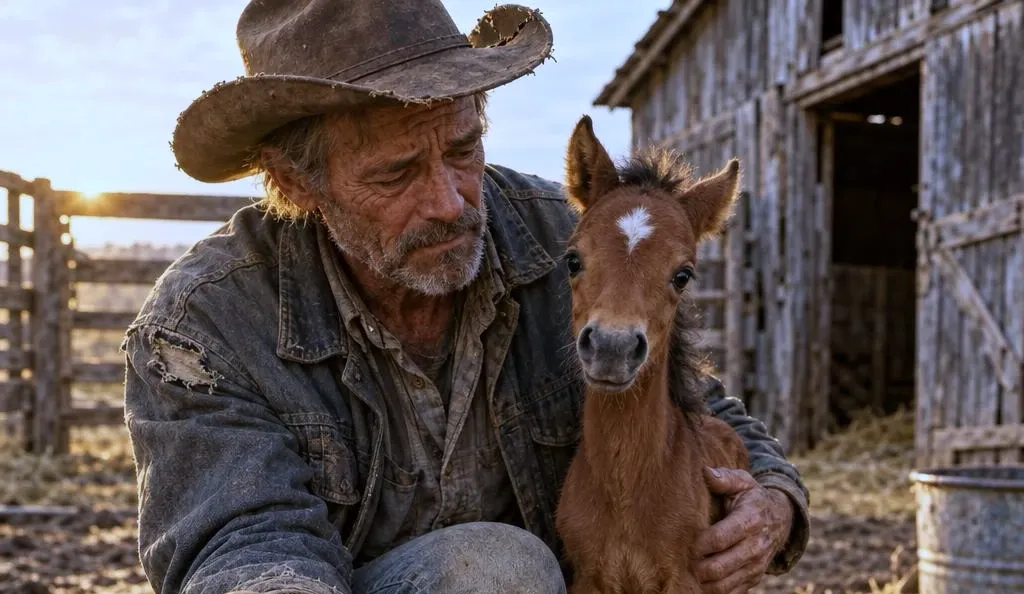
Then he heard a horse struggling for breath.
A young handler was pulling a small chestnut filly through the gate. The halter looked too large for her head. She stopped with her front feet planted in the sawdust, trembling so badly that the rope shivered between her and the boy.
Wade knew that thin, exhausted sound. His old dog Rusty had made it during the hard winter two years before, lying beside the stove while Wade sat with a hand beneath his jaw.
He took his hand out of his pocket.
At forty-five, Wade had already lost most of what a rancher could lose without leaving his land. The bank had taken his cattle. Drought had emptied the shallow draws across his little place in western Kansas, and the bigger outfits around him kept buying whatever their neighbors couldn’t hold.
Tervale had belonged to his grandfather, then his father. Now its gates hung crooked, the house roof leaked above the back bedroom, and Wade earned grocery money repairing other men’s fences. He’d come to the auction yard outside Merrow because somebody there might want a worn-out engine part.
Across the ring, the auctioneer shuffled his papers.
“Last lot. Yearling filly. Picked up along the interstate, stray hold completed. No pedigree available, no promises made. Who’ll start me at five dollars?”
A man near Wade studied the bottoms of his boots. Another turned toward the concession shed.
The filly’s coat was plastered to her sides with old mud. Beneath it, Wade could count the spaces between her ribs. She tried to move when the handler tugged, but one knee folded and she caught herself awkwardly.
“Five dollars,” Rusk repeated. “Somebody must need a horse.”
Nobody raised a hand.
The wind drove grit through the open sides of the auction shed. Wade’s denim jacket had gone thin at the elbows, and he pulled it closed without looking away from the ring.
“One dollar, then. I’d like to go home sometime today.”
“Save yourself the paperwork, Rusk.”
The voice came from behind Wade, smooth and loud enough to carry. Clayton Bellamy III stood beside a freshly painted fence post, wearing a pale hat without a mark on it. His family’s ranch bordered Tervale to the north. He’d been trying to buy Wade’s place for years.
“Put her down,” Clayton said. “There’s nothing there worth hauling.”
A few men chuckled.
The filly raised her head. For a moment her gaze settled on Wade, unfocused but steady enough that he couldn’t pretend she hadn’t seen him.
He had the ten-dollar bill. He also had a fifty-cent piece he’d picked up outside the diner that morning.
“I’ll give you half a dollar.”
Rusk leaned toward his microphone. “Was that you, Mercer?”
Wade stepped clear of the men in front of him and held up the coin.
Laughter traveled around the fence. Clayton tipped his head back, enjoying himself.
“Well, there’s a partnership,” he said. “Neither one of you worth feeding.”
Wade laid the coin on the rail.
“You’ve got my bid.”
Rusk looked from him to the horse, then slapped his auction block with the little wooden hammer.
“Take her before I charge you for the sawdust.”
Wade climbed into the ring.
He approached too quickly at first. The filly jerked away, nearly losing her footing, and he stopped with his hands open.
“Easy. That’s my mistake.”
He waited until she quit pulling against the rope. Then he moved beside her, talking quietly about nothing in particular, and rested a hand against her neck.
There was almost no flesh under the hide.
By the time he reached his pickup and the old stock trailer, the men behind him had found something else to laugh about.
The trip to Tervale took twice as long as it should have. Wade drove around every rut he could see and stopped twice when the trailer went too quiet. Each time he opened the rear door, the filly lay against the blankets he’d spread beneath the straw, breathing with her nostrils wide.
The second time, he stayed beside her until she blinked.
“All right,” he said. “We’re nearly there.”
There was no proper barn at home. A lean-to stood against the house, mostly empty since the cattle had gone. Wade scraped together clean bedding, then braced the filly against his hip as she stumbled down the trailer ramp. For the last few feet he carried much of her weight. He lowered her onto the straw and remained crouched beside her until his legs went numb.
The ten dollars went for a small quantity of feed he could soak and an inexpensive electrolyte solution. He found the section on starvation in an old livestock manual and read it twice, tracing the lines with his dirty thumb. Small amounts. Often. Don’t try to repair months of hunger in one feeding.
For three days she never rose.
Wade brought water from the deep well and held it where she could reach. When she wouldn’t drink, he dampened her mouth with a clean cloth. He offered softened feed a little at a time, waiting through the long pauses between each reluctant mouthful.
At night he made himself a bed of folded horse blankets. The cold came through the lean-to wall and worked into his back. He’d sleep for an hour, wake with his hand stretched toward her, and listen before he dared move.
He talked because the silence bothered him.
He told her about his father, who could straighten a gate without measuring anything. About summers when the grass had reached the lower wire and his mother had complained about all the mud tracked into her kitchen. About the calves he’d once intended to keep and the improvements he’d never managed to make.
“You’re getting the whole family history,” he murmured one night. “Nobody else ever sat still for it.”
On the fourth morning, a scraping noise woke him.
The filly was standing beside the empty water pail.
Her legs were spread wide, and she leaned slightly toward the wall. But when Wade sat up, both ears turned toward him.
He got to his feet carefully. Every joint seemed to object.
“Well,” he said, reaching for the feed pan. “I’d have dressed better if I’d known you were receiving company.”
She took a little food from his hand. Her muzzle searched his palm afterward, warm and damp.
Wade rubbed the patch of forehead he’d managed to clean. Under the dirt, reddish hairs caught the morning light. They reminded him of the last live bit in a stove after the fire had burned low.
“Ember,” he said.
She breathed against his wrist.
“That’ll do. You’ve made it through the road, the sale yard, and three days of my housekeeping.”
He kept his hand there until she lowered her head.
Keeping her alive cost more than buying her ever could have. Wade took his grandfather’s silver pocket watch to a pawnshop in Merrow and came home with alfalfa and dewormer. He spent a week rebuilding a neighbor’s wind-torn fence for several bags of grain.
Winter arrived in hard gusts. Snow gathered along the north side of the house, and Wade fastened an old wool blanket into a covering for Ember. He checked beneath it every morning, running his fingers along her spine, looking for changes too small to see.
Eventually he could feel them.
She filled out through the chest. Her neck gained muscle. By spring, when the first green appeared in the low places, she had shed enough rough hair to show a clear red coat underneath.
She also discovered the pleasure of making Wade wait.
He’d call her to the gate and she’d come halfway, pause, and look at him as though considering a better offer. Then she’d wheel away and race around the little corral he’d built from salvaged rails.
One morning his coffee went cold while he watched.
He had spent his life around ranch horses. He knew the quick gathering of their bodies, the hard burst across a short distance. Ember moved differently. Her hindquarters drove, her back stayed quiet, and each stride reached farther than he expected.
She came past him again, mane lifting from her neck, and Wade lowered the cup.
Inside the house, he found the livestock manual beneath a stack of overdue bills. He opened it to the drawings of horse conformation and carried it to the window.
The shoulder. The length through the hip. The room in that chest.
He shut the book and reached for the telephone.
Nolan Pike had retired from veterinary practice, but he still lived outside Dunnett and still owed Wade a favor. He came the next afternoon in an old utility wagon, spectacles sliding down his nose.
Ember wouldn’t let him approach at first. Pike stayed outside the rail and watched her trot, turn, then accelerate along the fence.
“How much did you say?” he asked.
“Fifty cents.”
Pike took off his glasses and cleaned them with his shirt.
“I can’t issue papers by looking over a fence,” he said. “But I know what I’m looking at. Wade, that’s a Thoroughbred. A very good one…”
To read the rest of the story – CLICK the NEXT button 👇👇👇