


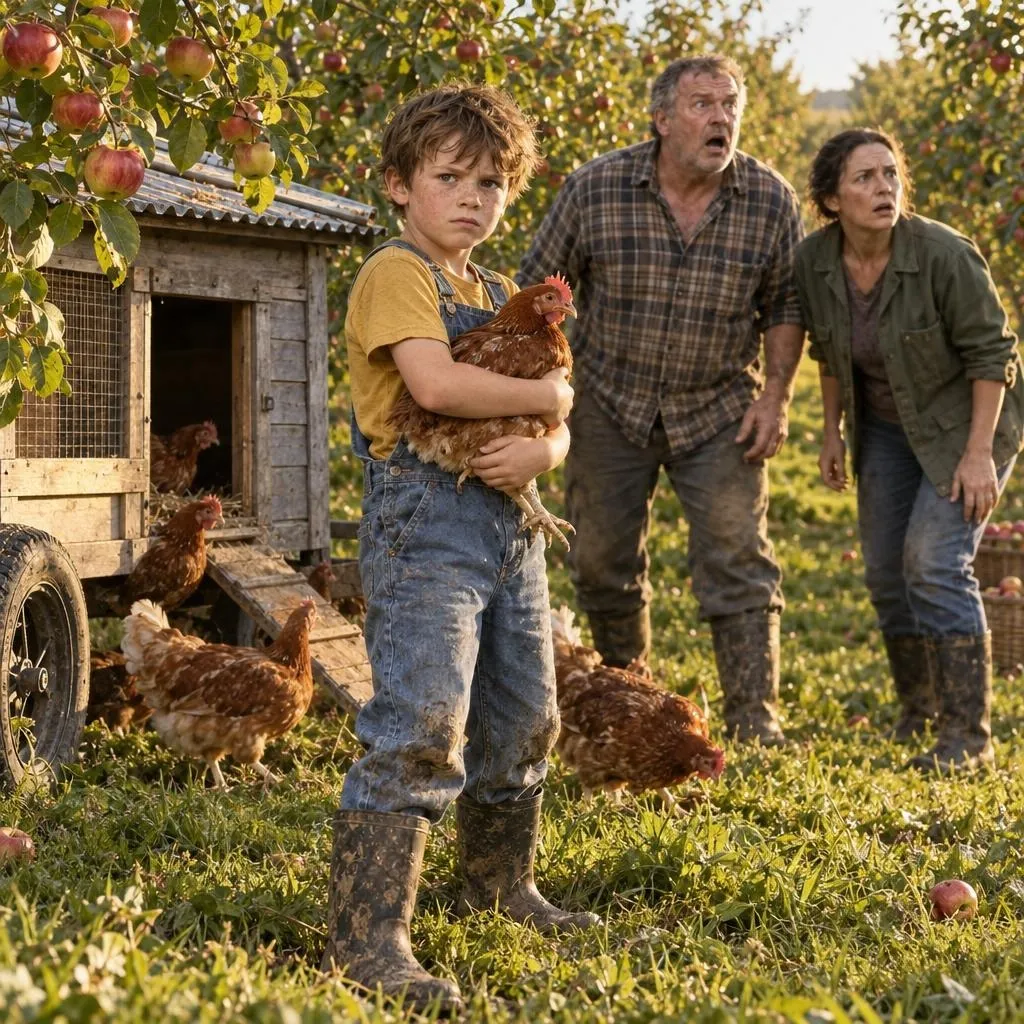
By the time the truck door slammed, Owen Bellamy had one hand on a loose hinge pin and the other keeping a hen from squeezing back through the orchard gate.
The bird ducked under his wrist anyway. He caught her against his coat, turned her around, and set her down facing the apple trees. All around his boots, the rest of the flock spread into the brown leaves.
Behind him, somebody began to laugh.
Curtis had stopped beside his truck with the co-op manager. He watched the hens hurry into the rows, then caught the door handle as another burst of laughter bent him forward.
“Coyotes’ll thank you for this.”
Owen pushed the hinge pin home with his thumb. Across the road, the neighbor had already offered an opinion nearly as useful.
His father stood a few yards away, hands tucked beneath his arms. Russell Bellamy wasn’t smiling. He studied the birds, the patched fencing, and the bare apple branches overhead. On that cold April morning in rural Pennsylvania, there was little green to soften the sight of an orchard that had disappointed him so badly the previous fall.
At fifteen, Owen knew the figures almost as well as his father did. Insect damage had spoiled too much of the last crop. Fruit that had taken months to grow had gone past the buyers’ sorting tables without bringing enough money home. Repairs, supplies, and the next season’s work still had to be paid for.
Curtis’s recommended treatment package would cost twelve thousand dollars. The Bellamys didn’t have it. Borrowing might carry them through another season, but Russell had said one evening that the same loan could finish what the bad harvest had started.
There were only a few weeks left before they were supposed to commit.
Owen had heard every word. His father had opposed bringing birds into the orchard before reluctantly allowing a limited trial. Permission hadn’t made him look any less worried.
The hens were hardly reassuring. Some carried uneven feathers; several had narrow breasts beneath their plumage. Their best egg-producing days were behind them. Curtis, who had spent two decades advising growers and selling orchard programs around the county, could probably see a separate expense attached to every bird.
Owen watched one hen brace her feet, rake backward, and lower her head into the patch she had opened. A pale grub moved beside a broken leaf stem.
He crouched before another bird could reach it.
That square of ground belonged to one of the sections he had marked in his notebook. The row had suffered badly last year. He had checked beneath its leaves during the past three weeks and found what he was looking for. Other marked rows would receive no chickens at all.
Curtis was still talking behind him. Owen eased a leaf aside with one fingernail, followed the grub’s movement, and allowed himself a small smile.
He had known the orchard from knee height long before he knew what it cost to operate.
As a little boy, he had carried sticks out of the mower’s path. Later came heavier work: buckets when a water line froze, boards when a shed needed patching, feed before school, storm-broken limbs after supper. At harvest, he walked beside his father and learned to look at an apple before reaching for it.
There were chickens near the barn then, too. Owen knew their favored places better than he knew some of the fields. After rain, they worked along the edge of the packed yard. They returned to certain damp patches and ignored others. A heap of leaves could occupy them for an afternoon.
He hadn’t considered any of this unusual. It was simply what happened when he stayed outside long enough to notice.
The question that eventually sent him into his grandfather’s books came during an inspection after the damaged harvest.
Russell had stopped beneath a tree with a rejected apple in his palm. He turned it toward the light, showing Owen where an insect had entered. Along that row, leaves and bits of debris had gathered around the trunks.
Owen scraped a boot through them.
“Would the hens go after anything living down here?”
His father lowered the apple. “Maybe. That doesn’t make putting them in here a good bargain.”
“They get through the same kind of stuff by the barn.”
“And this is the crop we have to sell.” Russell dropped the apple into the collection bucket. “I can’t use these trees to find out what chickens might do.”
Owen took the bucket when his father’s hand grew tired. He didn’t bring it up again that afternoon.
But he began noticing how often the farm paid to handle things separately. Fallen fruit went one way. Leaves were gathered into piles. Vegetation beneath the trees needed cutting. Pest management had its own schedule and expense. So did feeding birds, cleaning up after them, and maintaining the ground.
At night, he cleared a space on his desk for the old agricultural volumes his grandfather had left behind. Some had brittle pages and penciled marks in the margins. He found extension pamphlets in a cabinet, too, and read those beside the books.
The next day he would go outside and check whether what he had read resembled anything on their farm.
At first, he wanted to know how many orchard insects a chicken might eat. Before long, he was following other questions. What happened when birds disturbed the material where insects developed? What work did their scratching do? Where would their manure be useful, and where would it become a problem?
None of those questions made him qualified to manage an orchard. He knew that. The books often left him with another thing to examine rather than an answer.
By the time he approached his father again, he wasn’t asking to abandon pest control and turn the whole place over to hens.
Russell listened at the kitchen table while Owen unfolded a rough drawing of several rows. There were pencil marks where leaves collected and little boxes around places Owen wanted to compare.
“You’ve got a lot on that paper,” Russell said.
“I’d keep some rows out of it.”
His father glanced up.
“So I could see whether anything changed,” Owen continued. “Not just say it looked better.”
Russell ran a finger along the edge of the drawing. He had learned that his son’s quiet voice could mean he was still working something out, not that he had already decided he was right.
“A plan doesn’t pay a bill,” he said.
“No. I’d have to find out what it costs.”
Russell mentioned the proposal at the co-op. Curtis’s response was more definite.
Livestock could take vegetation down too far, he said. Birds brought predators with them. Manure had to be managed. They might spend their days eating something other than the pest Owen wanted them to reach. Meanwhile, the orchard’s treatment calendar would keep moving.
When Russell brought those objections home, Owen wrote them on the back of his drawing.
“You’re making a list?” his father asked.
“Things I need to watch.”
“And when one of them happens?”
“Depends how bad it is.” Owen put down the pencil. “Give me part of it. I’ll do the moving and the records. If they’re hurting more than they help, I’ll take them out.”
Russell sat back. Through the kitchen window, the rows were disappearing into dusk.
“You keep doing the other orchard work, too.”
“I know.”
After a while, his father pulled the drawing toward him and pointed to the boundary Owen had marked.
“Not beyond here.”
The hens came from commercial laying flocks that no longer had much use for them. Owen found two hundred he could buy cheaply and brought them home in several trips.
They weren’t birds anyone would put in a farm brochure. Some looked worn down. Others still laid regularly, just not often enough for the operations that had kept them. Owen checked them as they arrived and tried to judge them by what they could still do rather than what they had stopped producing.
He couldn’t afford the large movable pens he had seen demonstrated in agricultural videos. The materials available to him were behind the shed.
He straightened old wire, sorted usable boards from rotten ones, and built light frames he could shift alone. A pair of rough panels got wheels. The shelters were plain and awkward-looking, but he could move them without borrowing a tractor every morning.
Russell tested one corner with his hand. Owen watched the wood flex.
“I’ll brace it,” he said before his father spoke.
By the morning Curtis laughed at the gate, Owen had spent days preparing the trial area and weeks studying the ground. Getting the flock inside felt like the beginning. Before the week was over, it felt more like a long addition to his chores.
He carried water before school. He checked feed, adjusted wire, and walked the boundaries. In the afternoon he moved the birds to the next patch, unless the ground was too soft. A section on his schedule could wait if his boots sank when he stepped into it.
His notebook traveled in his coat. He recorded the location, the length of each stay, the feed he used, and what he saw after the birds passed through.
The hens scratched open places he would have missed standing upright. Sometimes a larva vanished as soon as it appeared. Sometimes a bird exposed an insect and hurried off after something else. Leaves broke apart under their feet. Small amounts of manure dotted the worked ground.
Owen wrote down what had happened without putting a benefit beside every observation.
In the comparison rows, he knelt in the leaves himself. He tried to examine the same amount of ground each time. There was no point in looking harder where he wanted a good answer.
He mended a loose wire before it became an escape route. He shifted a water container when it began leaving a wet hollow. Each fix took longer than it had in his drawing.
Then one morning he counted the flock and stopped near the shelter.
He went back along the wire, counting again as the hens moved around his boots. Beyond them, a length of the outside fence lay pressed toward the ground.
The second count was short, too…
To read the rest of the story – CLICK the NEXT button 👇👇👇