


The buckskin stopped before Nathan Rusk saw why.
Flint had lifted his head toward a stand of spruce above the wagon road. Nathan shortened the reins, listening past the small noises of tack and horse breath. Somewhere off to his right came a sound too thin to be an animal’s cry.
He had been three days on the road from Cheyenne, with eight dollars left from a cattle sale that hadn’t been worth the trouble. Fifteen head remained on his poor mountain ranch, and he still hadn’t figured out how he would feed them through the winter. Now, in September of 1878, winter was already announcing itself in the shaded hollows of Wyoming Territory.
Nathan wanted to reach his cabin before dark. He wanted coffee, a place to lie down, and no reason to speak until morning.
The sound came again.
At the foot of the spruce, a patch of faded cotton shifted among the roots. Nathan’s hand settled near his revolver. A lonely road could teach a man expensive lessons about pity, and he studied the trees before turning Flint off the track.
Then the cotton lifted enough to show a child’s hand.
He dismounted.
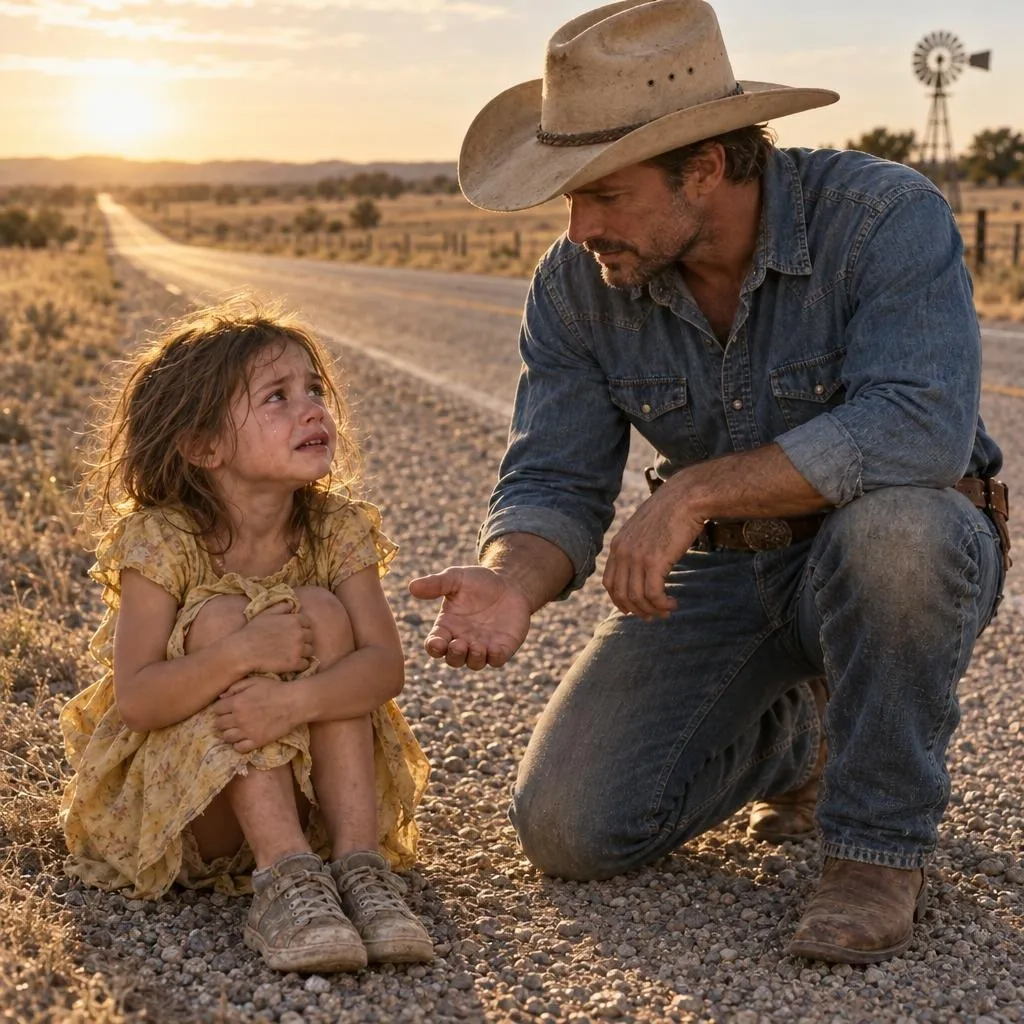
The girl had wedged herself against the trunk, as though she’d been trying to get farther into its meager shade. Her hair clung in dark ropes to her neck. Dust had collected along the dried tracks on her cheeks, and her mouth was swollen from thirst.
One knee drew sharply inward beneath her torn skirt. The foot below it lay at an angle no new injury could explain. The other leg looked scarcely stronger. When Nathan’s boot scraped a root, she flinched all through her shoulders, but her legs never moved.
He lowered himself onto one heel several feet away.
“I’m going to get you some water. Can you tell me if anything’s hurt?”
Her eyes went first to the gun, then to his face.
“My legs have always been like that,” she said. She had to wet her lips before she could finish. “I didn’t fall.”
Nathan glanced along the road. No wagon stood nearby. No smoke rose above the trees. Broad wheel ruts lay in the dust, overlaid by the prints of loose stock, but nothing suggested a camp.
“Who’s traveling with you?”
Her fingers began picking at a loose thread in her skirt.
He waited. Flint lowered his nose to a clump of dry grass.
“They went on.”
“How long?”
“It was dinner time.” She looked toward the low sun, then away. “I don’t know how long since.”
Nathan unslung his canteen and knelt closer. “Easy with this. A swallow, then wait.”
She took it in both hands. The effort she made to obey him was plain in the way she stopped herself, lowered the canteen, and swallowed nothing for several seconds before drinking again.
He watched her, his jaw working.
“Your folks know you’re here?”
The canteen stopped against her chin.
“They put me here.”
Nathan heard a branch tap another branch overhead. Far down the slope, a bird gave three quick calls.
“Tell me your name.”
“Lucy Hope Mercer, sir.”
She delivered all three names carefully. He had heard children speak that way before, when getting something wrong cost more than a scolding.
“And your age?”
“Nine, I believe. We left Iowa before my birthday. Ma said it would come in summer, but I don’t know what day.”
He accepted the canteen and set it where she could see it.
“What did they say when they left you, Lucy?”
She pressed her hands between her knees. “Pa said there were four others to look after. He said when there was trouble, bad weather or wolves or Indians, I couldn’t keep up. He couldn’t carry me and mind everybody else.”
Nathan looked again at the wagon marks. By the way the wind had softened their edges, the train was several hours ahead.
“He said I oughtn’t take it personal,” she continued. “That if I was meant to live, the Lord would settle it.”
“Your mother went along with that?”
“She cried.” The girl’s gaze stayed on his boots. “She left me some hardtack and a little water. Said I should pray somebody good came by.”
Nathan stood abruptly enough that she drew back.
He turned toward Flint and rested a hand on the saddle. For eight years, he had kept his days pared down to work and eating and sleep. Whenever his mind strayed toward Ellen or the boys, there was always a fence to mend, a horse to water, some task that could occupy his hands until he was tired enough to quit remembering.
There was no fence here.
“Any other family?” he asked without turning.
“No, sir. Pa lost his people in the war. Ma’s people didn’t want her marrying him. They don’t write.”
Eight dollars. A leaking roof. Cattle growing thinner on a pasture already bitten by frost.
He went back and crouched in front of her.
“Ever been on a horse?”
She looked past him at Flint. “Not up on one.”
“I can hold you. We’ll go slowly.”
“Where?”
“My cabin.”
She didn’t reach for him. She seemed to be waiting for a condition he hadn’t yet named.
“I’ll have to lift you,” he said. “Show me where I can put my arm without hurting you worse.”
Lucy touched the place below her knees, then her back. Nathan followed her directions. When he raised her, her face tightened and a small breath caught in her throat, but she made no other sound.
“You can tell me when it hurts,” he said, more gruffly than he intended.
She nodded against his shirt.
Getting her settled took patience. He folded a saddle blanket beneath her hip, eased her legs over one side, and placed her hands around the horn. Flint stood with one hind foot resting, as untroubled as if Nathan were loading a sack of oats.
“I’m coming up behind you. Keep hold until I’m settled.”
The horse shifted under Nathan’s weight. Lucy seized the horn harder, and Nathan brought an arm around her while he gathered the reins.
“How’s that?”
“Not very comfortable, sir.” After a pause, she added, “But I’ve had worse rides.”
A sound escaped him that nearly became a laugh.
“Well. We’ll improve on it if we can.”
They climbed away from the wagon road and took the narrow trail north. Above them, the last sun caught the bare tops of the ridges. Below, cold gathered among the trees.
Lucy held herself stiffly at first, leaving as much space between them as the saddle allowed. Every uneven step brought a fresh effort to sit upright without troubling him. Nathan loosened his hold on the reins and let Flint choose his footing.
“You can rest against me,” he told her. “You won’t upset the horse.”
Only after several minutes did she lean back.
“Will you take me somewhere else tomorrow?”
He had been thinking about Veyton’s little church. A minister ought to know what could be done. Perhaps someone in town had room. Perhaps there was an institution in Cheyenne.
He had seen enough institutions during his army years to remember their windows. Children stood behind them, watching people pass.
“I haven’t worked tomorrow out,” he said.
“I can be quiet.”
“I can see that.”
“And I don’t eat much.”
Nathan looked down at the hands clenched around the horn. “Tonight you’ll eat what there is. That’s all we’re deciding on this trail.”
She grew quiet again.
The air sharpened as the light failed. He had lost his coat over a card table two months earlier, an act of foolishness that hadn’t mattered much until now. Lucy’s thin dress offered no protection. When she began trembling, he drew her back against his chest.
“Put your hands under my arms.”
She obeyed, cautiously. Her fingers were icy even through his shirt.
They passed the bend where the creek could be heard below the rocks. Flint quickened, recognizing the last climb home. The cabin appeared only after the stars were out, a squat obstruction against the slope, with a rough barn standing a little way beyond it.
Nathan had built the barn first. The cavalry had taught him that much: see to the animal carrying you before seeing to yourself.
He lifted Lucy down and seated her on a bale inside the barn door. She watched as he stripped the tack, checked Flint’s back, and rubbed him with dry straw. The grain sack was light in his hands. He measured the feed anyway.
“Can you get about some on your own?” he asked while the horse ate.
“If there’s something to catch hold of.”
“Will you show me? I need to know how to arrange things.”
Lucy studied his face, then eased herself off the bale. She lowered onto her hands and pulled forward, finding purchase in the packed dirt. Her shoulders were strong from work no child should have needed to do merely to cross a room.
Nathan resisted the impulse to lift her before she finished. She covered several feet, stopped, and glanced back.
“That tells me what I need,” he said. “You’ve done enough traveling today. I’ll take the rest.”
This time, when he picked her up, she let her head settle against his shoulder.
Inside the cabin, he put her in his only chair. The seat gave a warning creak. Nathan shoved a folded cloth under the short leg, then set about making a fire.
The room slowly emerged around them: a pine table scarred by knife work, a shelf of tin dishes, a bedroll, a coffee pot blackened along one side. He had stopped noticing the cold that entered around the door. Now he moved a sack against the worst gap.
Lucy followed him with her eyes, taking in each movement without a question.
He wrapped his second blanket around her, holes and all, and put beans and a little cured pork in the pot. She watched the food go over the flames.
“Hungry?”
“Yes, sir.”
“Nathan will do. Or Mr. Rusk, if you can’t manage that yet.”
She nodded, but her eyes had moved to the door.
“Somebody expected to come for you?” he asked.
Her face changed.
“A man might.”
“What man?”
“He wore a black coat. A good one. I saw him talking to Pa after dark a few nights back.”
Nathan settled on the hearth, leaving her the chair. “Start with the first time you saw him.”
She drew the blanket closer.
“At a supply town, before we got into the mountains. He was talking to men about children. Said he found work for ones nobody could keep. Mines and mills and places like that. He paid money for taking them.”
The pot began to tick as it warmed.
“Then he came by our wagon three nights ago. Pa went off with him. The next morning was when Pa started saying I was holding everybody back.”
Nathan kept his voice low. “Did that man give your father money?”
“I didn’t see.” Her fingers vanished into the blanket’s ragged edge. “But I think Pa left me there for him…”
To read the rest of the story – CLICK the NEXT button 👇👇👇